Air Force Museum
Gen. T.D. White
General Thomas D. White served as Air Force Chief of Staff as missiles, satellites, and space operations became central national priorities. Thomas D. White entered military aviation during the interwar years and became Chief of Staff of the United States Air Force in 1957. His tenure coincided with Sputnik, the rapid development of long-range missiles, the creation of NASA, and intense debate over military responsibilities in space.
In depth
The story behind the display
White argued that air and space were parts of a continuous operating environment rather than separate subjects. His career places the nearby hardware inside an institutional story: new vehicles required new organizations, budgets, doctrine, training, and agreements about which service or agency would control a mission.
History & service
Gen. Thomas Dresser White was the fourth Chief of Staff of the U.S. Air Force (1957-1961). He was a visionary military leader and a brilliant scholar who helped bring the USAF into the space age.
Born in 1901 in Minnesota, Thomas D. White started his military career in the U.S. Army as an infantry officer, but soon transferred to aviation. He became a pilot in 1925, and was assigned to Washington, D.C. There, he began his study of foreign languages, for which he became renowned -- White learned Chinese, and his talent earned him an assignment to China to continue his studies. Later, he served as military attache to Russia, Greece, Italy and Brazil.
Along with Chinese, he became fluent in Russian, Greek, Italian, Portuguese and Spanish.
During World War II, White's several assignments included intelligence posts in Washington, and he commanded the 7th Air Force in combat in the South Pacific. After the war he continued to lead air forces in Japan. Returning to the Pentagon in 1948, General White worked in the Office of the Secretary of the Air Force, and was promoted to four-star rank in 1953. He became Chief of Staff of the USAF in 1957.
As Chief of Staff, White's largest challenge was to integrate the newest missiles and nuclear weapons into a cohesive force to deter atomic aggression in the Cold War. He advocated an integrated system he called a "mixed force," including strategic missiles, bombers, tactical aircraft, reconnaissance, space systems, cargo aircraft and improvements to bases and communications. In particular, he encouraged development of nuclear-armed intercontinental ballistic missiles.
He also urged leaders to consider air and space as a single medium -- "aerospace." Molding all these tools and concepts together in the late 1950s resulted in much of the effective Cold War force structure of the USAF.
As a scholar, General White was not only a talented linguist, but an expert on rare tropical fish. During his time in Brazil, he caught and cataloged many fish with his artist wife, and the couple even discovered two new species, which were named after them. When T.D. White retired in 1961, he kept working as a frequent columnist and an arms control consultant to the Kennedy administration. He also served on the boards of several companies. He passed away in 1965.
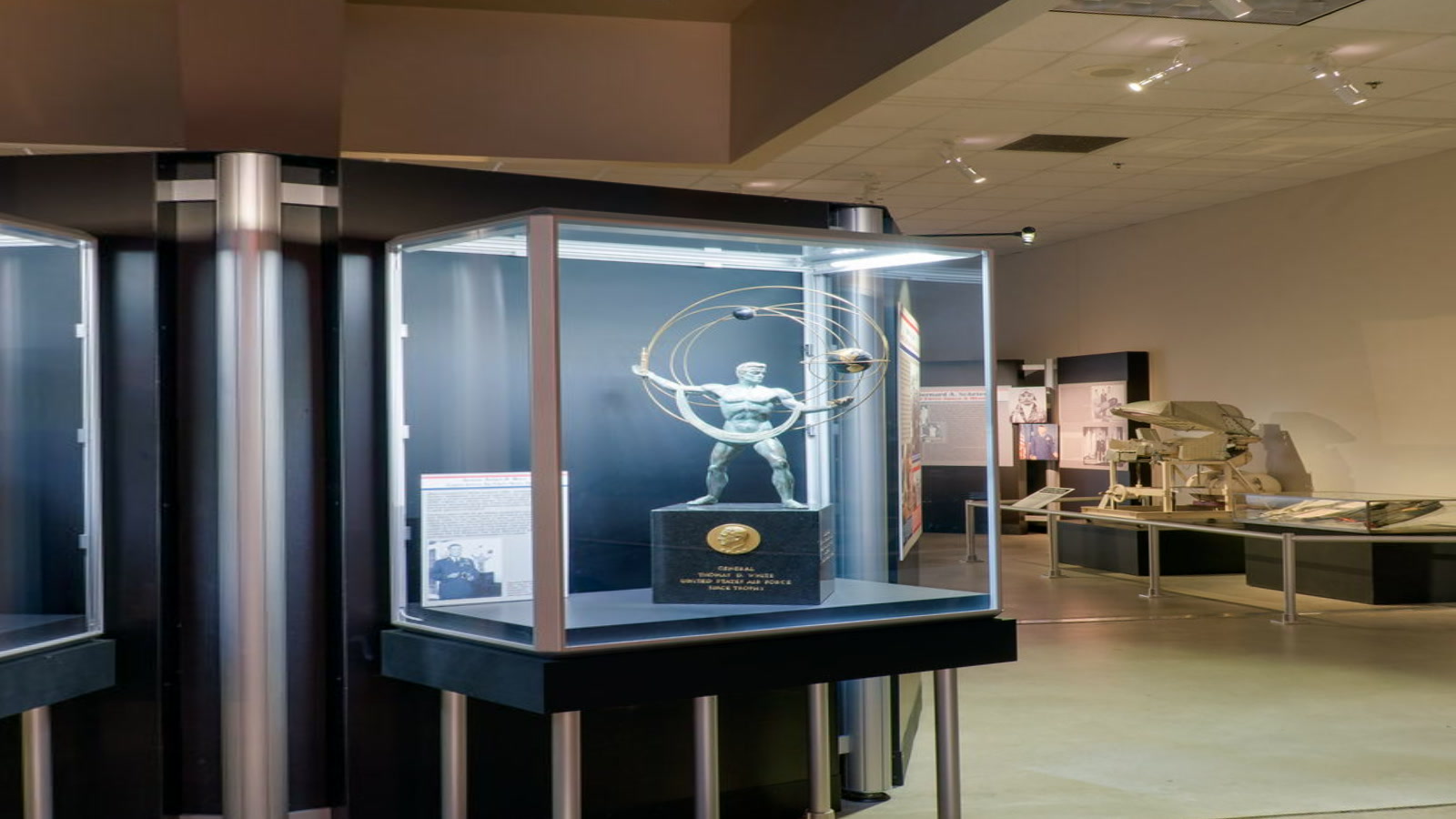
When Gen. T.D. White retired in 1961, the National Geographic Society established an annual award in his name, and commissioned a trophy symbolizing it. The award is given each year to a USAF military or civilian person for outstanding contribution to American aerospace progress. It has been won by a wide variety of Air Force people including astronauts, generals, administrators, and a wide selection of aviators.
Famed sculptor Felix W. de Weldon created the trophy dedicated to Gen White for his contributions to US space progress. The bronze figure holds in his right hand a Saturn 1B rocket used in the early space program. In the other hand, he holds a Dyna-Soar vehicle, a 1960s forerunner of the Space Shuttle concept planned as a re-usable Air Force spacecraft. The bright rings joining the earth and moon represent space travel and spacecraft orbits. De Weldon also created the U.S.
Details that tell the story
Served as Air Force Chief of Staff from 1957 to 1961 · Led during the acceleration of missile and satellite programs · Advocated a continuing Air Force role in space · His tenure overlapped the creation of NASA in 1958
Keeping people alive beyond the atmosphere
A crewed spacecraft carries a small, controlled environment into a place that cannot support unprotected human life. Pressure, temperature, oxygen, carbon dioxide removal, water, electrical power, and waste management all become engineering responsibilities. The flight suit or capsule displayed in a museum is therefore part of a larger life-support system, not simply clothing or a vehicle body.
Early missions established capabilities in stages. Launch and recovery, orbital flight, longer duration, maneuvering, rendezvous, and work outside a spacecraft each introduced different demands. Ground controllers, tracking stations, medical teams, recovery forces, and manufacturers supported the crew. A successful mission depended on that network as much as on the people visible in the cabin.
Artifacts preserve evidence of those demands at a human scale. A small hatch suggests the difficulty of entering or leaving in bulky equipment. A glove makes clear that pressure protection can restrict dexterity. The shape of a returning capsule reveals the importance of managing atmospheric heating and deceleration. Connections to high-altitude aviation are especially strong: pressure suits, research aircraft, and instrumented test flights helped build knowledge that spacecraft designers could use. The history is a sequence of carefully developed capabilities, with extraordinary journeys resting on many ordinary systems that had to keep working together.