Air Force Museum
YF-23A
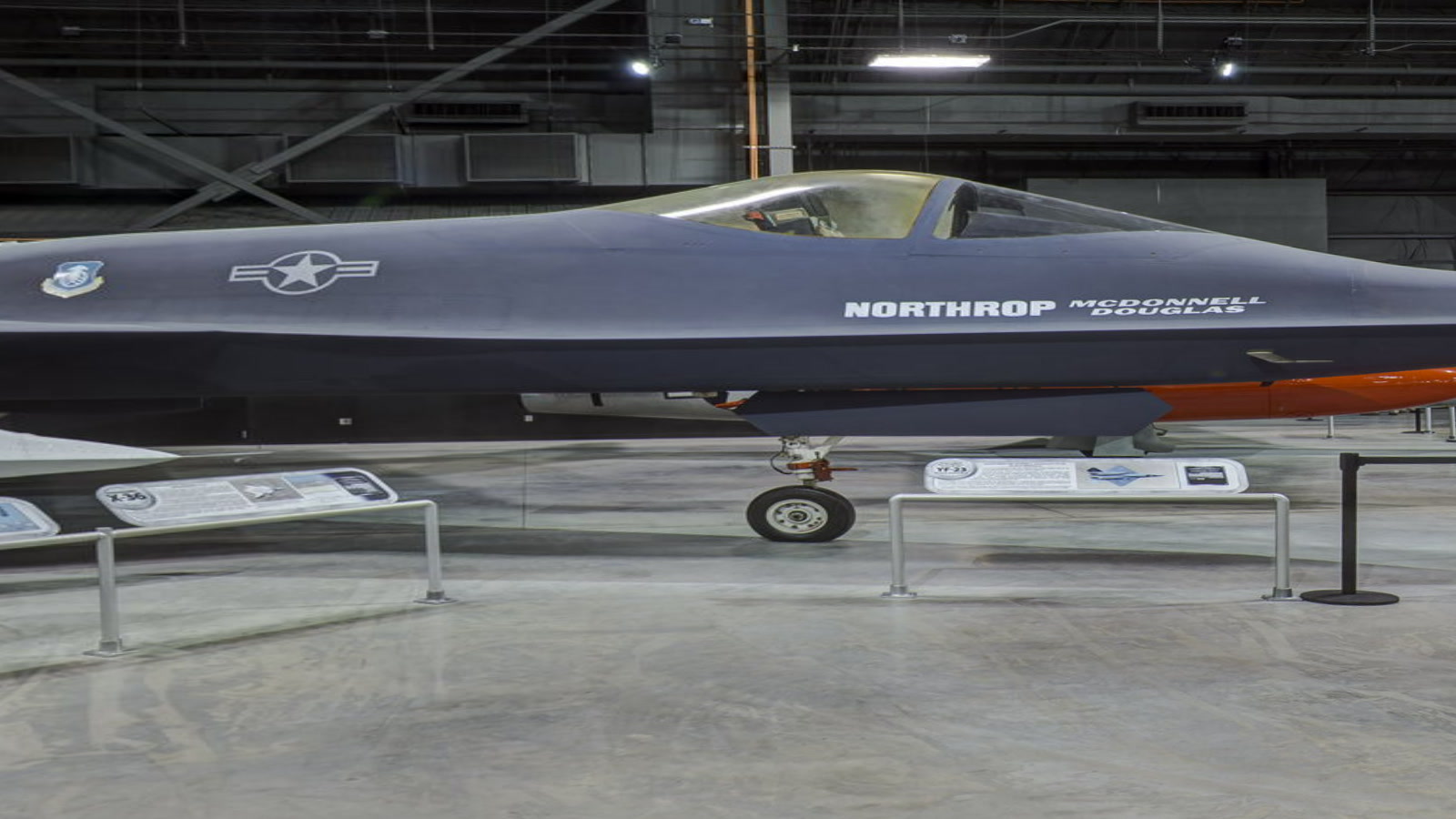
The YF-23 was one of two competing prototypes built for the Advanced Tactical Fighter program. Its form emphasized low radar visibility, speed, and aerodynamic efficiency. Northrop and McDonnell Douglas built the YF-23 to compete against the Lockheed-led YF-22. The aircraft used a blended shape, diamond-like wings, canted tail surfaces, buried engines, and carefully treated exhaust paths to reduce detection while maintaining high-speed performance.
In depth
The story behind the display
Two YF-23 prototypes flew. The Air Force selected the YF-22 team in 1991, leading to the F-22 Raptor. The surviving YF-23 is therefore evidence of an alternative solution: a technically sophisticated aircraft can lose a competition while still revealing what engineers believed was possible.
History & service
The YF-23A competed in the late 1980s/early 1990s against the YF-22A in the Advanced Tactical Fighter (ATF) program.
During the late 1970s, a new generation of Soviet fighters and Surface-to-Air Missiles (SAMs) prompted the US Air Force to find a replacement for the F-15 Eagle air superiority fighter. In 1986, the USAF awarded demonstration contracts to two competing industry teams—Lockheed-Boeing-General Dynamics (YF-22A) versus Northrop-McDonnell Douglas (YF-23A).
The Northrop YF-23A, unofficially named the Black Widow II, emphasized stealth characteristics. To lessen weight and increase stealth, Northrop decided against using thrust vectoring for aerodynamic control as was used on the Lockheed YF-22A. Northrop built two YF-23A prototypes.
In 1991, after extensive flight testing, the USAF announced that the Lockheed YF-22A won the airframe competition. Northrop ended its ATF program, and the YF-23A on display came to the Museum in 2000.
Details that tell the story
Built for the Advanced Tactical Fighter competition · Two YF-23 prototypes were completed · Design emphasized stealth and high-speed efficiency · The YF-22 was selected for development in 1991
The aircraft in figures
Crew: One · Engines: Two Pratt & Whitney YF119-PW-100s of approx. 35,000 lbs. thrust each · Maximum speed: Approx. Mach 2
Going beyond the known envelope
Flight testing turns a prediction into evidence. Engineers may calculate how an aircraft should behave, but actual flight brings structures, engines, controls, instruments, weather, and a human operator together. The safest useful test changes conditions deliberately and records enough information to explain what happened. The aim is knowledge, not simply a dramatic number.
Research aircraft often look unusual because they were built to answer a narrow question. A shape that is valuable for studying high-speed flight may be unsuitable for ordinary transport. A rocket engine can reach a demanding test condition but offers only a short powered flight. The carrier aircraft, tracking stations, telemetry, ground crews, and recovery procedures become part of the experiment.
The pilot's contribution is both technical and human. Training makes it possible to recognize a developing problem, follow a planned sequence, and describe behavior that instruments alone may not capture. Courage matters, but so does the discipline to end a test when conditions no longer match the plan. The X-1, X-15, rocket motors, pressure suits, and wind-tunnel equipment connect across museums because they belong to this shared process. Each represents a way of making the unknown smaller so that later aircraft and spacecraft could operate with greater confidence.