Air Force Museum
Moon Rock
A small lunar sample can hold evidence about the Moon's formation, its ancient surface, and the history of the solar system. Apollo 16 carried astronauts John Young, Charles Duke, and Thomas Mattingly to the Moon in April 1972. Young and Duke spent nearly three days on the surface, completed more than twenty hours of exploration outside the lunar module, and helped return more than 211 pounds of samples to Earth.
In depth
The story behind the display
The displayed rock is more than a souvenir of distance traveled. Lunar samples preserve chemical and geological evidence that researchers can examine with instruments unavailable to the astronauts on the surface. Decades after the mission, improved analytical methods continue to extract new information from material collected during Apollo.
History & service
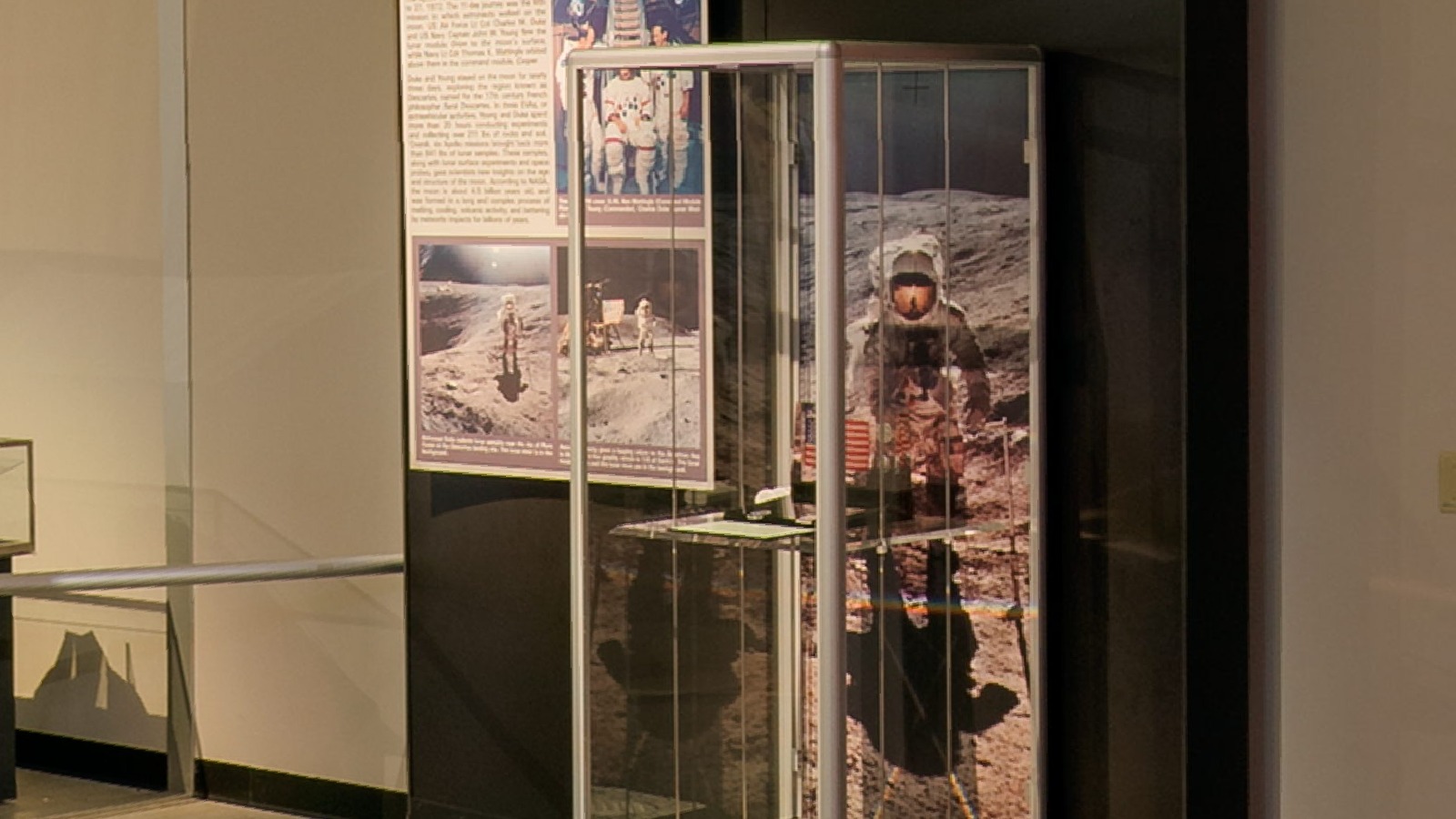
The Apollo 16 mission took place from April 16-27, 1972. The 11-day journey was the fifth mission in which astronauts walked on the moon. U.S. Air Force Lt. Col. Charles M. Duke and U.S. Navy Capt. John W. Young flew the lunar module Orion to the moon's surface, while Navy Lt. Cdr. Thomas K. Mattingly orbited above them in the command module, Casper.
Duke and Young stayed on the moon for nearly three days, exploring the region known as Descartes, named for the 17th century French philosopher Rene Descartes. In three EVAs, or extravehicular activities, Young and Duke spent more than 20 hours conducting experiments and collecting over 211 pounds of rocks and soil. Overall, six Apollo missions brought back 841 pounds of lunar samples.
These samples, along with lunar surface experiments and space probes, gave scientists new insights on the age and structure of the moon. According to NASA, the moon is about 4.5 billion years old, and was formed in a long and complex process of melting, cooling, volcanic activity, and battering by meteorite impacts for billions of years.
On display at the museum are a moon rock, flag and silver medallion from the Apollo 16 mission.
Details that tell the story
Returned during Apollo 16 in April 1972 · Apollo 16 astronauts spent nearly three days on the lunar surface · More than 211 pounds of lunar material were returned by the mission · The museum display also connects the sample with mission-carried artifacts
Keeping people alive beyond the atmosphere
A crewed spacecraft carries a small, controlled environment into a place that cannot support unprotected human life. Pressure, temperature, oxygen, carbon dioxide removal, water, electrical power, and waste management all become engineering responsibilities. The flight suit or capsule displayed in a museum is therefore part of a larger life-support system, not simply clothing or a vehicle body.
Early missions established capabilities in stages. Launch and recovery, orbital flight, longer duration, maneuvering, rendezvous, and work outside a spacecraft each introduced different demands. Ground controllers, tracking stations, medical teams, recovery forces, and manufacturers supported the crew. A successful mission depended on that network as much as on the people visible in the cabin.
Artifacts preserve evidence of those demands at a human scale. A small hatch suggests the difficulty of entering or leaving in bulky equipment. A glove makes clear that pressure protection can restrict dexterity. The shape of a returning capsule reveals the importance of managing atmospheric heating and deceleration. Connections to high-altitude aviation are especially strong: pressure suits, research aircraft, and instrumented test flights helped build knowledge that spacecraft designers could use. The history is a sequence of carefully developed capabilities, with extraordinary journeys resting on many ordinary systems that had to keep working together.