Air Force Museum
Advance Biomedical Capsule
Before a human could be sent into space, researchers had to learn how a living body would respond to acceleration, vibration, confinement, weightlessness, and recovery. The Advance Biomedical Capsule belonged to a research program that trained chimpanzees to perform simple tasks while instruments recorded their reactions. At Holloman Air Force Base, the animals learned to respond to lights and levers during repeated training sessions.
In depth
The story behind the display
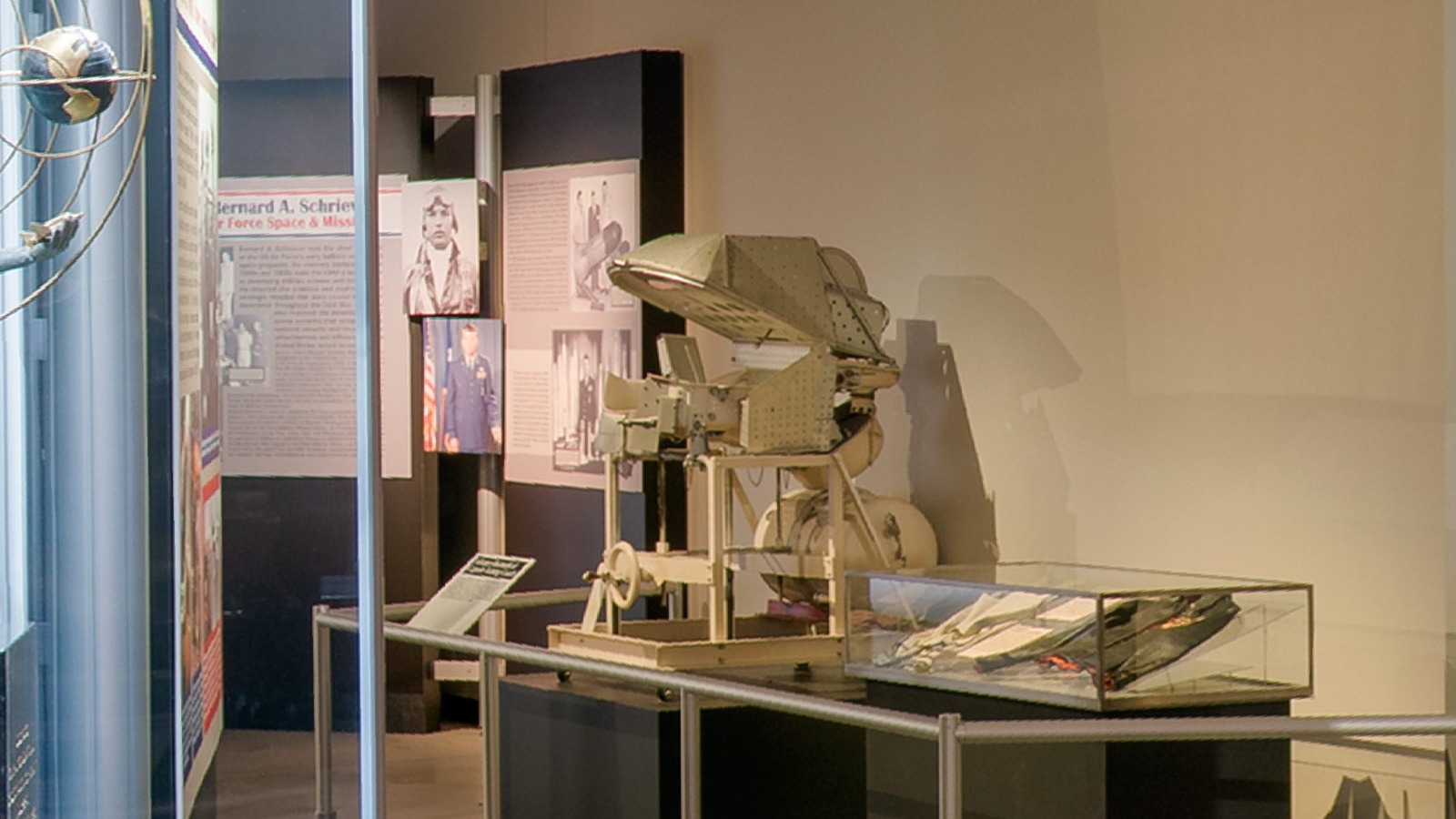
The Advance Biomedical Capsule belonged to a research program that trained chimpanzees to perform simple tasks while instruments recorded their reactions. At Holloman Air Force Base, the animals learned to respond to lights and levers during repeated training sessions. The capsule, couch, restraints, controls, and sensors formed one system: they protected the occupant, presented the tasks, and returned data to researchers.
This work addressed a practical uncertainty at the beginning of the space age. Engineers could calculate a trajectory, but they still needed biological evidence that a trained living subject could remain conscious and perform during a ballistic flight. The experiments helped connect laboratory medicine, aircraft escape research, rocket engineering, and the emerging human spaceflight program.
History & service
At Holloman Air Force Base, N.M., Air Force researchers trained chimpanzees to push levers in response to timed and colored lights in order to approximate human behavior in spaceflight. The training couch on display contains two levers and a selection of lights. Holloman's group of six chimps underwent 29 training sessions before one chimp was selected for the first Mercury primate test flight.
Details that tell the story
Developed for biomedical research before early human spaceflight · Used a fitted couch, restraints, controls, and physiological sensors · Chimpanzees learned visual-response tasks during repeated training sessions · Research connected Air Force space medicine with the Mercury program
Keeping people alive beyond the atmosphere
A crewed spacecraft carries a small, controlled environment into a place that cannot support unprotected human life. Pressure, temperature, oxygen, carbon dioxide removal, water, electrical power, and waste management all become engineering responsibilities. The flight suit or capsule displayed in a museum is therefore part of a larger life-support system, not simply clothing or a vehicle body.
Early missions established capabilities in stages. Launch and recovery, orbital flight, longer duration, maneuvering, rendezvous, and work outside a spacecraft each introduced different demands. Ground controllers, tracking stations, medical teams, recovery forces, and manufacturers supported the crew. A successful mission depended on that network as much as on the people visible in the cabin.
Artifacts preserve evidence of those demands at a human scale. A small hatch suggests the difficulty of entering or leaving in bulky equipment. A glove makes clear that pressure protection can restrict dexterity. The shape of a returning capsule reveals the importance of managing atmospheric heating and deceleration. Connections to high-altitude aviation are especially strong: pressure suits, research aircraft, and instrumented test flights helped build knowledge that spacecraft designers could use. The history is a sequence of carefully developed capabilities, with extraordinary journeys resting on many ordinary systems that had to keep working together.