National Mall
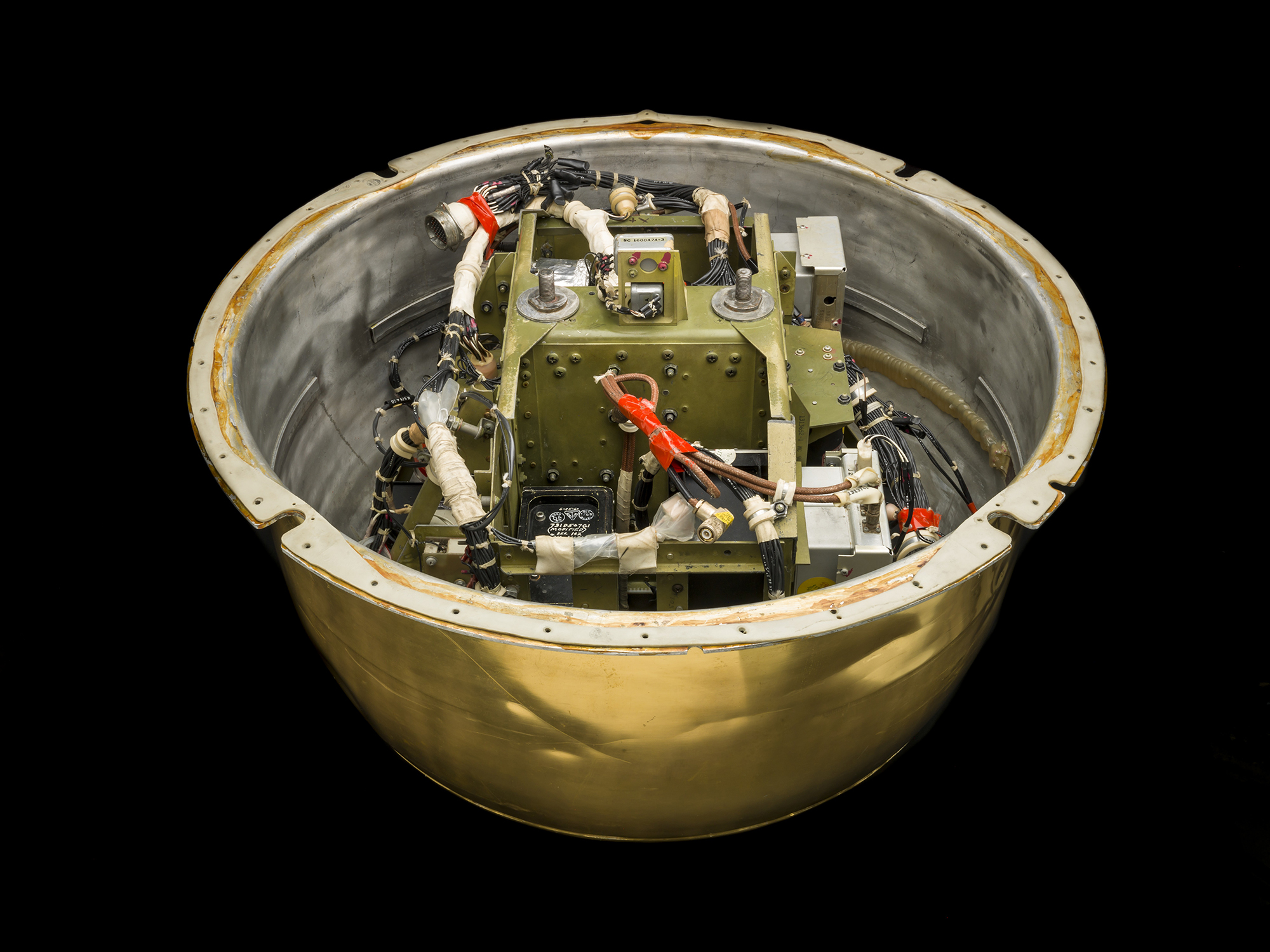
Discoverer XIII
Discoverer XIII became the first human-made object recovered from orbit. The Navy retrieved it from the Pacific after it completed a one-day flight. Later Corona satellites exposed film in orbit, protected it during reentry, and returned it for physical processing. Guidance, heat protection, parachutes, tracking, and recovery forces all had to work in sequence.
In depth
Recovery made early space photography useful
“Discoverer” covered the Air Force and CIA Corona program, which photographed the Soviet Union, China, and other regions. The artifact records engineering achievement and the expansion of surveillance during the Cold War.
Seeing what could not be reached
Reconnaissance turns access into information. The earliest aerial observers used their elevated position to see beyond ground obstacles. Cameras added a record that could be studied after the flight. As aircraft became faster and reached higher altitudes, the equipment had to deal with vibration, motion, changing light, and the difficulty of locating an image precisely on a map.
The mission was not complete when the photograph was taken. Film or electronic data had to be recovered, processed, interpreted, and delivered to someone who could use it. A remarkable image could still be misleading without context. Different collection methods therefore complemented one another: direct observation, photography, radar, intercepted signals, and later satellite sensing supplied different kinds of evidence.
Aircraft such as the U-2 and SR-71 are famous for their performance, but their reason for flying was the information they could bring back. The same distinction helps connect military reconnaissance with planetary exploration and Earth observation. A spacecraft travelling far from Earth also needs to turn a fleeting encounter into useful measurements and transmit them home. Across these galleries, the camera, sensor, computer, and communications link belong beside the aircraft in the story. The real achievement is not simply reaching a distant place, but making that place more understandable.