Air Force Museum
RF-84K Thunderflash
The RF-84K was built to be carried beneath a modified B-36 and released for high-speed reconnaissance. The FICON concept attempted to combine the bomber’s range with a smaller jet’s ability to penetrate defended airspace. Recovering the jet beneath the moving bomber demanded exceptional precision and revealed both the creativity and complexity of early Cold War reconnaissance.
In depth
History & service
The RF-84K was a reconnaissance and nuclear strike fighter that was intended to be carried toward a target as a "parasite" underneath the GRB-36 bomber. At the time, jet aircraft possessed relatively short range and aerial refueling was not yet proven, so this provided a method to extend their range.
The U.S. Air Force applied this parasite concept to the FICON (FIghter CONveyer) project, which became the RF-84K. The mission profile called for the recon aircraft or attack fighter to leave the carrier aircraft (a modified strategic bomber) upon reaching hostile territory, make a dash to the target and perform its mission. The aircraft then returned to the waiting carrier, hooked up underneath it and was carried back to a base.
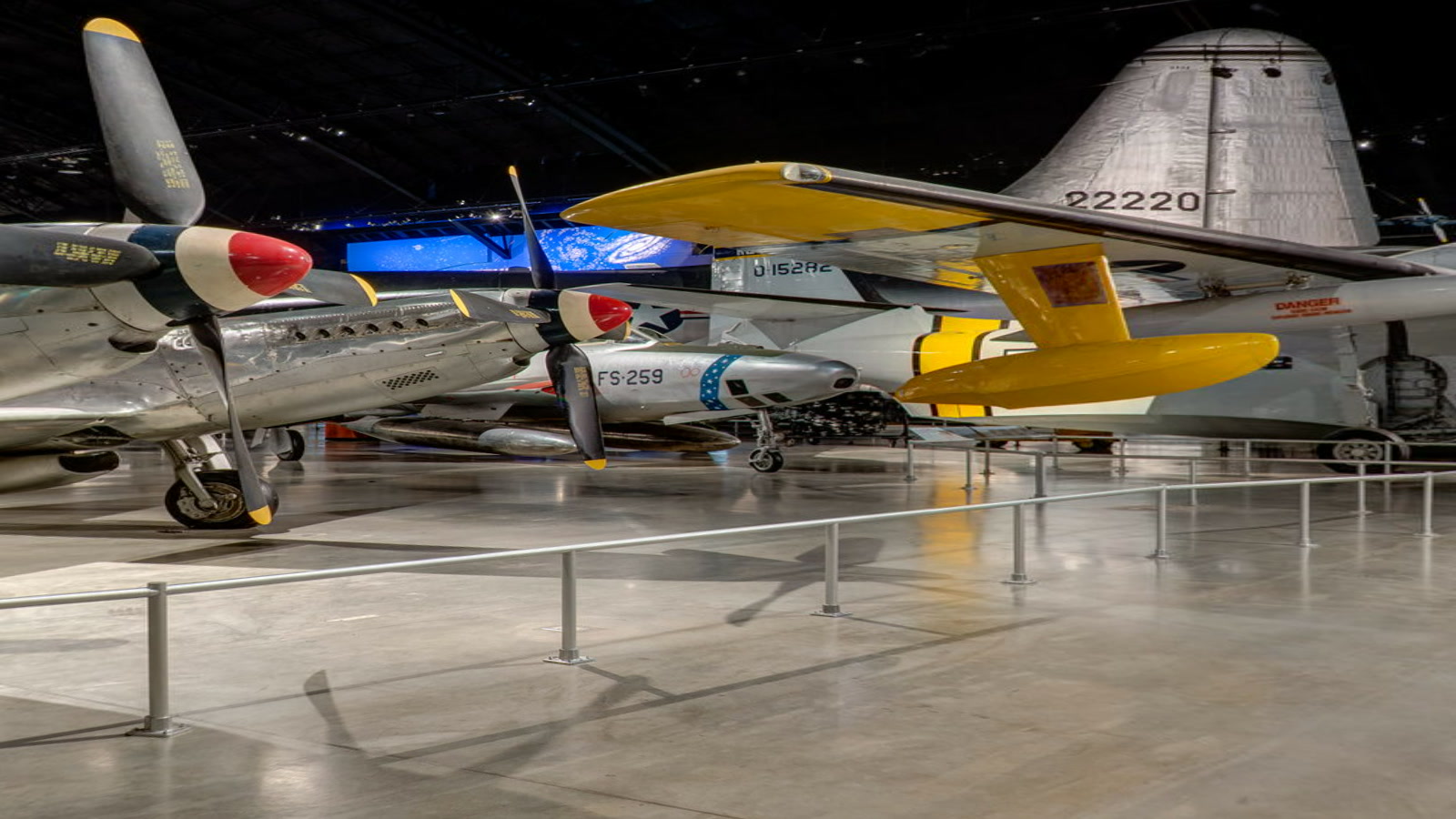
In 1952, as it tested two F-84 FICON prototypes, the USAF ordered 25 RF-84Ks and began modifying 10 B-36s into GRB-36 FICON carriers. The RF-84K design was a modification of the RF-84F, the USAF's most numerous and advanced tactical reconnaissance aircraft at the time. The only major differences were the RF-84K's retractable hook in the upper part of the nose, rods on either side behind the cockpit, and downward angled horizontal stabilizers (to fit inside the GRB-36's bomb bay).
The RF-84K entered service with the 91st Strategic Reconnaissance Squadron (SRS) in 1955. For the next year, pilots of the 91st SRS successfully flew their RF-84Ks, but they experienced many near disasters while separating or hooking back up to the GRB-36 carrier aircraft.
The museum's aircraft is marked as it appeared while serving in the 91st SRS in the mid-1950s.
Details that tell the story
Special reconnaissance version of the RF-84F · Carried and recovered by modified B-36 bombers · Part of the FICON parasite-aircraft program
The aircraft in figures
Armament: Four .50-cal. machine guns · Engine: Wright Sapphire J65 of 7,800 lbs. thrust · Maximum speed: 629 mph · Range: 2,000 miles (plus GRB-36's 10,000-mile range) · Ceiling: 39,390 ft.
Seeing what could not be reached
Reconnaissance turns access into information. The earliest aerial observers used their elevated position to see beyond ground obstacles. Cameras added a record that could be studied after the flight. As aircraft became faster and reached higher altitudes, the equipment had to deal with vibration, motion, changing light, and the difficulty of locating an image precisely on a map.
The mission was not complete when the photograph was taken. Film or electronic data had to be recovered, processed, interpreted, and delivered to someone who could use it. A remarkable image could still be misleading without context. Different collection methods therefore complemented one another: direct observation, photography, radar, intercepted signals, and later satellite sensing supplied different kinds of evidence.
Aircraft such as the U-2 and SR-71 are famous for their performance, but their reason for flying was the information they could bring back. The same distinction helps connect military reconnaissance with planetary exploration and Earth observation. A spacecraft travelling far from Earth also needs to turn a fleeting encounter into useful measurements and transmit them home. Across these galleries, the camera, sensor, computer, and communications link belong beside the aircraft in the story. The real achievement is not simply reaching a distant place, but making that place more understandable.