Air Force Museum
F-84E Thunderjet
The durable F-84E became an important fighter-bomber for strikes against ground targets throughout Korea. The straight-wing Thunderjet lacked the high-altitude performance needed to meet the MiG-15 on equal terms, but it could carry bombs and rockets over useful distances. Units attacked bridges, rail lines, troop positions, airfields, and supply concentrations.
In depth
The story behind the display
Its Korean service demonstrates that combat value is not defined by a single comparison. Reliability, payload, range, available crews, maintenance support, and suitability for the assigned mission could make an aircraft essential even when a newer fighter dominated public attention.
History & service
The rugged F-84 Thunderjet gained its greatest renown during the Korean War. Initially sent to escort B-29s on long-range missions over North Korea, the Thunderjet excelled as a close air support and daytime interdiction strike aircraft. In Korea, F-84 pilots attacked enemy railroads, dams, bridges, supply depots and troop concentrations with bombs, rockets and napalm.
The Thunderjet became the Army Air Forces' second jet fighter to enter large-scale production, and it first flew in February 1946. Early F-84s had several problems, including weak wing spars, excessive weight and shortages of engines and spare parts. The F-84E, however, corrected most of the Thunderjet's shortcomings.
During its service life, the Thunderjet served in several roles, including day fighter, long-range escort fighter, fighter-bomber and as the USAF's first tactical nuclear bomber. The USAF also supplied F-84s to 14 other countries.
The basic "straight-wing" F-84 design later evolved into a swept-wing fighter version called the Thunderstreak and a swept-wing reconnaissance version called the Thunderflash. F-84s were also used as test-beds for experiments, including power plant trials and aerodynamic research.
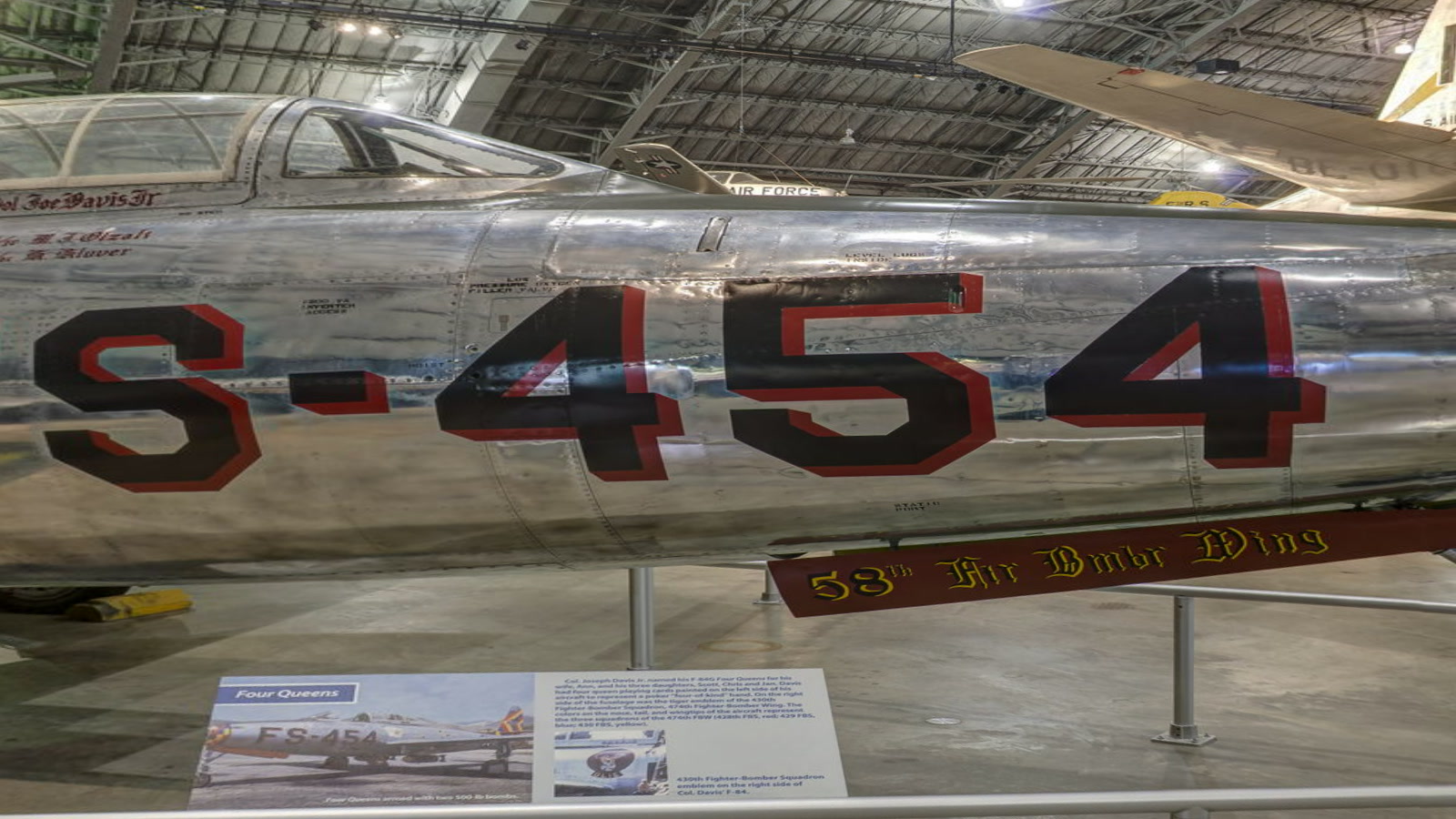
By the time production ceased in 1953, about 4,450 "straight-wing" Thunderjets (XP-84, YP-84A, F-84B/C/D/E/G) had been built. The F-84E on display came to the museum in 1963. It is marked to represent the F-84G flown by Col. Joseph Davis Jr., commander of the 58th Fighter-Bomber Wing in 1953.
Details that tell the story
Straight-wing jet fighter-bomber · Carried bombs, rockets, and guns · Used extensively against ground targets · Value came from payload, range, and operational availability
Performance was only part of the contest
A fighter's speed, climb, range, visibility, and armament shaped what it could do, but those qualities did not act alone. Training, tactics, warning systems, maintenance, fuel, and the condition of the airfield influenced every encounter. The aircraft that looks best in a table might be at a disadvantage at the wrong altitude, carrying the wrong load, or arriving with too little fuel to remain in the fight.
Escort missions demonstrate the importance of purpose. A fighter defending bombers had responsibilities beyond pursuing an opponent. It needed sufficient range, a useful position, and the discipline to remain with the force it protected. Ground attack imposed different demands, including visibility, endurance near the target, and the ability to survive damage from below.
Comparing aircraft across museums is most rewarding when the mission remains in view. An early pursuit biplane, a wartime piston fighter, and a Cold War jet represent different technologies, but all were part of a larger operational system. Personal accounts reveal how pilots worked within those limits. They also show why claims of individual success need context: weather, surprise, teamwork, and opportunities created by others shaped the outcome. The aircraft provides the physical evidence; the surrounding stories explain how people used it and what that use cost.