Air Force Museum
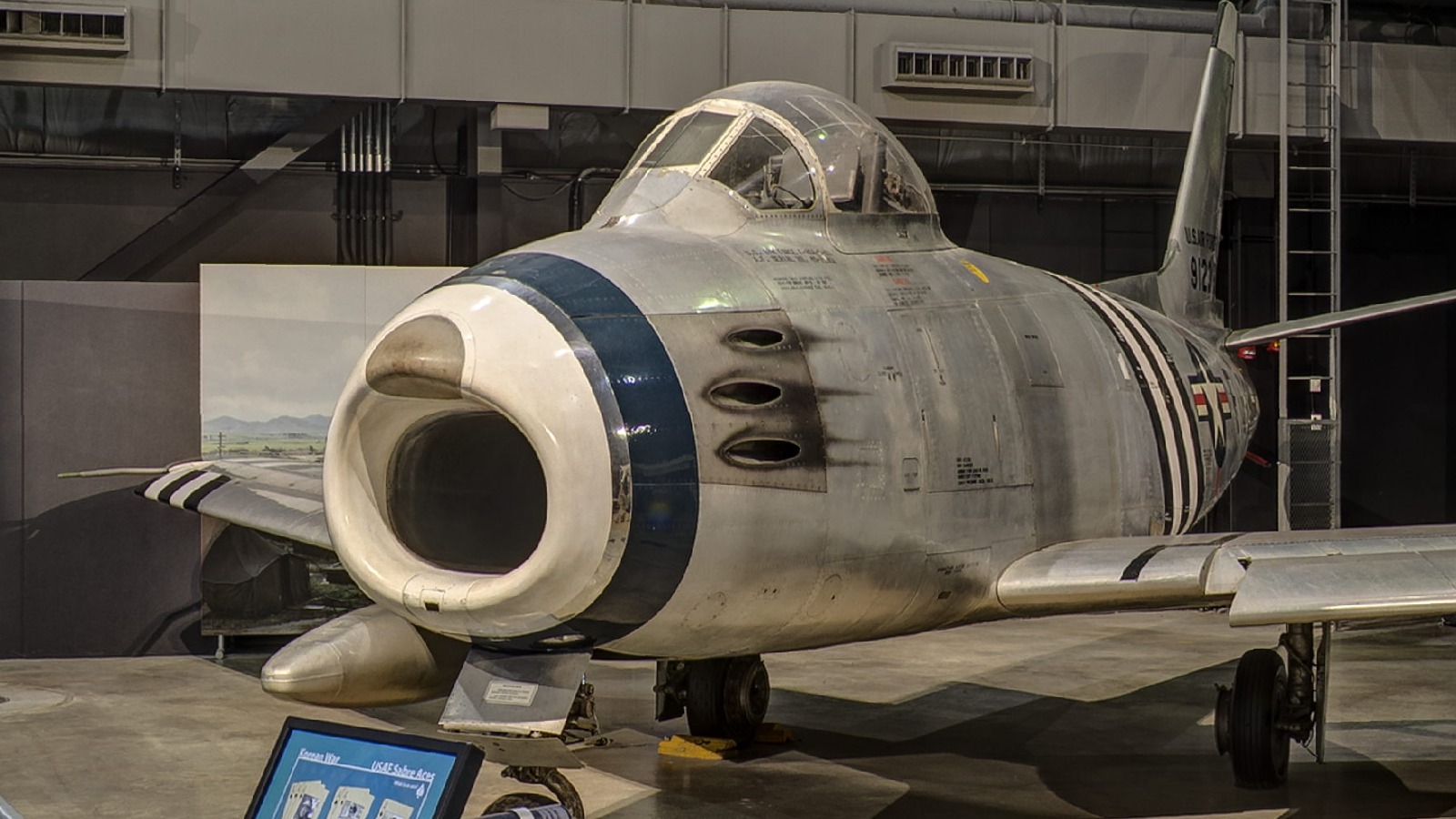
F-86A Sabre
The swept-wing F-86 Sabre became the principal American fighter in the air battles against the MiG-15. The Sabre combined swept wings, radar-ranging gunsight, six .50-caliber machine guns, and responsive handling at high speed. It entered combat in late 1950 after MiG-15s challenged United Nations aircraft over northwestern Korea.
In depth
The story behind the display
The aircraft did not fight alone. Radar sites, controllers, maintenance crews, fuel, spare parts, intelligence, and experienced pilots formed the system that allowed Sabre units to contest the skies.
History & service
The F-86, the U.S. Air Force's first swept-wing jet fighter, made its initial flight in October 1947. The first production model flew in May 1948, and four months later, an F-86A set a new world speed record of 670.9 mph.
As a day fighter, the F-86A (and later F-86Es and F-86Fs) saw service in Korea as the primary opponent of the Russian-built MiG-15. By the end of hostilities, F-86 pilots had shot down 792 MiGs, with a kill ratio of about 8:1.
More than 5,500 F-86 day fighters were built in the U.S. and Canada. Air forces of 20 other nations, including West Germany, Japan, Spain, Great Britain and Australia, also operated the Sabre.
The F-86A on display was flown to the museum in 1961. It is marked as the 4th Fighter Group F-86A flown by Lt. Col. Bruce Hinton on Dec. 17, 1950, when he became the first F-86 pilot to shoot down a MiG.
Details that tell the story
Swept-wing jet fighter · Six .50-caliber machine guns · Entered Korean combat in December 1950 · Closely associated with the air battles of MiG Alley
The aircraft in figures
Armament: Six .50-cal. machine guns · Engine: General Electric J47 of 5,200 lbs. thrust · Maximum speed: 685 mph · Range: 1,200 miles · Ceiling: 49,000 ft. · Span: 37 ft. 1 in. · Length: 37 ft. 6 in. · Height: 14 ft. 8 in. · Weight: 13,791 lbs. loaded · Serial number: 49-1067
Performance was only part of the contest
A fighter's speed, climb, range, visibility, and armament shaped what it could do, but those qualities did not act alone. Training, tactics, warning systems, maintenance, fuel, and the condition of the airfield influenced every encounter. The aircraft that looks best in a table might be at a disadvantage at the wrong altitude, carrying the wrong load, or arriving with too little fuel to remain in the fight.
Escort missions demonstrate the importance of purpose. A fighter defending bombers had responsibilities beyond pursuing an opponent. It needed sufficient range, a useful position, and the discipline to remain with the force it protected. Ground attack imposed different demands, including visibility, endurance near the target, and the ability to survive damage from below.
Comparing aircraft across museums is most rewarding when the mission remains in view. An early pursuit biplane, a wartime piston fighter, and a Cold War jet represent different technologies, but all were part of a larger operational system. Personal accounts reveal how pilots worked within those limits. They also show why claims of individual success need context: weather, surprise, teamwork, and opportunities created by others shaped the outcome. The aircraft provides the physical evidence; the surrounding stories explain how people used it and what that use cost.