Air Force Museum
Air-to-Air Combat over North Vietnam
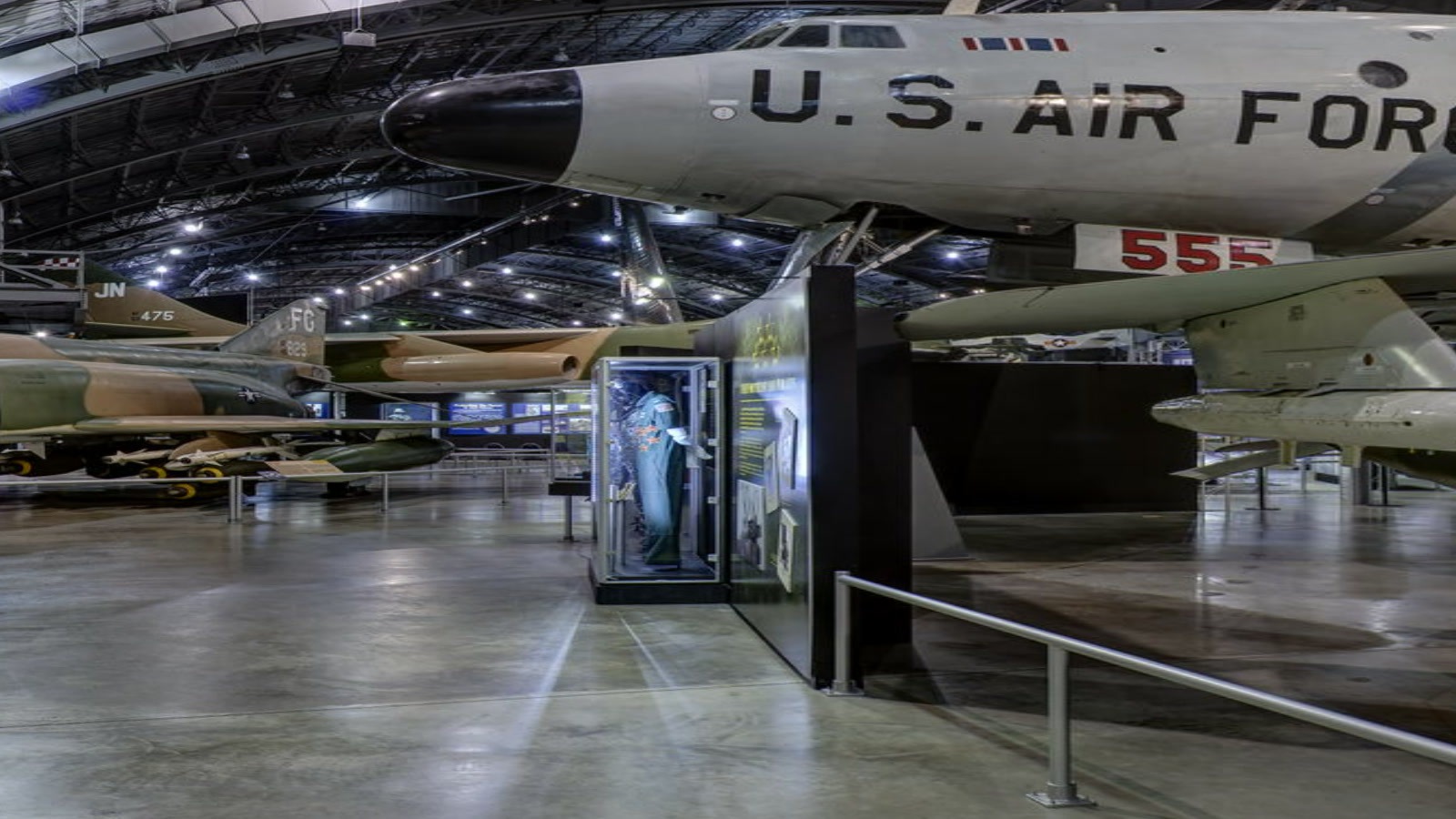
Air combat over North Vietnam exposed weaknesses in training, missiles, identification, formations, and rules of engagement. American fighters faced MiG-17s, MiG-19s, and MiG-21s supported by ground control and a dense air-defense network. Beyond aircraft performance, success depended on warning, formations, visual identification, missile reliability, fuel, and the ability to leave defended airspace.
In depth
The story behind the display
Early results led to changes in tactics and training, including more realistic dissimilar-air-combat programs. The experience showed that advanced weapons do not replace repeated practice against a capable opponent.
History & service
The key mission for U.S. Air Force fighter escorts (or MiGCAPs) over North Vietnam was to prevent enemy MiG fighters from interfering with American strike aircraft. The MiG pilots' primary goal was to force strike aircrews to jettison their bombs early, thereby disrupting the bombing mission.
In 1965, the small North Vietnamese Air Force (also known as the Vietnam People's Air Force or VPAF) was equipped with somewhat outdated, gun-armed MiG-17s. The entry of missile-armed, supersonic MiG-21s in early 1966, however, dramatically increased the VPAF threat. The USAF's primary counter to the MiG was the F-4 Phantom II fighter.
Though outnumbered, VPAF MiGs had some significant advantages. Guided by ground controllers using early warning radar, MiG pilots only attacked under ideal circumstances, such as when USAF aircraft were bomb-laden, low on fuel, or damaged. The small, hard-to-see MiGs typically made one-pass attacks at high speed, then escaped to a sanctuary (either their airfields, which were not bombed until mid-1967, or to nearby communist China).
Since they were always over friendly territory, MiG pilots could be back in action quickly if they survived being shot down.
USAF fighter pilots had better training and superior aircraft, but they endured several disadvantages. One serious issue was missile reliability and performance. Over one-half of the missiles fired by the USAF during the SEA War malfunctioned, and only about 1 in 11 fired scored a victory. The USAF rules of engagement dictated visual identification of an enemy aircraft before firing, which negated using the Sparrow missile at long range.
USAF F-4s flown during ROLLING THUNDER did not have an internal gun to use when missiles failed. Although some F-4s carried external gun pods, it was not until the F-4E arrived in late 1968 that USAF Phantoms finally had an internal gun. Lastly, USAF pilots had to combat MiGs, SAMs and AAA over hostile North Vietnam, and if shot down, they were not always rescued.
Even so, enemy MiGs failed in their primary mission to stop US air attacks over North Vietnam during OPERATION ROLLING THUNDER. In fact, the VPAF fighter force sometimes retreated to China and stood down from combat operations due to heavy losses suffered at the hands of American fighter crews.
MiG pilots did little better in December 1972 -- by the end of OPERATION LINEBACKER II, USAF B-52s and tactical aircraft hit targets at will, forcing the North Vietnamese to sign a peace treaty. At the end of the Southeast Asia War in 1973, the VPAF had lost nearly 150 MiGs in combat to USAF fighter crews, while the USAF lost about 70 aircraft (of all types) to MiGs.
Details that tell the story
Opposition included MiG-17, MiG-19, and MiG-21 fighters · Rules often required visual identification · Missile reliability and employment limits affected results · Combat experience drove major changes in fighter training
Readiness became a permanent condition
During the Cold War, aviation was organized around the possibility of a conflict that governments hoped to prevent. Bombers, missiles, interceptors, reconnaissance aircraft, warning networks, and tankers became parts of interdependent systems. Their value was judged not only by what they could do in flight, but by how reliably they could be maintained, alerted, launched, supported, and controlled.
This emphasis produced striking aircraft and difficult tradeoffs. Long range demanded fuel and support. High speed increased heat and mechanical stress. Sophisticated electronics offered new capabilities but created new maintenance requirements. A reconnaissance aircraft needed an effective camera and a workable route as well as altitude or speed. An interceptor depended on warning and guidance before its pilot could make an engagement.
The human experience included long periods of training and routine punctuated by crises. Crews and ground personnel practiced procedures whose purpose was to remain credible without being used in war. At the same time, military aviation carried out reconnaissance, transport, rescue, humanitarian missions, and conventional operations around the world. Linking these aircraft with civil airliners, research machines, and spacecraft reveals a history of shared technologies and different purposes. The machines embody technical accomplishment, but also the enormous resources and sustained human effort required to keep a global force ready.