Air Force Museum
Republic F-105 Thunderchief
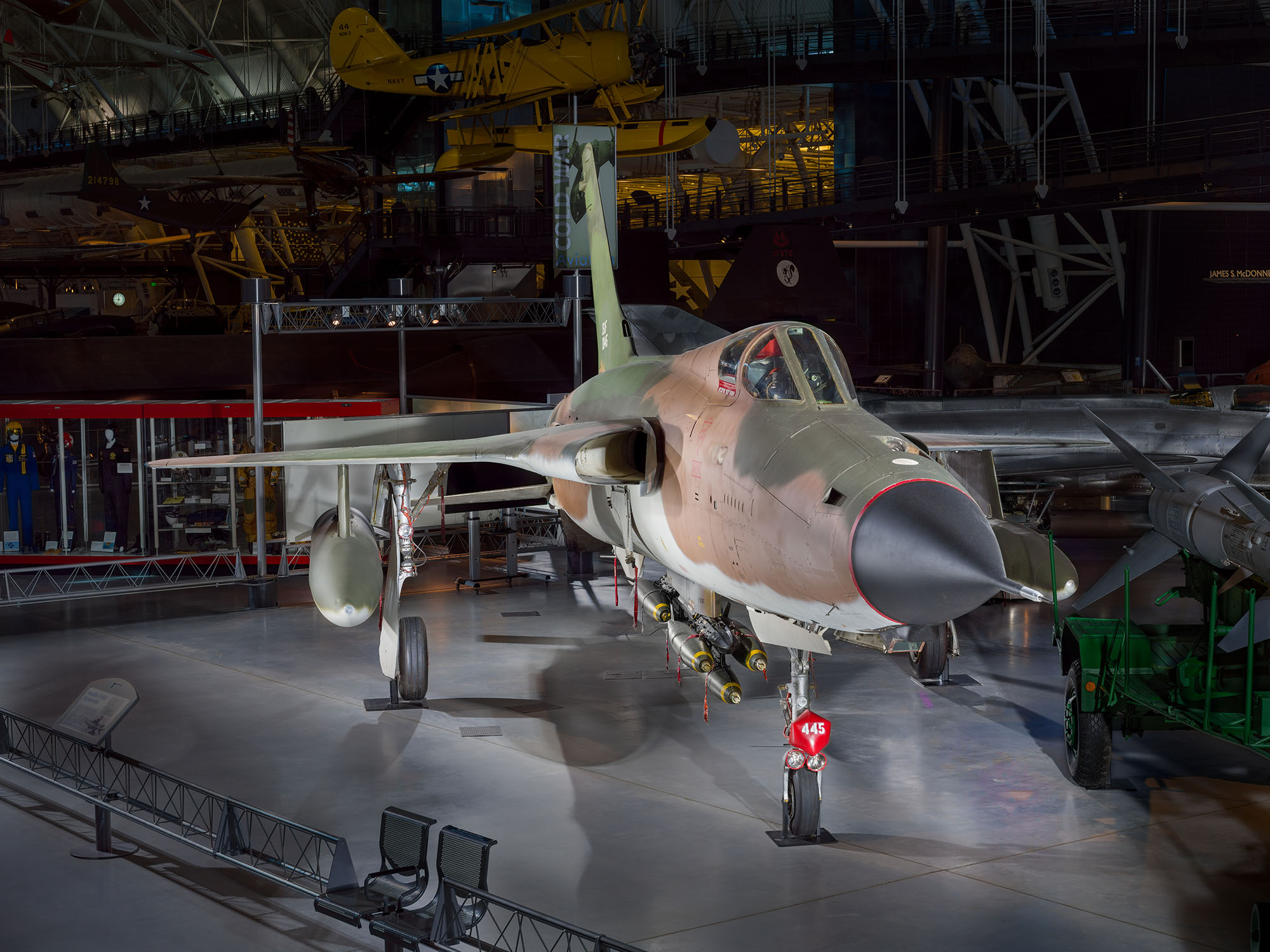
The F-105 carried much of the early strike campaign over North Vietnam and suffered severe losses in the process. Designed as a supersonic fighter-bomber, the F-105D carried heavy conventional bomb loads on demanding missions against defended targets. Crews flew at high speed through antiaircraft guns, surface-to-air missiles, and fighter opposition.
In depth
The story behind the display
Specialized two-seat F-105F and G Wild Weasel aircraft hunted radar-guided defenses. Their mission required crews to expose themselves so they could identify and suppress threats facing the larger strike force.
History & service
The F-105, nicknamed the "Thud," evolved from a 1951 project by to replace the F-84F fighter-bomber. The prototype first flew in October 1955, and Republic delivered the first production aircraft to the U.S. Air Force in 1958. Republic also developed a fully combat-capable two-seat trainer version, the F-105F, and 143 of them in 1963-1964.
The Thunderchief on display began operational service in 1964 as a standard F-105F. In 1967 it joined the 355th Tactical Fighter Wing in Thailand, where it flew combat missions for nearly three years. During this time, it became one of a select few USAF aircraft to claim three MiG kills. In 1970 it was fitted with electronic counter-measure equipment and joined the 388th TFW for "Wild Weasel" duty, attacking enemy surface-to-air missile sites.
In 1972 the aircraft was modified to the improved F-105G "Wild Weasel" configuration. After another year in Thailand, it was assigned to the 35th TFW at George Air Force Base, Calif. It remained there until February 1980 when it was flown to the museum. It is marked as it appeared while assigned to the 561st Tactical Fighter Squadron based at Korat Royal Thai Air Force Base, Thailand, in 1972-1973.
Details that tell the story
Supersonic fighter-bomber · Major strike aircraft during Rolling Thunder · Wild Weasel variants attacked radar-guided defenses · High operational tempo produced heavy losses
The aircraft in figures
Armament: One M61 20mm Vulcan cannon and over 12,000 lbs. of ordnance · Engine: One Pratt & Whitney J75-P-19W of 26,500 lbs. thrust · Maximum speed: 1,386 mph · Cruising speed: 596 mph · Range: 1,500 miles · Ceiling: 50,000 ft. · Span: 34 ft. 11 in. · Length: 67 ft. · Height: 20 ft. 2 in. · Weight: 54,580 lbs. maximum
Performance was only part of the contest
A fighter's speed, climb, range, visibility, and armament shaped what it could do, but those qualities did not act alone. Training, tactics, warning systems, maintenance, fuel, and the condition of the airfield influenced every encounter. The aircraft that looks best in a table might be at a disadvantage at the wrong altitude, carrying the wrong load, or arriving with too little fuel to remain in the fight.
Escort missions demonstrate the importance of purpose. A fighter defending bombers had responsibilities beyond pursuing an opponent. It needed sufficient range, a useful position, and the discipline to remain with the force it protected. Ground attack imposed different demands, including visibility, endurance near the target, and the ability to survive damage from below.
Comparing aircraft across museums is most rewarding when the mission remains in view. An early pursuit biplane, a wartime piston fighter, and a Cold War jet represent different technologies, but all were part of a larger operational system. Personal accounts reveal how pilots worked within those limits. They also show why claims of individual success need context: weather, surprise, teamwork, and opportunities created by others shaped the outcome. The aircraft provides the physical evidence; the surrounding stories explain how people used it and what that use cost.