Air Force Museum
EC-135E
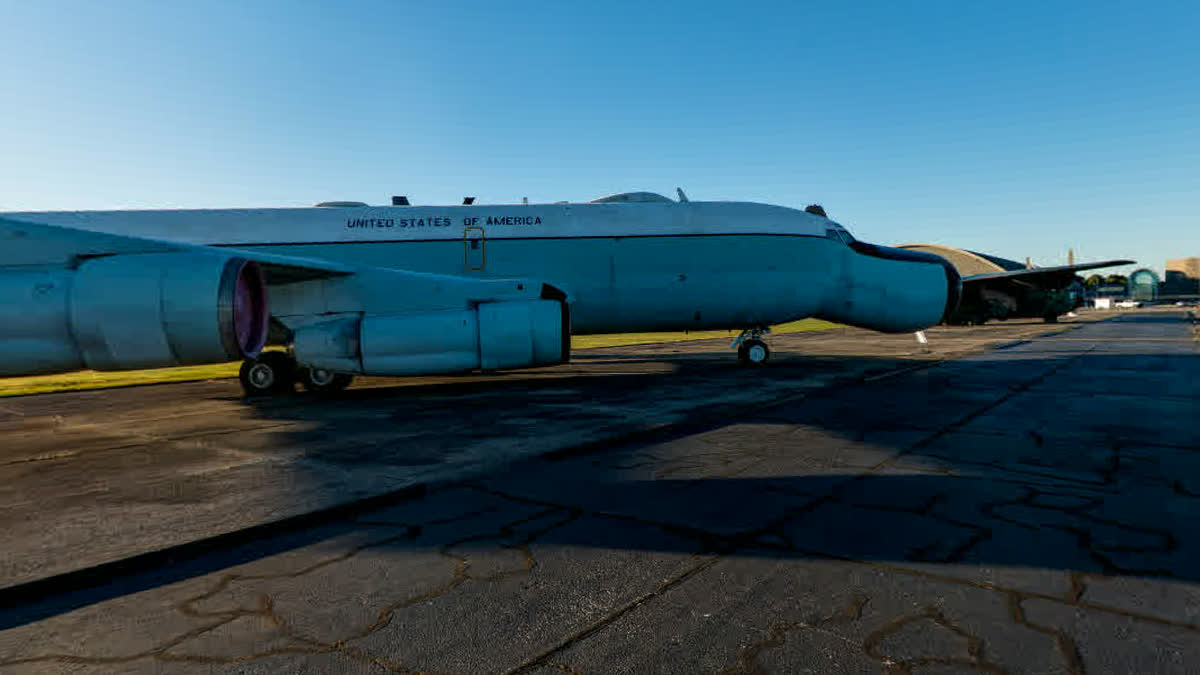
The EC-135E ARIA carried a large tracking antenna in its distinctive nose so engineers could collect telemetry from spacecraft and missile tests far beyond fixed ground stations. The aircraft became operational in January 1968 and supported the Apollo program as well as ballistic-missile and satellite work. By taking receivers, recorders, technicians, and their antenna wherever a mission demanded, ARIA made the test range mobile.
In depth
The story behind the display
The aircraft became operational in January 1968 and supported the Apollo program as well as ballistic-missile and satellite work. By taking receivers, recorders, technicians, and their antenna wherever a mission demanded, ARIA made the test range mobile. The museum received this aircraft in 2000.
History & service
During the early 1960s, NASA and the Department of Defense needed a mobile tracking and telemetry platform to support the Apollo space program and other unmanned space flight operations. In a joint project, NASA and the DoD contracted with the McDonnell Douglas and the Bendix Corporations to modify eight Boeing C-135 Stratolifter cargo aircraft into Apollo/Range Instrumentation Aircraft (A/RIA).
Equipped with a steerable seven-foot antenna dish in its distinctive "Droop Snoot" or "Snoopy Nose," the EC-135N A/RIA became operational in January 1968. The Air Force Eastern Test Range (AFETR) at Patrick Air Force Base, Fla., maintained and operated the A/RIA until the end of the Apollo program in 1972 when the USAF renamed it the Advanced Range Instrumentation Aircraft (ARIA).
Transferred to the 4950th Test Wing at Wright-Patterson Air Force Base, Ohio, in December 1975 as part of an overall consolidation of large test and evaluation aircraft, the ARIA fleet underwent numerous conversions, including a re-engining that changed the EC-135N to the EC-135E. In 1994 the ARIA fleet relocated to Edwards Air Force Base, Calif., as part of the 412th Test Wing.
However, taskings for the ARIA dwindled because of high costs and improved satellite technology, and the USAF transferred the aircraft to other programs such as J-STARS (Joint Surveillance and Target Attack Radar System).
On Nov. 3, 2000, a flight crew from the Air Force Flight Test Center delivered the last EC-135E (serial number 60-374, nicknamed Bird of Prey) to the National Museum of the United States Air Force. Over its 32-year career, the ARIA supported the U.S. space program, gathered telemetry, verified international treaties and supported cruise missile and ballistic missile defense tests.
Details that tell the story
ARIA means Advanced Range Instrumentation Aircraft · The seven-foot nose antenna collected test and spacecraft telemetry · Supported Apollo missions and later missile and satellite programs
The aircraft in figures
Armament: None · Engines: Four Pratt & Whitney TF-33-PW-102 turbofans (JT3D) of 18,000 lbs. thrust each · Crew: 11 · Maximum cruising speed: 490 knots · Normal cruising speed: 430 knots · Maximum operation altitude: 33,000 ft. · Range: 2800-4500 nautical miles without in-flight refueling (depending on mission and equipment carried) · Span: 103.8 ft. · Length: 141.5 ft. · Height: 41.7 ft.
What survives after the mission
A museum object begins a second life when it stops performing its original job. An aircraft that once carried a crew becomes a place for public memory. A jacket, letter, medal, or small piece of equipment can preserve a much more intimate connection. The object is valuable both for what it reveals physically and for the documented story that gives it meaning.
Famous aircraft and individuals can make a complicated history approachable, but they are only part of it. Many people left no celebrated machine behind. Memorials, personal possessions, unit records, and photographs help recover the experiences of those whose service was less visible. They also preserve loss, separation, captivity, recovery, and the consequences of war for families and communities.
Preservation involves choices. Restoring an aircraft may make its design easier to understand, while retaining wear or damage may protect evidence of its use. A reproduction can explain how a machine worked, provided its identity remains clear. Linking objects across collections helps fill the gaps created when surviving material is dispersed. A uniform in one gallery, an aircraft in another, and a memorial elsewhere can illuminate the same history from different directions. The result is more than a record of machines: it is a way to keep the people, decisions, and experiences connected to them in view.