Air Force Museum
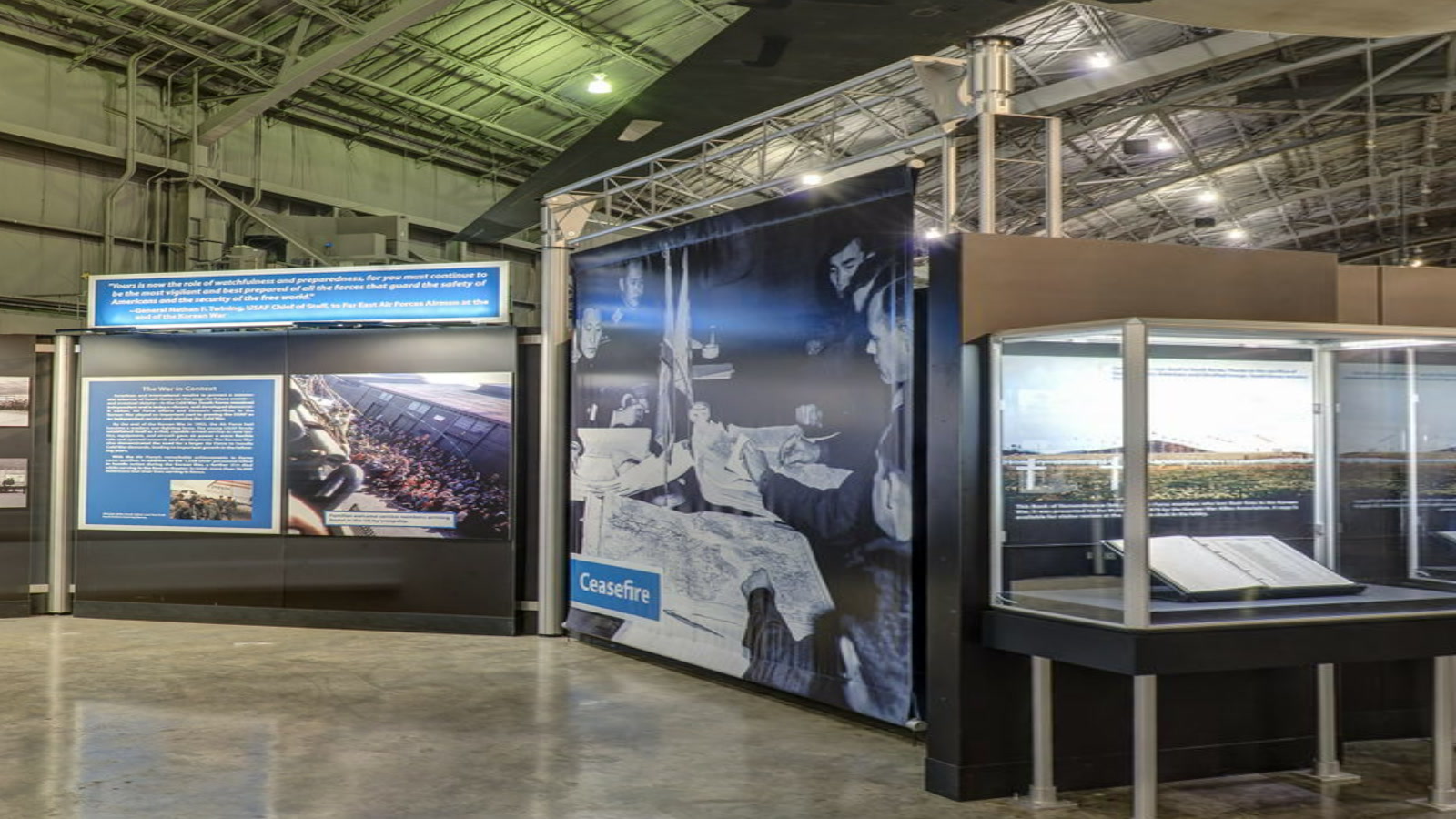
Ceasefire
The Korean Armistice ended major fighting but did not create a peace treaty. Negotiations took more than two years while combat continued. The agreement established a military demarcation line and a demilitarized zone and arranged mechanisms for prisoners and supervision.
In depth
The story behind the display
The ceasefire froze rather than resolved the political division of the peninsula. Its endurance makes the Korean War both a completed historical conflict and an unfinished international problem.
History & service
Facing increasing UN air power pressure, the communists finally signed a ceasefire on July 27, 1953, ending the fighting in Korea. The U.S. Air Force emerged from the Korean War as a proven force, ready to face future Cold War challenges. In the fight to resist communist aggression, 1,198 USAF Airmen gave their lives.
Peace negotiations began on July 10, 1951, in Kaesong, a city near the 38th parallel and now part of North Korea. For two years, negotiations stalled over the prisoner of war issue. Talks were deadlocked and troops faced a stalemate on the ground, but air power still gave the UN effective leverage. Air attacks made continuing the war too costly for the communists, and they signed an armistice on July 27, 1953.
The end of combat created the famous Demilitarized Zone or "DMZ" as a buffer zone between the two Koreas. This zone has become the world's most fortified international frontier, and has been the scene of several small-scale but violent North Korean incursions over the years. The zone completely divides the peninsula. It is 4 kilometers wide, or 2 kilometers on either side of the border.
While the armistice ended the fighting, there is still no peace treaty officially ending the war in Korea. Since 1953, U.S. forces have remained on guard in South Korea and Japan, ready to defend South Korea against aggression from the north.
Details that tell the story
Armistice signed July 27, 1953 · Created the military demarcation line and demilitarized zone · Stopped major combat without a peace treaty · Negotiations lasted more than two years
Air power in a limited war
The Korean War brought early jet combat into the same theater as piston fighters, large bombers, helicopters, and transports. Different technologies served different needs. Fast fighters contested the air, while other aircraft attacked supply routes, supported troops, carried equipment, gathered information, and evacuated casualties. The mountainous terrain and severe weather made those tasks especially demanding.
The conflict also exposed the limits of air power used within a larger political and military struggle. Aircraft could damage bridges and transportation networks, but opposing forces adapted, repaired, dispersed, and moved under cover. Supporting troops required communications and coordination close to the ground. Maintaining operations depended on suitable bases and an extensive flow of supplies.
The surviving artifacts show why a gallery cannot be understood through jet fighters alone. A tent, vehicle, radio, flight nurse's equipment, or rescue helicopter belongs to the same operational history. The stories of individual airmen are compelling because they took place within that complicated setting. Cross-links to the Second World War and later Cold War galleries reveal both continuity and change: familiar aircraft found new roles, jet performance expanded, and rescue systems developed further. The war ended in an armistice, making its history one of service and sacrifice within an unresolved division as well as one of technological change.
