Air Force Museum
Capt. Lillian Kinkela Keil
Flight nurse Lillian Kinkela Keil cared for wounded personnel during hundreds of evacuation missions in World War II and Korea. Keil served as an Army Air Forces flight nurse during World War II and returned to aeromedical evacuation duty in Korea. She cared for patients in transport aircraft where vibration, cold, noise, altitude, and limited equipment made every flight demanding.
In depth
The story behind the display
Her service makes clear that air power also moved wounded people toward hospitals. The lifesaving chain included medics, flight nurses, loadmasters, aircrews, maintenance personnel, and receiving hospitals.
History & service
Capt. Lillian Kinkela Keil was one of the most accomplished women in the U.S. Air Force during the Korean War, and one of the most decorated women in American military history. Her work in aviation began in 1938 when Kinkela (later Keil), a registered nurse, was hired as one of United Airlines' first flight attendants. During World War II, she became a flight nurse and made 250 evacuation flights in England and France, plus several transatlantic flights, caring for wounded patients.
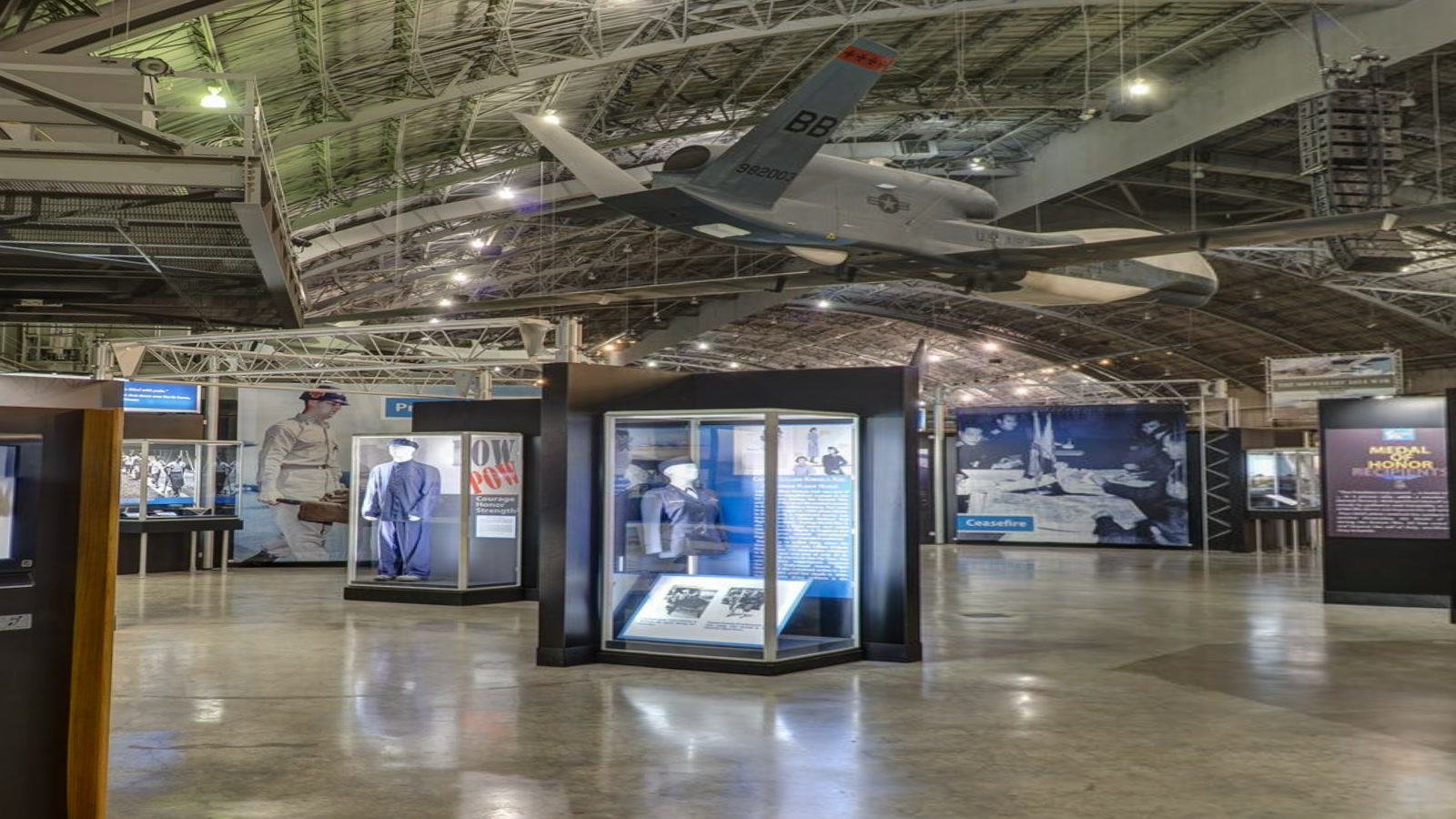
Returning to active duty when the Korean War broke out, Kinkela flew another 175 evacuation missions in Korea, and was one of only 30 Air Force flight nurses in the Far East. Her extraordinary experiences inspired the 1953 Hollywood movie Flight Nurse, and she remained active in veterans' affairs until her death in 2005. Keil's service dress uniform is displayed here.
Details that tell the story
Served in World War II and Korea · Completed 250 evacuation missions, including 175 in Korea · Cared for thousands of wounded personnel · One of the most highly decorated women in U.S. military history
Air power in a limited war
The Korean War brought early jet combat into the same theater as piston fighters, large bombers, helicopters, and transports. Different technologies served different needs. Fast fighters contested the air, while other aircraft attacked supply routes, supported troops, carried equipment, gathered information, and evacuated casualties. The mountainous terrain and severe weather made those tasks especially demanding.
The conflict also exposed the limits of air power used within a larger political and military struggle. Aircraft could damage bridges and transportation networks, but opposing forces adapted, repaired, dispersed, and moved under cover. Supporting troops required communications and coordination close to the ground. Maintaining operations depended on suitable bases and an extensive flow of supplies.
The surviving artifacts show why a gallery cannot be understood through jet fighters alone. A tent, vehicle, radio, flight nurse's equipment, or rescue helicopter belongs to the same operational history. The stories of individual airmen are compelling because they took place within that complicated setting. Cross-links to the Second World War and later Cold War galleries reveal both continuity and change: familiar aircraft found new roles, jet performance expanded, and rescue systems developed further. The war ended in an armistice, making its history one of service and sacrifice within an unresolved division as well as one of technological change.
