Air Force Museum
Operation Kiddy Car
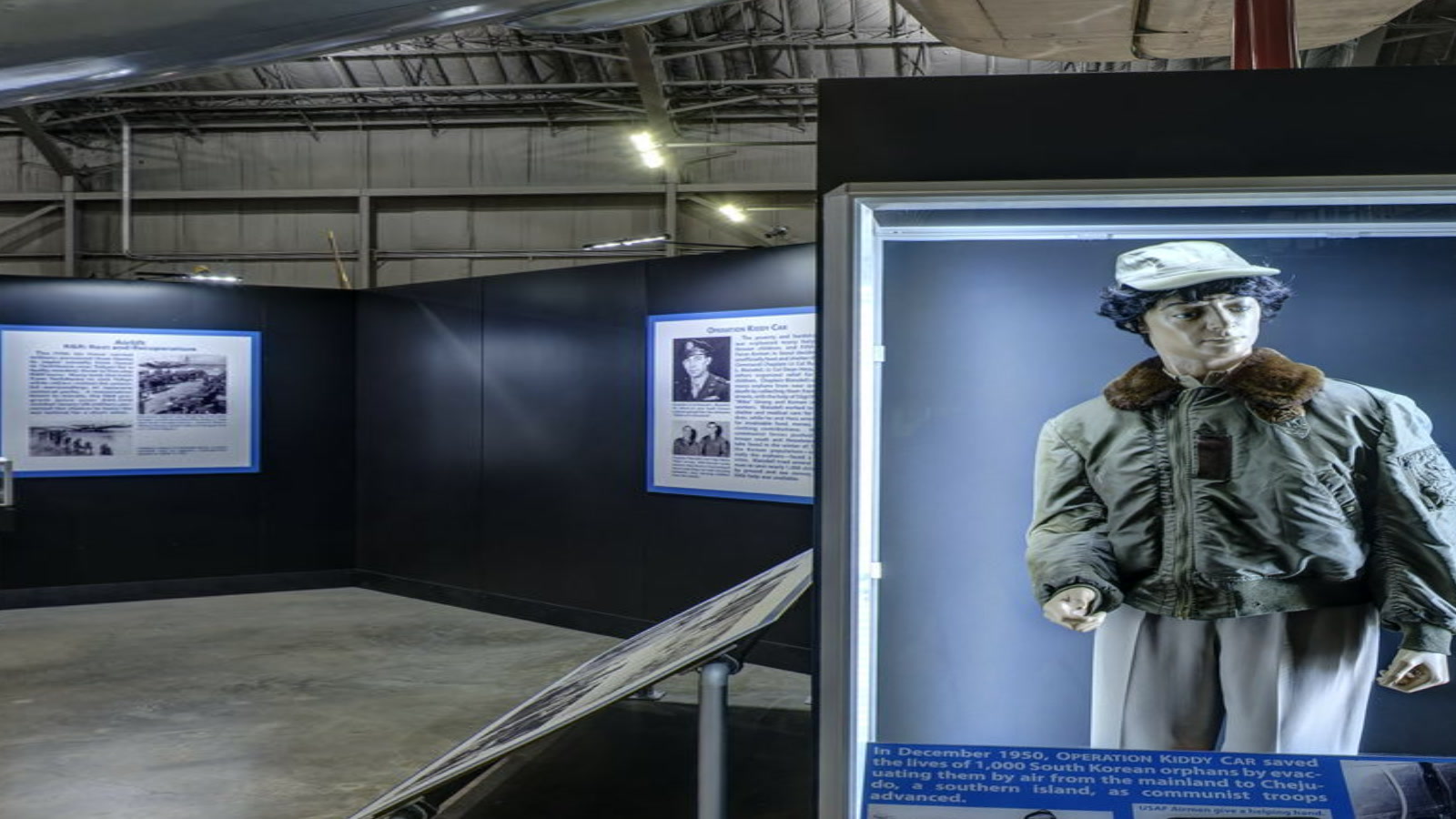
Operation Kiddy Car evacuated nearly a thousand Korean children from the Seoul area as Chinese intervention drove United Nations forces south. Chaplain Russell Blaisdell and other caregivers had gathered children displaced by the war. As the military situation worsened, personnel secured transport to move them from Kimpo to safety on Jeju Island, where Korean caregivers continued their work.
In depth
The story behind the display
The evacuation involved far more than a single airplane or famous participant. Children, Korean staff, chaplains, drivers, airlift planners, flight crews, commanders, and people who received them all formed a humanitarian chain inside a military emergency.
History & service
The poverty and hardship of war orphaned many helpless Korean children, and Fifth Air Force Airmen in Seoul decided to unofficially feed and shelter them. Command Chaplain Lt. Col. Russell L. Blaisdell, Lt. Col. Dean Hess and others organized relief for the children. Blaisdell saved many orphans from near certain death by collecting them from the streets with the help of Staff Sgt. Merle "Mike" Strang and Korean social workers.
Blaisdell worked to find shelter and medical care for children, while he and Hess arranged invaluable food, money and clothing contributions. When communist forces pushed UN troops south and threatened to take Seoul in the winter of 1950, the Korean population -- especially the orphans -- faced a dire crisis. Blaisdell tried several avenues to save nearly 1,000 children by ground and sea convoy, but little help was available.
Blaisdell and Hess devised a plan to transport the children to Cheju-do, an island off the southern coast of Korea, where Hess's men were to be stationed. This plan became known as OPERATION KIDDY CAR. As communist forces approached, Blaisdell's dogged persistence paid off: 5th Air Force Chief of Operations Col. T.C. Rogers found 16 C-54 transports to evacuate the orphans.
Commandeering several trucks at the port of Inchon, Blaisdell orchestrated orphans' and rescue workers' movement to nearby Kimpo airfield and the waiting aircraft.
The transports flew the children to Cheju-do, where Hess made arrangements to receive them. With contributions from U.S. troops and many others, an orphanage established there by Hess was able to accept even more children.
In 1957 Hess published the Kiddy Car story in his book Battle Hymn, later made into a motion picture. Royalties from the book and movie went to build a new orphanage near Seoul. In 2001 Blaisdell returned to Korea to visit those he helped to save and has been honored along with Hess as a great friend of the South Korean people.
Blaisdell, Strang, Hess and many other Airmen who selflessly aided helpless orphans amid the terrible destruction of the Korean War exemplified the continuing humanitarian spirit of the U.S. Air Force.
Details that tell the story
Conducted during the winter retreat of 1950 · Moved children from the Seoul area to Jeju Island · Used military airlift under emergency conditions · Required Korean caregivers and many military participants
Air power in a limited war
The Korean War brought early jet combat into the same theater as piston fighters, large bombers, helicopters, and transports. Different technologies served different needs. Fast fighters contested the air, while other aircraft attacked supply routes, supported troops, carried equipment, gathered information, and evacuated casualties. The mountainous terrain and severe weather made those tasks especially demanding.
The conflict also exposed the limits of air power used within a larger political and military struggle. Aircraft could damage bridges and transportation networks, but opposing forces adapted, repaired, dispersed, and moved under cover. Supporting troops required communications and coordination close to the ground. Maintaining operations depended on suitable bases and an extensive flow of supplies.
The surviving artifacts show why a gallery cannot be understood through jet fighters alone. A tent, vehicle, radio, flight nurse's equipment, or rescue helicopter belongs to the same operational history. The stories of individual airmen are compelling because they took place within that complicated setting. Cross-links to the Second World War and later Cold War galleries reveal both continuity and change: familiar aircraft found new roles, jet performance expanded, and rescue systems developed further. The war ended in an armistice, making its history one of service and sacrifice within an unresolved division as well as one of technological change.
