Air Force Museum
B-45C Tornado
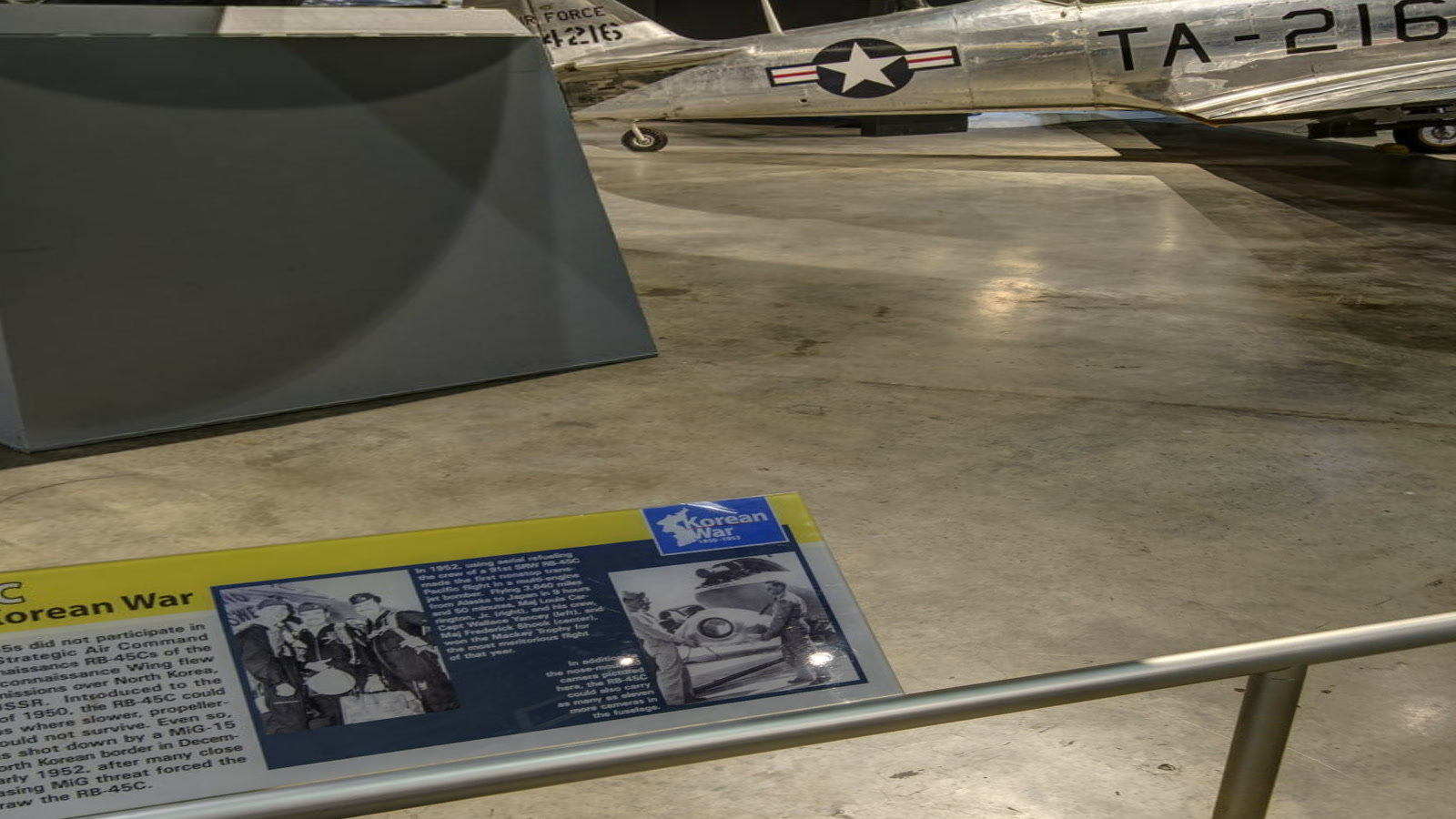
The B-45 was America's first operational jet bomber, and reconnaissance versions carried high-priority cameras over Korea and neighboring regions. The four-engine jet represented the rapid transition from piston bombers to jet-powered aircraft after World War II. In the Far East, RB-45C reconnaissance aircraft gathered imagery needed to understand airfields, transportation, defenses, and other activity.
In depth
The story behind the display
Reconnaissance required speed and altitude but also careful route planning, camera operation, weather interpretation, film processing, and analysis. The information mattered only when it could reach decision-makers in time to shape another mission.
History & service
The B-45 achieved many "firsts." It was the first American four-engine jet bomber to fly; the first American production jet bomber; the first jet bomber capable of carrying an atomic bomb; and the first multi-jet reconnaissance aircraft to refuel in mid-air.
Design of the Tornado began during World War II, and the B-45 made its first flight in March 1947. North American built 142 B-45s, including 10 long-range B-45Cs with wingtip fuel tanks and 33 RB-45Cs configured for high-altitude photo reconnaissance and aerial refueling.
Based at RAF Sculthorpe, England, from 1952-1958, B-45s of the 47th Bomb Wing (Light) were a key nuclear deterrent against a Soviet ground attack in Europe. Also flying from RAF Sculthorpe were USAF RB-45Cs from the USAF 19th Tactical Reconnaissance Squadron and Royal Air Force (RAF) Special Duty Flight crews. These RAF RB-45 crews flew highly classified reconnaissance missions deep into communist territory.
The aircraft on display was returned to the USAF by Pratt & Whitney Aircraft Division, where it had been on loan for engine testing. Flown to the museum in 1971, it is painted in the markings of the 47th Bomb Wing (Light).
Details that tell the story
First operational jet bomber of the United States · RB-45C variants performed photographic reconnaissance · Four turbojet engines · Reconnaissance linked aircraft, cameras, processing, and interpretation
The aircraft in figures
Armament: Two .50-cal. machine guns in the tail and 22,000 lbs. of bombs · Engines: Four General Electric J47s of 6,000 lbs. thrust each · Maximum speed: 570 mph · Range: 1,000 miles · Ceiling: 37,550 ft. · Span: 89 ft. · Length: 75 ft. 4 in. · Height: 25 ft. 2 in. · Weight: 110,000 lbs. maximum · Serial number: 48-0010
Air power in a limited war
The Korean War brought early jet combat into the same theater as piston fighters, large bombers, helicopters, and transports. Different technologies served different needs. Fast fighters contested the air, while other aircraft attacked supply routes, supported troops, carried equipment, gathered information, and evacuated casualties. The mountainous terrain and severe weather made those tasks especially demanding.
The conflict also exposed the limits of air power used within a larger political and military struggle. Aircraft could damage bridges and transportation networks, but opposing forces adapted, repaired, dispersed, and moved under cover. Supporting troops required communications and coordination close to the ground. Maintaining operations depended on suitable bases and an extensive flow of supplies.
The surviving artifacts show why a gallery cannot be understood through jet fighters alone. A tent, vehicle, radio, flight nurse's equipment, or rescue helicopter belongs to the same operational history. The stories of individual airmen are compelling because they took place within that complicated setting. Cross-links to the Second World War and later Cold War galleries reveal both continuity and change: familiar aircraft found new roles, jet performance expanded, and rescue systems developed further. The war ended in an armistice, making its history one of service and sacrifice within an unresolved division as well as one of technological change.
