Air Force Museum
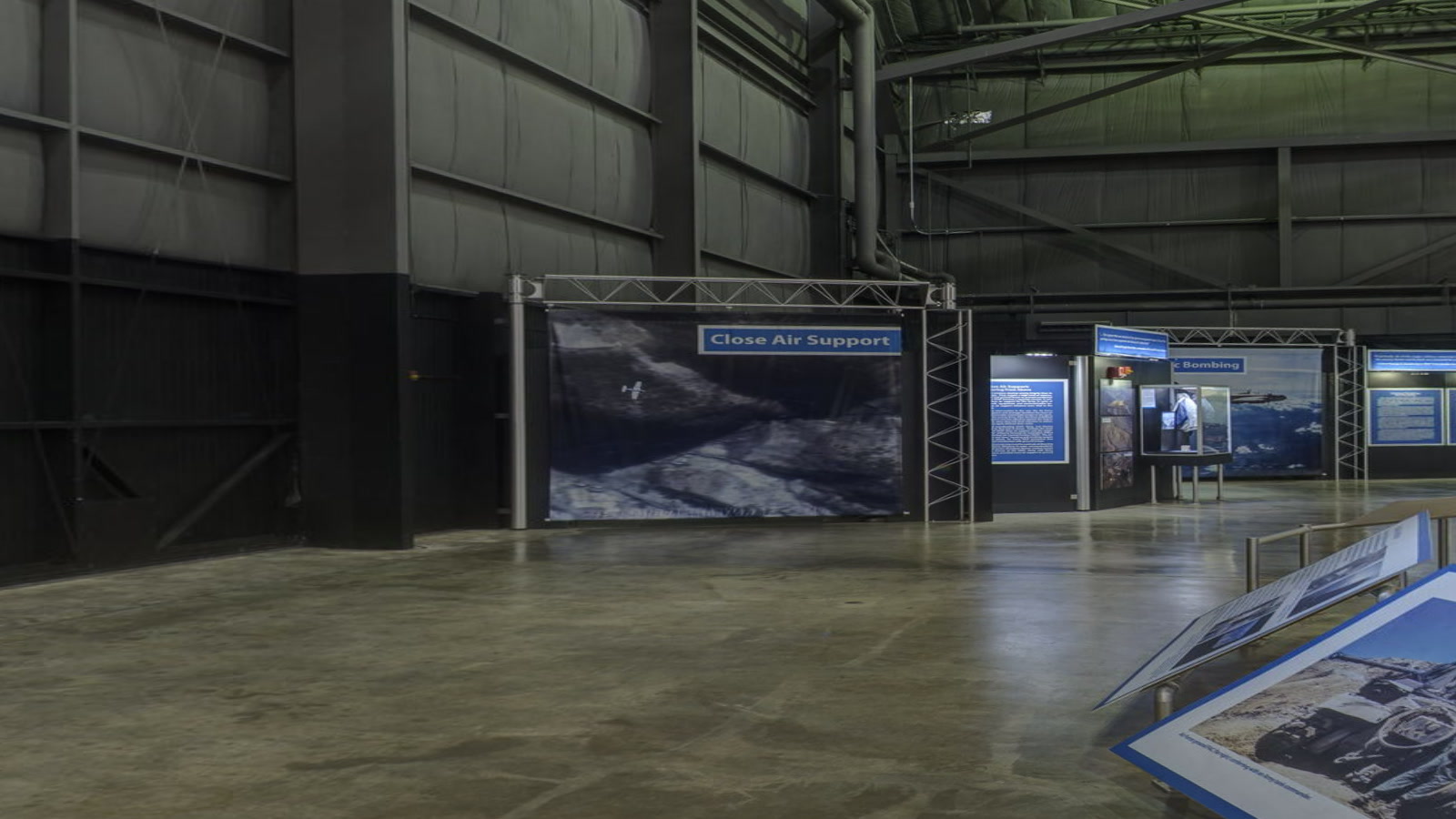
Close Air Support
Close air support placed aircraft near friendly ground forces, where speed and firepower had to be balanced with precise coordination. Pilots attacked enemy positions, vehicles, and troops close to United Nations forces. Forward air controllers and tactical air control parties helped identify targets and prevent attacks on friendly units.
In depth
The story behind the display
The mission exposed a fundamental problem: the pilot saw the battlefield from above, while ground forces understood the immediate terrain. Radios, shared maps, procedures, and trust joined those perspectives.
History & service
On April 6, 2003, Lt. Col. Raymond Strasburger and Capt. Gregory Thornton, A-10 Thunderbolt II pilots in the 75th Fighter Squadron, were operating near Baghdad when they heard a ground forward air controller call out: "We are taking heavy fire, we need you now!" Strasburger and Thornton made multiple 30mm gun, rocket, and missile attacks through very heavy anti-aircraft fire and blinding sandstorms to decimate an enemy Republican Guard armored force.
When the 33-minute engagement was over, their two-aircraft flight, named “Demob 71” for this mission, had destroyed three T-72 tanks, six armored personnel carriers and several other enemy vehicles. For their gallantry in action, Strasburger and Thornton were both awarded Silver Stars.
Details that tell the story
Supported troops in direct contact with enemy forces · Required positive target identification · Coordinated through ground and airborne controllers · Used fighters, fighter-bombers, and light observation aircraft
Air power in a limited war
The Korean War brought early jet combat into the same theater as piston fighters, large bombers, helicopters, and transports. Different technologies served different needs. Fast fighters contested the air, while other aircraft attacked supply routes, supported troops, carried equipment, gathered information, and evacuated casualties. The mountainous terrain and severe weather made those tasks especially demanding.
The conflict also exposed the limits of air power used within a larger political and military struggle. Aircraft could damage bridges and transportation networks, but opposing forces adapted, repaired, dispersed, and moved under cover. Supporting troops required communications and coordination close to the ground. Maintaining operations depended on suitable bases and an extensive flow of supplies.
The surviving artifacts show why a gallery cannot be understood through jet fighters alone. A tent, vehicle, radio, flight nurse's equipment, or rescue helicopter belongs to the same operational history. The stories of individual airmen are compelling because they took place within that complicated setting. Cross-links to the Second World War and later Cold War galleries reveal both continuity and change: familiar aircraft found new roles, jet performance expanded, and rescue systems developed further. The war ended in an armistice, making its history one of service and sacrifice within an unresolved division as well as one of technological change.