Air Force Museum
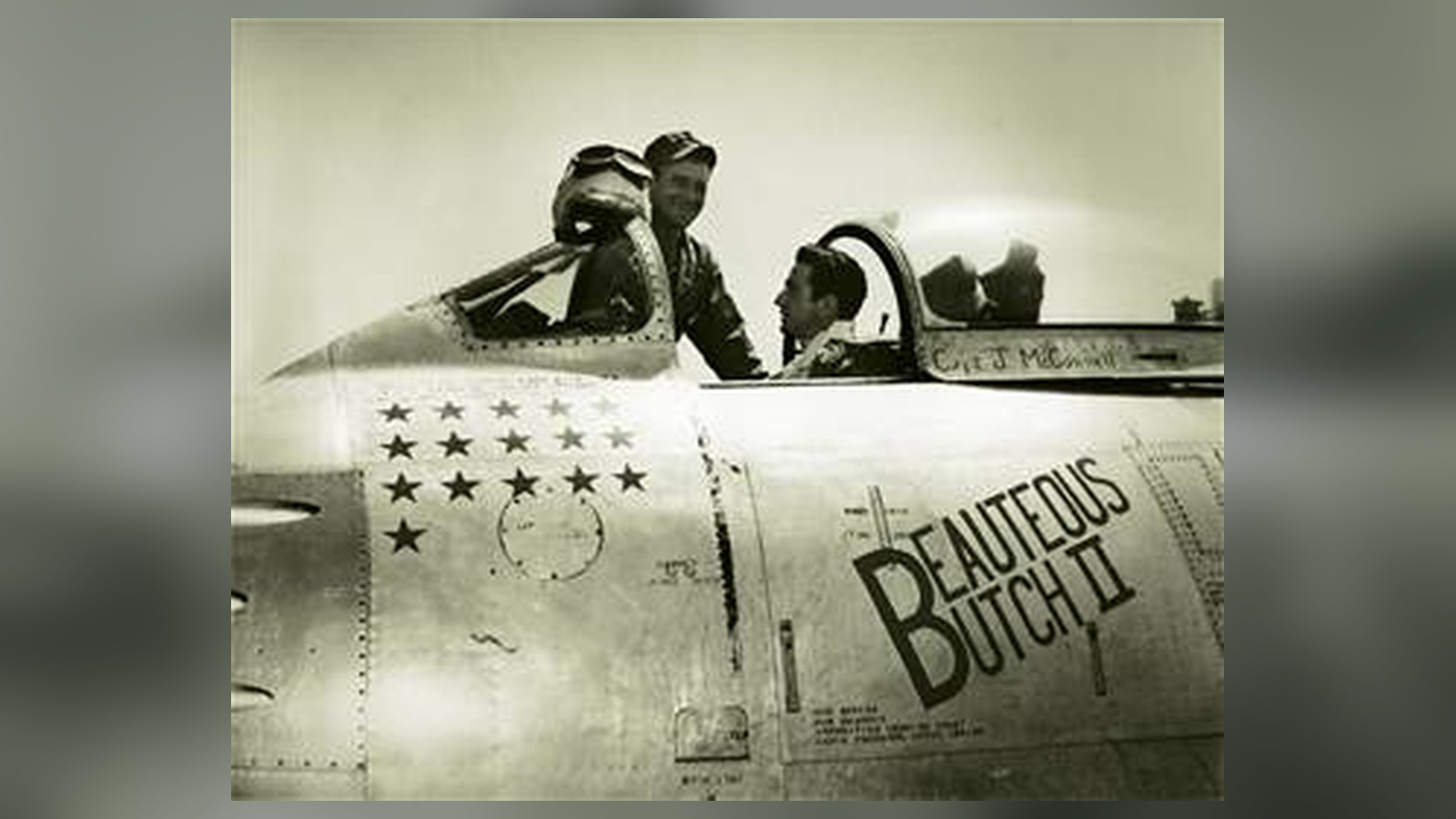
Capt. Joseph McConnell Jr.
Joseph McConnell became the leading American ace of the Korean War with sixteen credited aerial victories. McConnell began his combat career as a navigator in World War II and later became a fighter pilot. During a concentrated period of Korean War operations, he flew the F-86 and was credited with sixteen MiG victories.

In depth
The story behind the display
His experience connects changes in training and technology across two wars. It also illustrates the intense tempo and risk of repeated fighter missions.
History & service
The leading jet ace of the Korean War was Capt. Joseph McConnell Jr., who scored his first victory on Jan. 14, 1953. In a little more than a month, he gained his fifth MiG-15 victory, thereby becoming an ace.
On the day McConnell shot down his eighth MiG, his F-86 was hit by enemy aircraft fire, and he was forced to bail out over enemy-controlled waters of the Yellow Sea west of Korea. After only two minutes in the freezing water, a helicopter rescued him. The following day he was back in combat and shot down his ninth MiG. By the end of April 1953, he had scored his 10th victory to become a "double ace."
He scored his last victories on May 18, 1953. That morning McConnell shot down two MiGs in a furious air battle and became a "triple ace" with 15 kills. On another mission that afternoon, he shot down his sixteenth and final MiG-15.
On Aug. 25, 1954, McConnell crashed to his death while testing an F-86H at Edwards AFB, Calif.
Details that tell the story
Credited with sixteen aerial victories in Korea · Flew with the 51st Fighter-Interceptor Wing · Previously served as a B-24 navigator · Killed in a flight-test accident in 1954
Air power in a limited war
The Korean War brought early jet combat into the same theater as piston fighters, large bombers, helicopters, and transports. Different technologies served different needs. Fast fighters contested the air, while other aircraft attacked supply routes, supported troops, carried equipment, gathered information, and evacuated casualties. The mountainous terrain and severe weather made those tasks especially demanding.
The conflict also exposed the limits of air power used within a larger political and military struggle. Aircraft could damage bridges and transportation networks, but opposing forces adapted, repaired, dispersed, and moved under cover. Supporting troops required communications and coordination close to the ground. Maintaining operations depended on suitable bases and an extensive flow of supplies.
The surviving artifacts show why a gallery cannot be understood through jet fighters alone. A tent, vehicle, radio, flight nurse's equipment, or rescue helicopter belongs to the same operational history. The stories of individual airmen are compelling because they took place within that complicated setting. Cross-links to the Second World War and later Cold War galleries reveal both continuity and change: familiar aircraft found new roles, jet performance expanded, and rescue systems developed further. The war ended in an armistice, making its history one of service and sacrifice within an unresolved division as well as one of technological change.
