Air Force Museum
Korean War Introduction
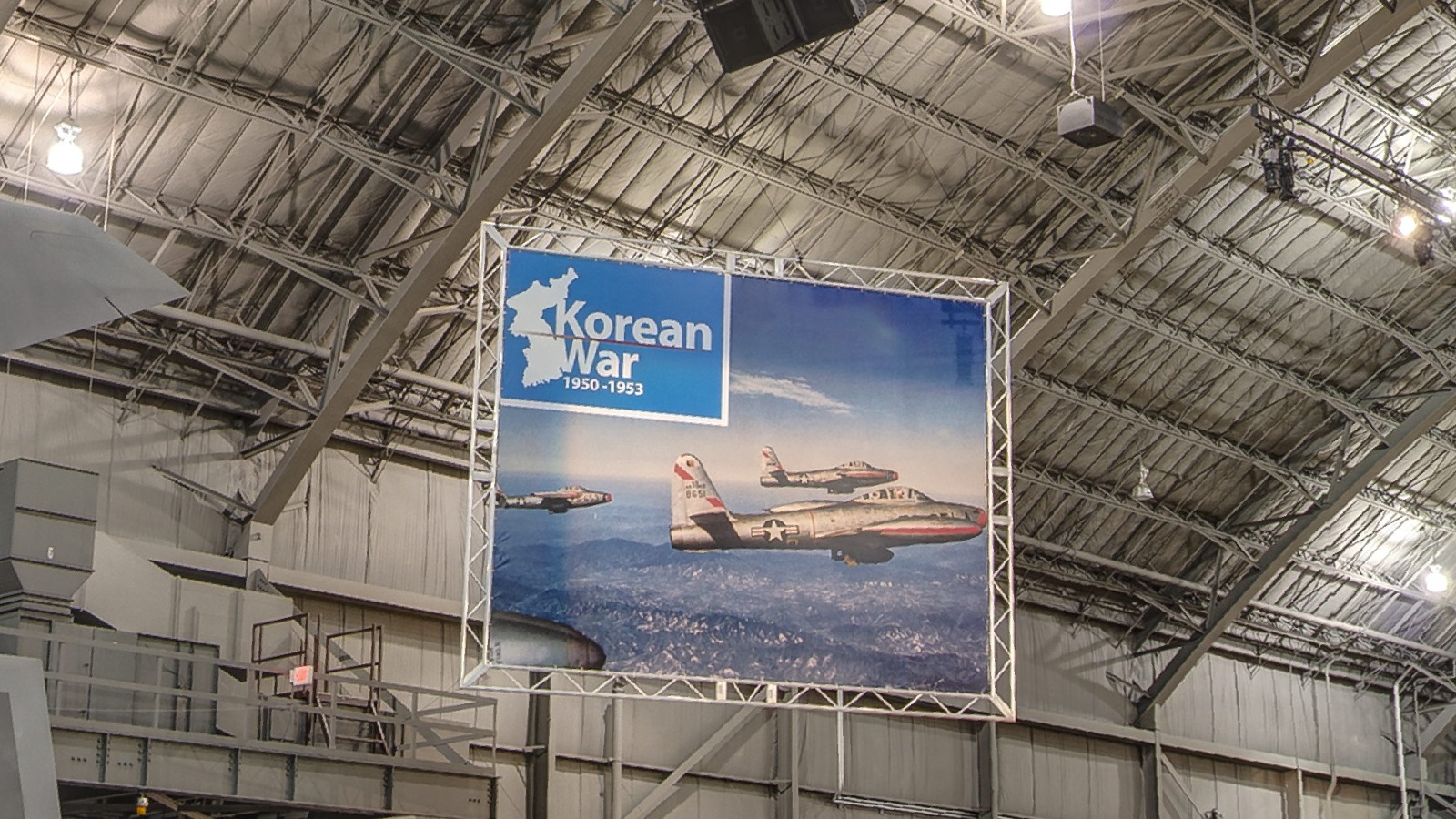
The Korean War became the first major armed conflict of the Cold War and the first war fought by the independent U.S. Air Force. North Korean forces crossed the 38th parallel on June 25, 1950. United Nations forces entered a fast-moving war in which air units had to deploy from Japan, establish bases in Korea, protect retreating troops, move people and supplies, and contest the sky while the ground front repeatedly shifted.
In depth
The story behind the display
The conflict joined piston aircraft and new jets, strategic bombers and small observation airplanes, helicopters and transports. It tested whether air power could support a limited war without allowing combat to expand into a larger confrontation with China or the Soviet Union.
History & service
The U.S. Air Force was only three years old as a separate service when North Korea invaded South Korea in the summer of 1950. The next three years brought significant changes in technology, roles and tactics, marking the beginning of the modern Air Force.
When World War II ended, the United States accepted the surrender of the Japanese in Korea south of the 38th parallel, while the Soviet Union accepted the Japanese surrender north of that line. Although the western Allies intended that Korea become an independent democracy, the Soviet Union had other plans.
In 1947 the United States put the problem of Korean independence before the United Nations. When the UN ordered free elections throughout the country, the Soviet Union refused to allow them in the north. Free elections in the southern half of Korea in May of 1948 established the Republic of Korea. The Soviets created a rival communist government in the north, the "People's Democratic Republic of Korea."
With governments established in both halves of Korea, the Soviets announced their intention to leave the country and challenged the United States to do the same. After training a small national force for internal security in South Korea, the United States departed, leaving only a few military advisors. In the north, the Soviets oversaw the creation of the well-trained and equipped North Korean People's Army with Soviet tanks, heavy artillery, and aircraft.
After assuring the military superiority of North Korea, the Soviets left in 1949. Less than a year later, border skirmishes between north and south exploded into all-out war with the North Korean invasion of South Korea on June 25, 1950.
The United States was committed to defending South Korea against communist aggression. Although the United States had no official treaty obligating it to South Korea, President Harry Truman ordered U.S. forces in the Far East into action on June 27, and three days later authorized air attacks in North Korea. He also began to mobilize reserves for the coming battles.
The Korean crisis was also the first major test for the five-year-old United Nations. On June 25, 1950, the United Nations Security Council met to address the crisis. The Soviet Union, boycotting the UN because the international body did not recognize communist rule in China, did not attend. On June 27, the U.S. proposed the UN intervene in Korea with armed force. With the Soviets absent and unable to veto the measure, the resolution passed.
In addition to South Korea and the U.S., 15 other member nations sent military forces to stop the communist attack.
Details that tell the story
Began June 25, 1950 · First major war of the independent U.S. Air Force · United Nations air forces operated from Korea and Japan · Armistice halted major combat on July 27, 1953
Air power in a limited war
The Korean War brought early jet combat into the same theater as piston fighters, large bombers, helicopters, and transports. Different technologies served different needs. Fast fighters contested the air, while other aircraft attacked supply routes, supported troops, carried equipment, gathered information, and evacuated casualties. The mountainous terrain and severe weather made those tasks especially demanding.
The conflict also exposed the limits of air power used within a larger political and military struggle. Aircraft could damage bridges and transportation networks, but opposing forces adapted, repaired, dispersed, and moved under cover. Supporting troops required communications and coordination close to the ground. Maintaining operations depended on suitable bases and an extensive flow of supplies.
The surviving artifacts show why a gallery cannot be understood through jet fighters alone. A tent, vehicle, radio, flight nurse's equipment, or rescue helicopter belongs to the same operational history. The stories of individual airmen are compelling because they took place within that complicated setting. Cross-links to the Second World War and later Cold War galleries reveal both continuity and change: familiar aircraft found new roles, jet performance expanded, and rescue systems developed further. The war ended in an armistice, making its history one of service and sacrifice within an unresolved division as well as one of technological change.
