Air Force Museum
Martin B-26G Marauder
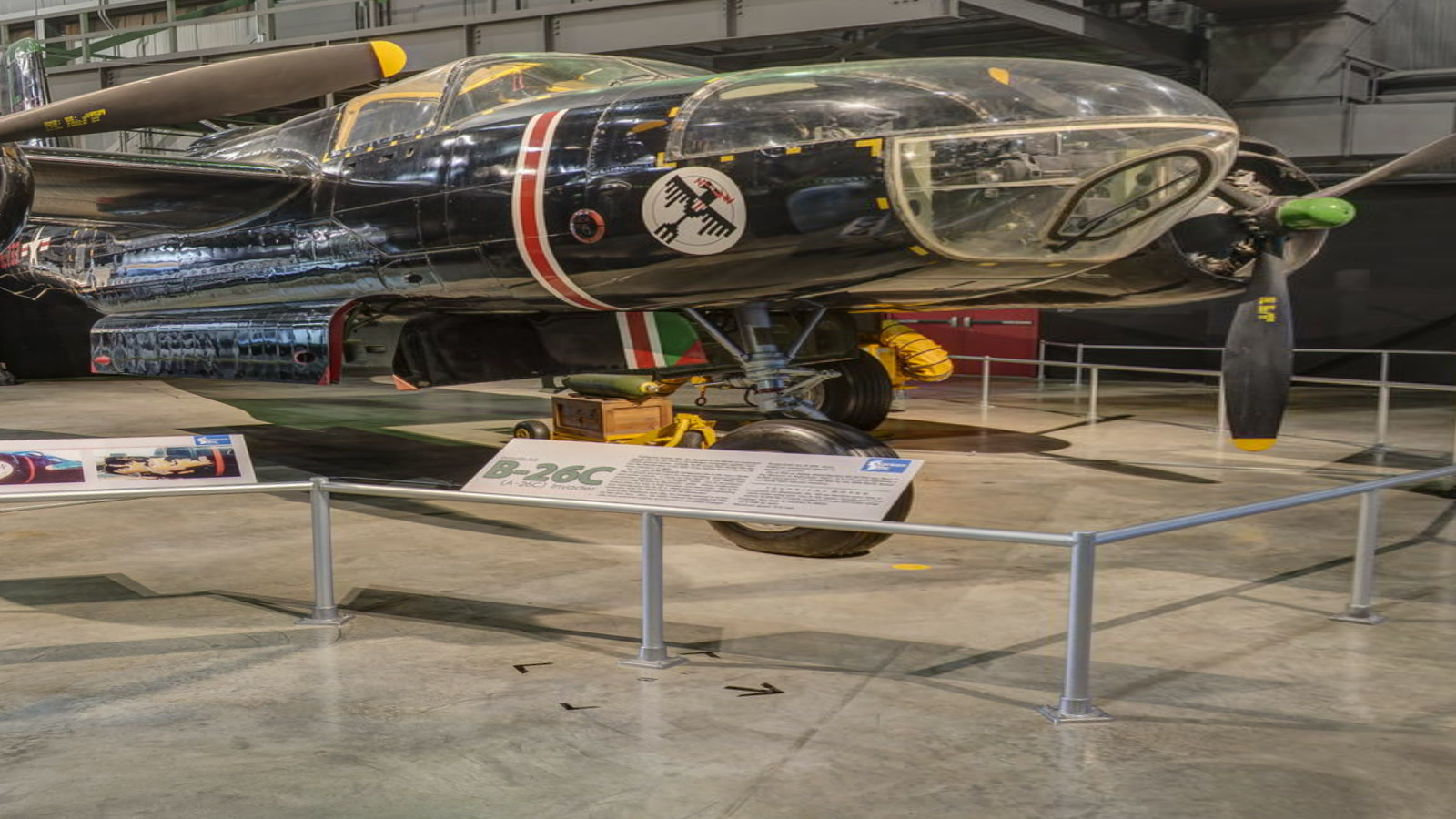
Although the Marauder did not make its first flight until Nov. 25, 1940, its design showed such promise that the Air Corps ordered 1,131 B-26s in September 1940. The B-26 began flying combat missions in the Southwest Pacific in the spring of 1942, but most were subsequently assigned to Europe and the Mediterranean.
In depth
History & service
Bombing from medium altitudes of 10,000 to 15,000 feet, the Marauder had the lowest loss rate of any Allied bomber -- less than one-half of one percent. U.S., British, Free French, Australian, South African and Canadian aircrews all flew the B-26 in combat. By the end of World War II, B-26 crews had flown more than 110,000 sorties and had dropped 150,000 tons of bombs.
In 1945, when B-26 production was halted, 5,266 had been built. The Marauder on display was flown in combat by the Free French during the final months of WWII. It was obtained from the Air France airline's training school near Paris in June 1965. It is painted as a 9th Air Force B-26B assigned to the 387th Bomb Group in 1945.
The aircraft in figures
Armament: 11.50-cal. machine guns; 4,000 lbs. of bombs · Engines: Two Pratt & Whitney R-2800s of 2,000 hp each · Maximum speed: 285 mph · Cruising speed: 190 mph · Range: 1,100 miles · Ceiling: 19,800 ft. · Span: 71 ft. · Length: 58 ft. 6 in. · Height: 20 ft. 3 in. · Weight: 37,000 lbs. loaded
A bomber was a workplace under pressure
A multi-engine bomber carried a crew whose members performed different jobs in a confined, noisy, and often very cold environment. Pilots, navigators, bombardiers, radio operators, engineers, and gunners depended on one another. Oxygen, communications, heating, and the movement of equipment mattered to survival as well as to the mission. Damage could turn an ordinary procedure into a difficult act of improvisation.
Formation flying added another layer of dependence. Bombers attempted to combine navigation, concentrated bombing, and defensive fire while holding position through changing weather and enemy attacks. Long-range fighter escort altered the balance, but it did not remove antiaircraft fire, mechanical failure, or the consequences of fatigue. Mission reports and surviving equipment reveal both the power of the force and the vulnerability of the people inside it.
Named aircraft and famous crews offer an entry into this history without representing every experience. Nose art and personal possessions made an industrial machine feel like a shared home, yet many crews and aircraft left little material trace. The museums preserve fragments of that wider world: a turret, a flight jacket, an engine, a decorated aircraft, a story of escape. Linking them across galleries allows the technical history of bombing to be read alongside courage, loss, civilian consequences, and the work required to bring a damaged aircraft and its crew back.