Air Force Museum
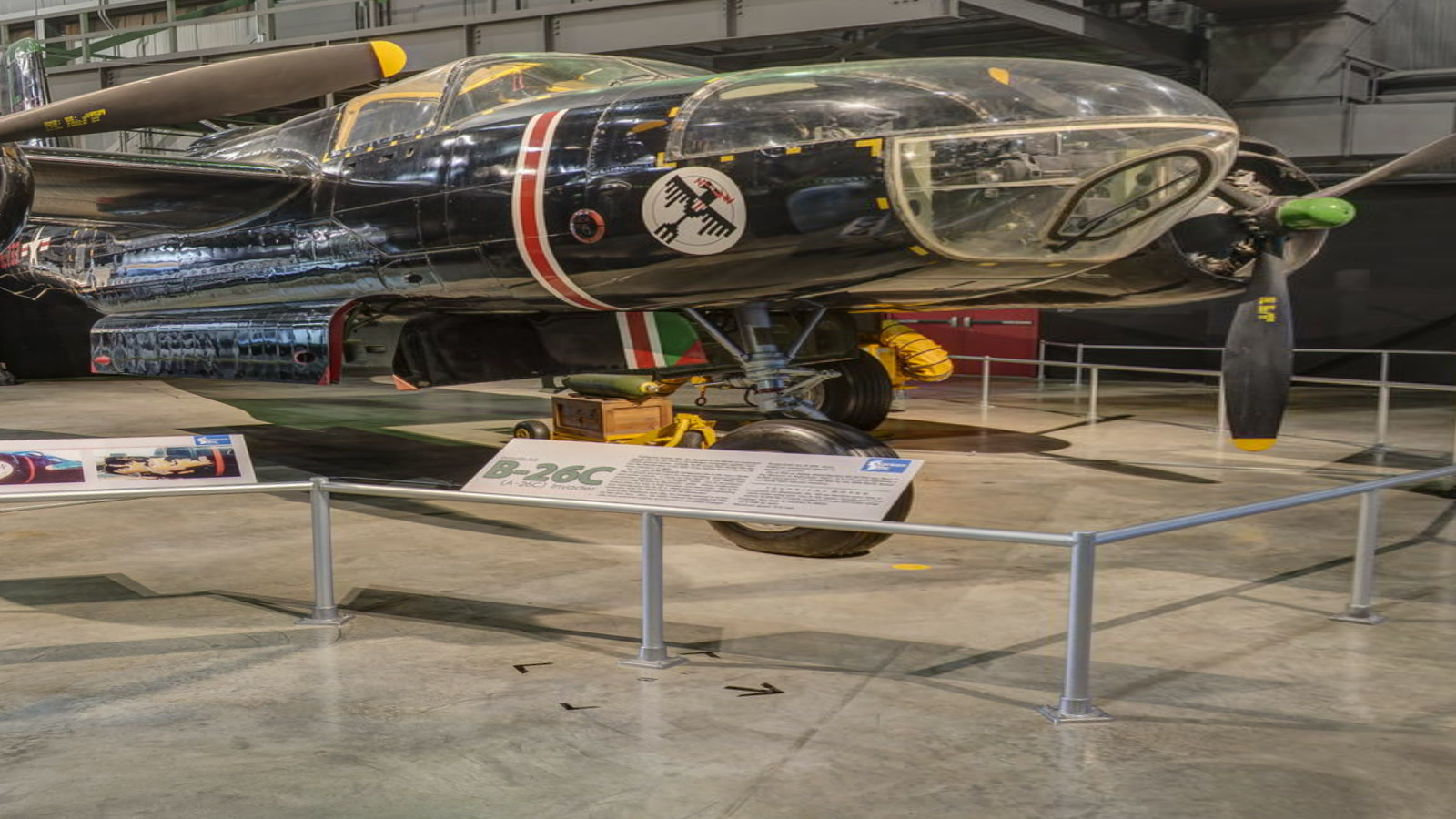
B-26C (A-26C) Invader
Invader crews attacked transportation and supply targets, increasingly at night, in an effort to slow movement toward the front. The twin-engine aircraft had entered service during World War II as the A-26 and was redesignated B-26 after the war. In Korea, crews struck railways, roads, bridges, vehicles, airfields, and other targets that supported enemy operations.
In depth
The story behind the display
Night interdiction reduced some exposure to fighters but made navigation and target identification difficult. Crews depended on radar, flares, visual cues, intelligence, and repeated knowledge of routes that could be repaired or concealed between attacks.
History & service
During the Korean War, the Douglas B-26 played an important part in the U.S. Air Force's interdiction campaign against communist ground forces. Initially, B-26 crews flew during the day, but the introduction of the MiG-15 jet fighter forced them to fly most missions at night.
The Douglas B-26 (originally designated the A-26) was a World War II attack aircraft used for level bombing, ground strafing, and rocket attacks. It made its first flight in July 1942, and production delivery began in August 1943. The A-26 entered combat over Europe in November 1944. When production halted after the war, 2,502 Invaders had been built. The A-26 was redesignated the B-26 in 1948 (thus creating everlasting confusion with the WWII Martin B-26 Marauder).
Early in the Southeast Asia War, the Invader returned to action for the third time. Also, the USAF ordered 40 modified B-26Bs with more powerful engines and increased structural strength. Designated the B-26K, these airplanes performed special air warfare missions.
The A-26C on display (S/N 44-35733) was flown to the museum in September 1957. It is painted to represent a B-26C used during the Korean War by the 34th Bomb Squadron flying night intruder missions.
Details that tell the story
Twin-engine light bomber and attack aircraft · Known as the A-26 during World War II and B-26 in Korea · Flew day and night interdiction missions · Targeted transportation and supply networks
The aircraft in figures
Armament (as displayed): Six .50-cal. machine guns (two in each under wing pod; two in the upper, remote controlled turret); 6,000 lbs. of bomb carried internally and under wings · Engines: Two Pratt & Whitney R-2800s of 2,000 hp each · Maximum speed: 373 mph · Span: 70 ft. · Length: 51 ft. 3 in. · Height: 18 ft. 3 in. · Weight: 35,000 lbs. loaded
A bomber was a workplace under pressure
A multi-engine bomber carried a crew whose members performed different jobs in a confined, noisy, and often very cold environment. Pilots, navigators, bombardiers, radio operators, engineers, and gunners depended on one another. Oxygen, communications, heating, and the movement of equipment mattered to survival as well as to the mission. Damage could turn an ordinary procedure into a difficult act of improvisation.
Formation flying added another layer of dependence. Bombers attempted to combine navigation, concentrated bombing, and defensive fire while holding position through changing weather and enemy attacks. Long-range fighter escort altered the balance, but it did not remove antiaircraft fire, mechanical failure, or the consequences of fatigue. Mission reports and surviving equipment reveal both the power of the force and the vulnerability of the people inside it.
Named aircraft and famous crews offer an entry into this history without representing every experience. Nose art and personal possessions made an industrial machine feel like a shared home, yet many crews and aircraft left little material trace. The museums preserve fragments of that wider world: a turret, a flight jacket, an engine, a decorated aircraft, a story of escape. Linking them across galleries allows the technical history of bombing to be read alongside courage, loss, civilian consequences, and the work required to bring a damaged aircraft and its crew back.