Air Force Museum
D-Day Paratrooper
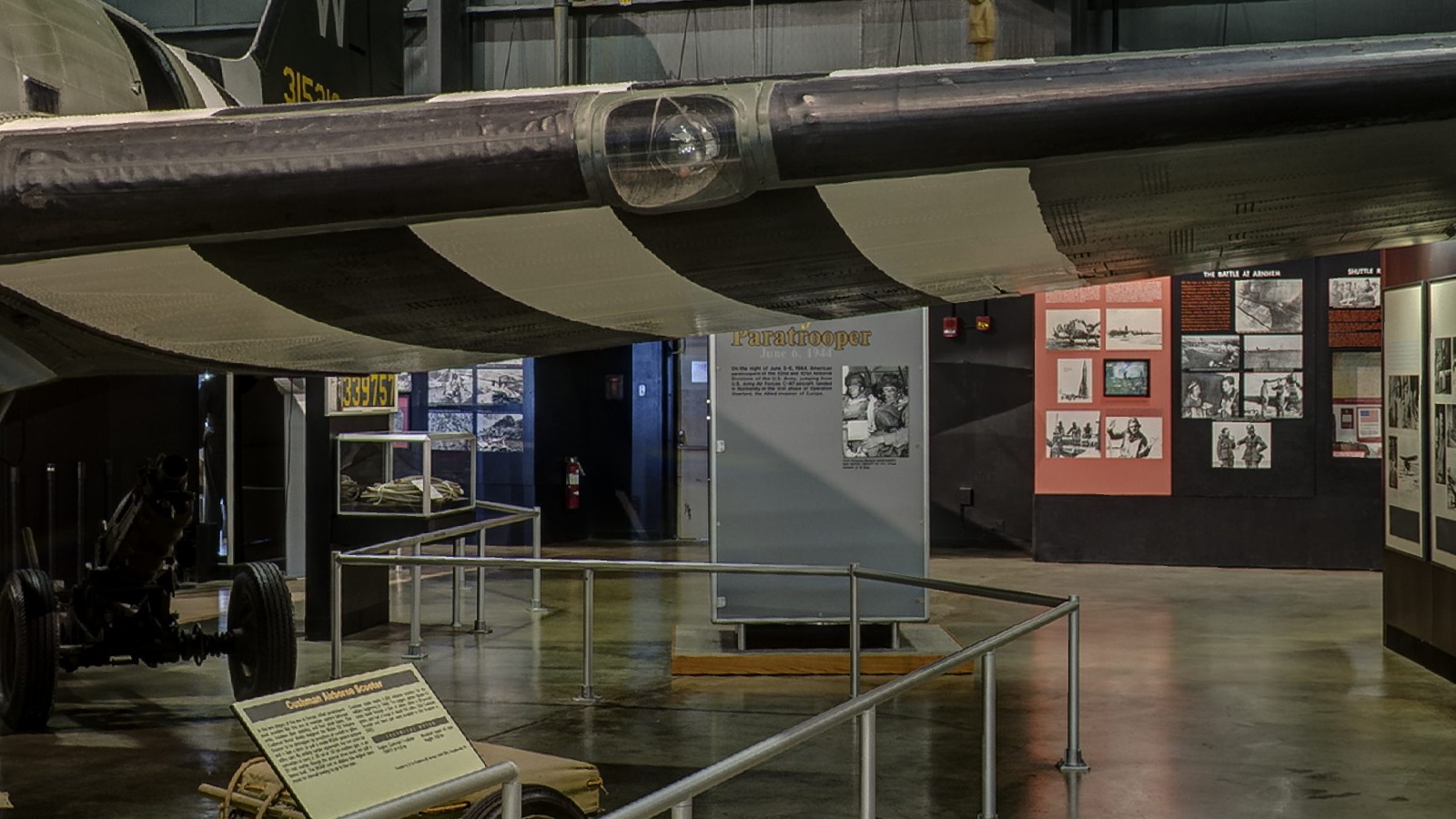
Airborne troops carried the invasion inland before dawn, relying on transport crews, pathfinders, gliders, and equipment designed for a dangerous night drop. C-47 formations crossed the Normandy coast carrying American paratroopers toward drop zones behind the beaches. Darkness, cloud, anti-aircraft fire, and evasive action scattered many units, forcing small groups to improvise while seeking roads, bridges, and strongpoints.
In depth
The story behind the display
The story belongs to both the soldiers who jumped and the transport crews who flew at low altitude through hostile fire. Their dispersed landings complicated plans but also spread confusion among German defenders and created many local actions across the invasion area.
History & service
This figure, dressed and equipped as a typical D-Day paratrooper is hooked up to a static line and ready to jump. Paratroopers wore specialized jump suits with large pockets to carry extra rations, ammunition or grenades. The paratrooper helmet, a modified version of the standard infantry helmet, had a modified liner with forked straps to secure the special chin cup.
Since airborne troops had to fight with what they could carry or what could be airdropped to them, each paratrooper jumped with a heavy load of equipment. Some burdened paratroopers drowned when they landed in marshy areas.
The T-5 parachute assembly on the mannequin was the type used by most U.S. Army paratroopers during World War II. When the paratrooper jumped from an aircraft, the static line pulled the cover from the backpack, which released the parachute. If the jumpers main parachute malfunctioned, he could pull the red rip chord on his reserve parachute in front (Americans were the only airborne forces to use reserve parachutes during World War II combat operations).
Paratroopers carried a length of rope to lower themselves in case they landed in a tree.
Most paratroopers carried the standard M-1 Garand rifle. For the airdrop, paratroopers carried their disassembled in special quilted cloth containers called Griswold bags. Unfortunately, this practice left the paratrooper vulnerable and some chose to carry their weapons assembled and readily available. Some paratroopers dropped with submachine guns or folding carbines.
Details that tell the story
American airborne divisions landed before the beach assault · C-47 transports carried most paratroopers · Pathfinders marked intended drop zones · Weather and enemy fire scattered many formations
Aircraft change the battlefield
In the First World War, aircraft became valuable because they could see beyond the front line. Reconnaissance and artillery observation affected decisions on the ground. Once that information mattered, opposing forces had reason to attack the aircraft gathering it. Fighters, defensive armament, and increasingly specialized missions developed around this contest over observation and freedom of movement.
The aircraft were fragile by later standards, but their crews worked inside a rapidly expanding military system. Training, maintenance, replacement aircraft, photography, communications, and weather reporting supported each sortie. Improvements in engines and armament changed tactics, while the pressures of combat exposed weaknesses that might have taken much longer to discover in peacetime.
Personal stories should be read alongside those systems. A uniform or a named aircraft connects the war to an individual, but the individual depended on many others and operated under constraints that skill could not eliminate. Aircraft from opposing sides show how designers answered similar problems in different ways. The later military collections in Dayton and at Udvar-Hazy reveal what endured: the need to gather information, protect friendly forces, move people and supplies, and coordinate action across distance. The scale changed enormously; the relationship between an aircraft's design and the job it had to perform remained fundamental.