Air Force Museum
Douglas C-47D Skytrain
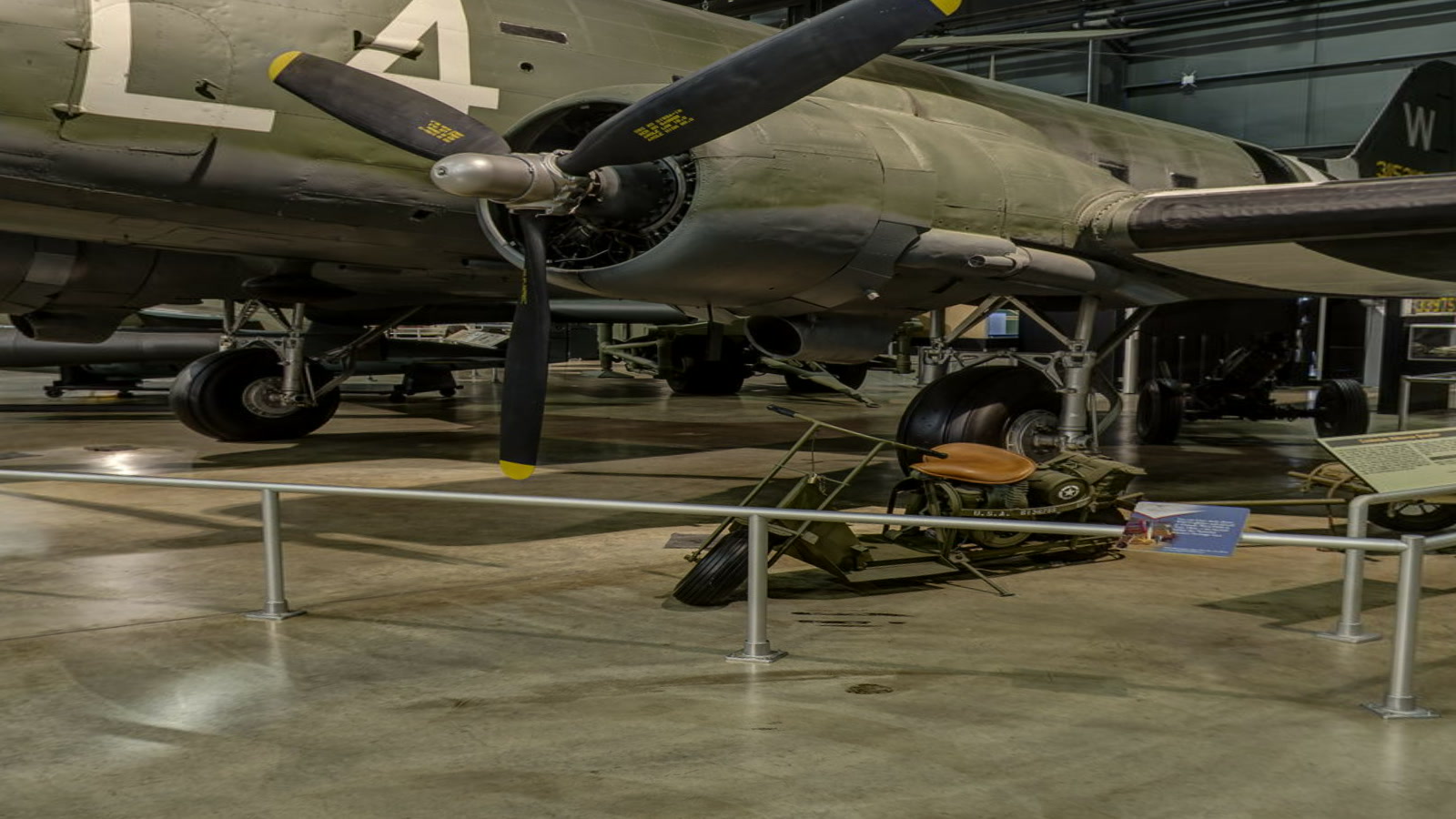
The C-47 carried paratroopers, cargo, wounded personnel, and essential supplies, making air mobility a central part of Allied operations. Developed from the civilian DC-3, the military C-47 became one of the most useful transport aircraft of the war. It towed gliders, dropped paratroopers, delivered supplies, moved personnel, and evacuated casualties across widely separated theaters.
In depth
The story behind the display
Its importance came from dependable service rather than dramatic speed or armament. Airborne operations on D-Day and later campaigns depended on fleets of transports, trained crews, navigators, pathfinders, ground support, and carefully timed routes.
History & service
Few aircraft are as well known, were so widely used or used as long as the C-47. Affectionately nicknamed the "Gooney Bird," this aircraft was adapted from the Douglas DC-3 commercial airliner. The U.S. Army Air Corps ordered its first C-47s in 1940, and by the end of World War II, procured a total of 9,348. These C-47s carried personnel and cargo around the globe. They also towed troop-carrying gliders, dropped paratroops into enemy territory, and air evacuated sick or wounded patients.
A C-47 could carry 28 passengers, 18-22 fully equipped paratroopers, about 6,000 lbs. of cargo or 18 stretchers and three medical personnel.
After World War II, many C-47s remained in U.S. Air Force service, participating in the Berlin Airlift and other peacetime activities. During the Korean War, C-47s hauled supplies, dropped paratroops, evacuated wounded, and dropped flares for night bombing attacks. In the Southeast Asia War, the C-47 served again as a transport, but it also flew a variety of other missions, including ground attack as gunships, reconnaissance, and psychological warfare.
The C-47D on display, the last C-47 in routine USAF use, flew to the museum in 1975. It is painted and marked to represent the C-47A flown by 2nd Lt. Gerald "Bud" C. Berry of the 91st Troop Carrier Squadron, 439th Troop Carrier Group, to recover gliders used in the invasion of France on D-Day, June 6, 1944. "Snatched" from the ground in Normandy, the gliders were towed back to England for reuse. On March 22, 1945, Lt.
Berry used that aircraft to "snatch" a glider filled with wounded soldiers at Remagen, Germany.
Details that tell the story
Military development of the Douglas DC-3 · Carried troops, cargo, and medical evacuees · Towed gliders and dropped paratroopers · Served in every major theater of the war
The aircraft in figures
Engines: Two Pratt & Whitney R-1830s of 1,200 hp each · Maximum speed: 232 mph · Range: 1,513 miles
The work behind a record flight
Long-distance flying exposed the difference between an aircraft's advertised performance and the demands of a real journey. More fuel extended range but increased takeoff weight. A route that looked direct on a map might cross hostile weather, mountains, or ocean with few options for landing. Navigation, fatigue, engine reliability, and access to fuel could matter as much as speed.
Record flights made individual pilots famous, but their preparation drew on a much wider circle. Mechanics inspected and modified aircraft. Weather specialists helped assess routes. Manufacturers supplied parts and advice. Ground organizations arranged fuel, communications, and recovery. Some journeys were feats of endurance; others were surveys intended to show where dependable future routes might run.
The human stories are strongest when those practical details remain visible. A pilot's courage did not remove risk; it operated alongside planning, experience, and judgment. The surviving aircraft can reveal what the mission demanded through its fuel capacity, cockpit arrangement, engine installation, and provisions for navigation. Related objects in other museums supply the rest of the picture: an engine, a pressure suit, a radio, or a later transport that made the once-exceptional route routine. A record becomes more meaningful when it can be connected to what followed.