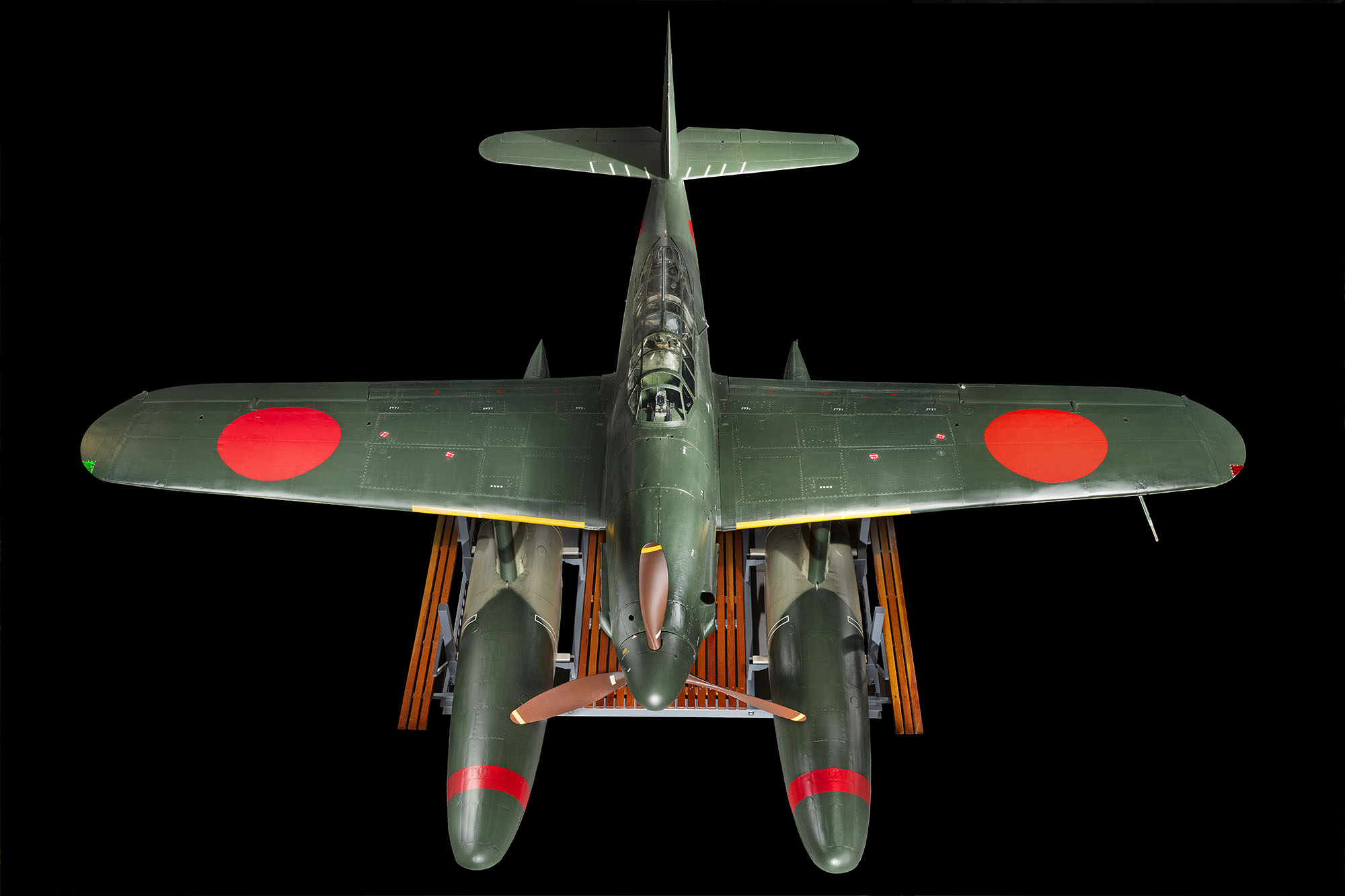
Air Force Museum
Macchi MC.200 Saetta
Developed in the mid-1930s for the Regia Aeronautica (Italian Royal Air Force), the Saetta was one of its principal fighters during World War II. The prototype made its first flight in December 1937, and by Italy's entry into WWII in June 1940, some 156 were in service. A total of 1,151 were produced.
In depth
History & service
The Regia Aeronautica first employed the Saetta against the British on the Mediterranean island of Malta. Italian pilots also flew the MC.200 in Greece, North Africa, Yugoslavia and the Soviet Union. The U.S. Army Air Forces fought against MC.200s in North Africa and over Italy itself.
The MC.200 on display was transferred from the Regia Aeronautica's 372nd Squadron in Italy to the 165th Squadron in North Africa during November 1942, just in time to be abandoned at Banghazi airfield following the battle of El Alamein. It appears that, in the press of circumstances, it remained in its 372nd markings. Captured by British forces, it was subsequently shipped to the United States where it was exhibited around the country to sell war bonds.
Later obtained by the New England Air Museum, in 1989 it was purchased by a private owner who had it restored in Italy by a team from Aermacchi, the original builder, before its acquisition by the museum. It is displayed in the markings of the 372nd Squadron of the Regia Aeronautica that it carried at the time of its capture.
The aircraft in figures
Armament: Two 12.7mm Breda machine guns · Engine: One FIAT A.74 R.C.38 double row, 14-cylinder, air cooled radial engine of 870 hp · Maximum speed: 313 mph · Range: 355 miles · Ceiling: 29,200 ft. · Span: 34 ft. 8 in. · Length: 27 ft. 6 in. · Height: 10 ft. · Weight: 5,275 lbs.
Aircraft change the battlefield
In the First World War, aircraft became valuable because they could see beyond the front line. Reconnaissance and artillery observation affected decisions on the ground. Once that information mattered, opposing forces had reason to attack the aircraft gathering it. Fighters, defensive armament, and increasingly specialized missions developed around this contest over observation and freedom of movement.
The aircraft were fragile by later standards, but their crews worked inside a rapidly expanding military system. Training, maintenance, replacement aircraft, photography, communications, and weather reporting supported each sortie. Improvements in engines and armament changed tactics, while the pressures of combat exposed weaknesses that might have taken much longer to discover in peacetime.
Personal stories should be read alongside those systems. A uniform or a named aircraft connects the war to an individual, but the individual depended on many others and operated under constraints that skill could not eliminate. Aircraft from opposing sides show how designers answered similar problems in different ways. The later military collections in Dayton and at Udvar-Hazy reveal what endured: the need to gather information, protect friendly forces, move people and supplies, and coordinate action across distance. The scale changed enormously; the relationship between an aircraft's design and the job it had to perform remained fundamental.