Air Force Museum
Bataan Death March
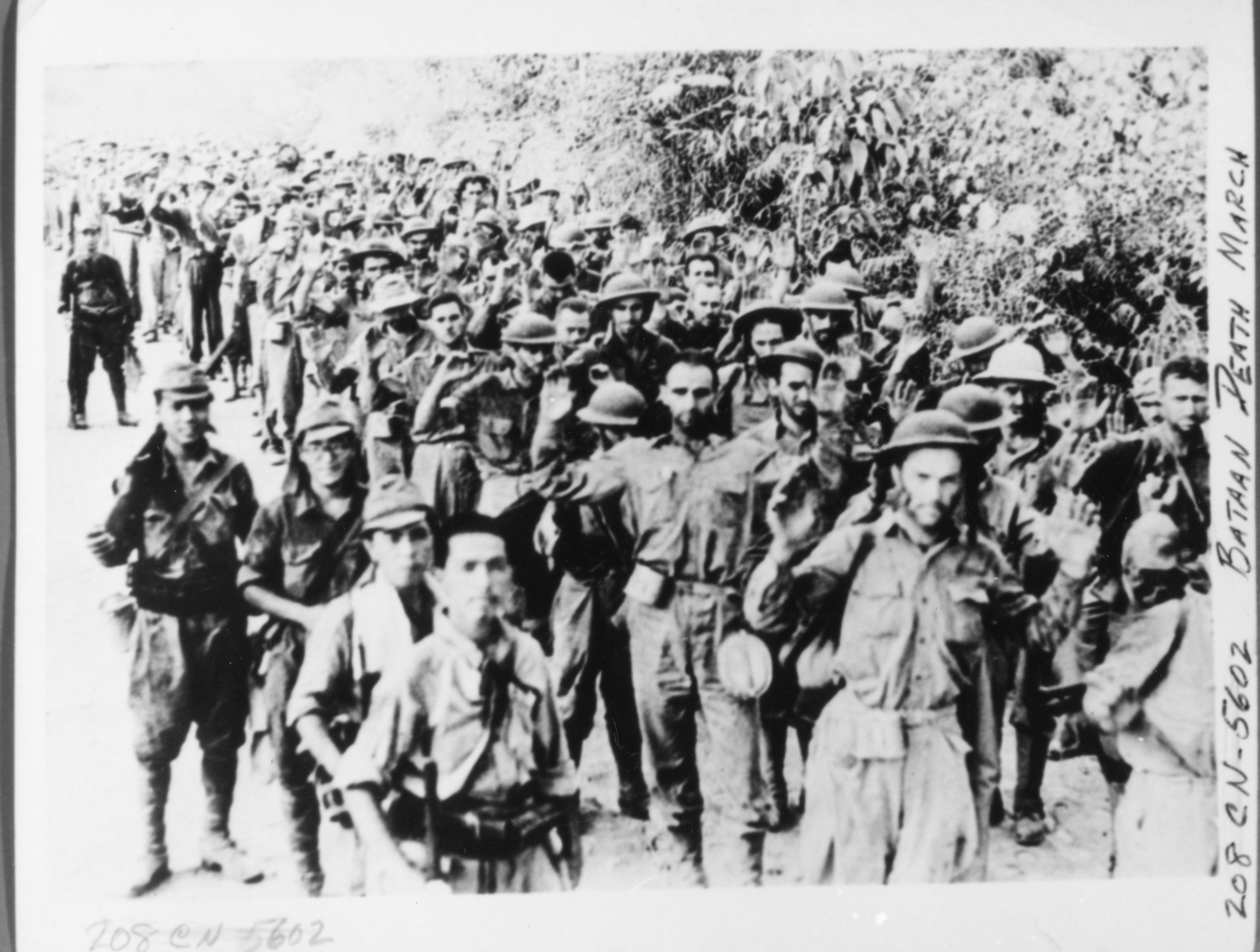
After the surrender of Bataan, Japanese forces compelled tens of thousands of Filipino and American prisoners to march north under brutal conditions. Exhausted by months of combat, hunger, disease, and dwindling supplies, the defenders of Bataan surrendered on April 9, 1942. Japanese guards then forced prisoners along a route of roughly sixty-five miles toward rail transport and prison camps.
In depth
The story behind the display
Exhausted by months of combat, hunger, disease, and dwindling supplies, the defenders of Bataan surrendered on April 9, 1942. Japanese guards then forced prisoners along a route of roughly sixty-five miles toward rail transport and prison camps. Men who could not keep pace faced beatings, shootings, and denial of food, water, and medical care.
Thousands died during the march and its immediate aftermath, with Filipino prisoners suffering the greatest losses. The Bataan Death March is remembered both as a war crime and as part of the wider experience of occupation, captivity, resistance, and survival in the Philippines.
History & service
With few aircraft left, United States Army Air Forces (USAAF) personnel fought as infantry to hold the Bataan Peninsula in the Philippines. Although they suffered from malnourishment and disease, these men battled valiantly until they were ordered by their commander to surrender on April 9, 1942.
Then followed the barbarity of the Bataan Death March, during which their Japanese captors tortured, starved, and killed thousands of US and Filipino prisoners of war (POWs) during the 65-mile forced march. Worse still, the majority of those who survived the march later perished in POW camps or in transit on "hell ships" to Japan.
Details that tell the story
Bataan surrendered on April 9, 1942 · Most prisoners were Filipino soldiers · The march led toward Camp O'Donnell · The experience became evidence in postwar war-crimes proceedings
Aircraft change the battlefield
In the First World War, aircraft became valuable because they could see beyond the front line. Reconnaissance and artillery observation affected decisions on the ground. Once that information mattered, opposing forces had reason to attack the aircraft gathering it. Fighters, defensive armament, and increasingly specialized missions developed around this contest over observation and freedom of movement.
The aircraft were fragile by later standards, but their crews worked inside a rapidly expanding military system. Training, maintenance, replacement aircraft, photography, communications, and weather reporting supported each sortie. Improvements in engines and armament changed tactics, while the pressures of combat exposed weaknesses that might have taken much longer to discover in peacetime.
Personal stories should be read alongside those systems. A uniform or a named aircraft connects the war to an individual, but the individual depended on many others and operated under constraints that skill could not eliminate. Aircraft from opposing sides show how designers answered similar problems in different ways. The later military collections in Dayton and at Udvar-Hazy reveal what endured: the need to gather information, protect friendly forces, move people and supplies, and coordinate action across distance. The scale changed enormously; the relationship between an aircraft's design and the job it had to perform remained fundamental.