Air Force Museum
Evolution of the Air Force Song
In 1938, Liberty magazine sponsored a contest for an enduring Army Air Corps song. A committee selected Robert MacArthur Crawford's composition from hundreds of entries, and Crawford introduced it publicly at the 1939 Cleveland Air Races.
In depth
Identity expressed through music
As the Air Corps became the Army Air Forces and then the independent U.S. Air Force, the song's title and wording changed with the institution. Music can build shared identity, but its history also preserves the names and assumptions of the periods through which it passes.
History & service
In 1938 Liberty magazine sponsored a contest for a spirited, enduring musical composition to become the official Army Air Corps song. Of 757 scores submitted, one written by Mr. Robert Crawford was selected by a committee of Air Corps wives. The song was officially introduced at the Cleveland Air Races on Sept. 2, 1939. Fittingly, Mr. Crawford sang it in its first public rendition.
Mr. Crawford's original title was "What Do You Think of the Air Corps Now?" However, he changed it for the contest to "Nothing'll Stop the Air Corps Now." By the time the song was published in 1939 as "The Army Air Corps," the phrase had been changed again, this time to "Nothing'll Stop the Army Air Corps." With the creation of the separate U.S. Air Force in 1947, the official name became "The U.S. Air Force" and the phrase was changed to "Nothing'll Stop the U.S. Air Force."
The first page of the score that Mr. Crawford submitted to the selection committee in July 1939 was carried to the surface of the moon on July 30, 1971, aboard the Apollo 15 "Falcon" lunar module by Col. David R. Scott and Lt. Col. James B. Irwin. Ironically, at the moment the "Falcon" blasted off the surface of the moon with Col. Scott and Lt. Col. Irwin on board, a rendition of the "Air Force Song" was broadcast to the world by Maj. Alfred W.
Worden Jr., who had a tape recorder aboard the "Endeavor" command module, which was in orbit above the moon. Col. Scott, Lt. Col. Irwin and Maj. Worden comprised the first and only all-Air Force Apollo crew and arranged to take the page of sheet music with them as a tribute to Mr. Crawford and the U.S. Air Force.
Details that tell the story
Contest announced in 1938 · Robert MacArthur Crawford composed the selected song · Publicly introduced September 2, 1939 · Text evolved as the organization changed
A new invention becomes a public world
Before airplanes became routine transport, public demonstrations helped establish what they could do. Exhibition flights, races, and crossings placed fragile machines before crowds, officials, and potential customers. The audience saw courage and spectacle. Behind the spectacle were less visible questions about reliable engines, controllable wings, suitable landing grounds, and how to recover when the weather changed.
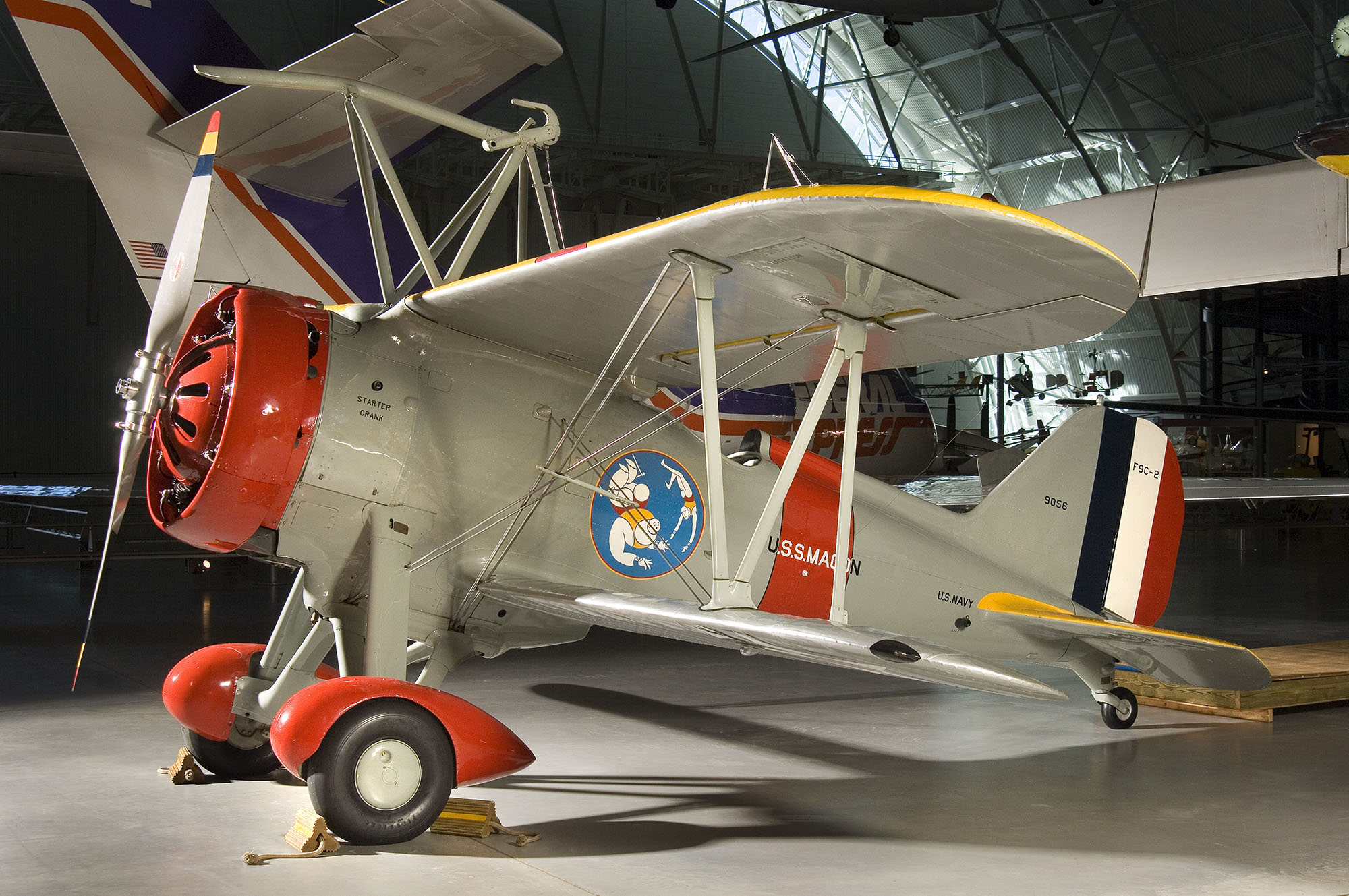
Different configurations competed at the same time. Some designers placed the propeller behind the pilot; others put it at the front. Biplanes used bracing to make light structures sufficiently rigid. Monoplanes reduced some of that external framework but posed their own structural and handling problems. Balloons and dirigibles remained part of the same aviation world, offering capabilities that early airplanes could not simply replace.
The famous firsts matter, but so does the period immediately after them. Flight schools, licensed manufacture, military trials, mechanics, and spare parts carried an invention outward. An aircraft could influence aviation through the pilots trained on it or the designs adapted from it, even after its own performance became outdated. The machines in Washington and Dayton preserve different points along that process. Their differences show how quickly an experimental achievement became an international industry, and how many people had to turn a remarkable flight into a repeatable service.