Udvar-Hazy
Curtiss F9C-2 Sparrowhawk
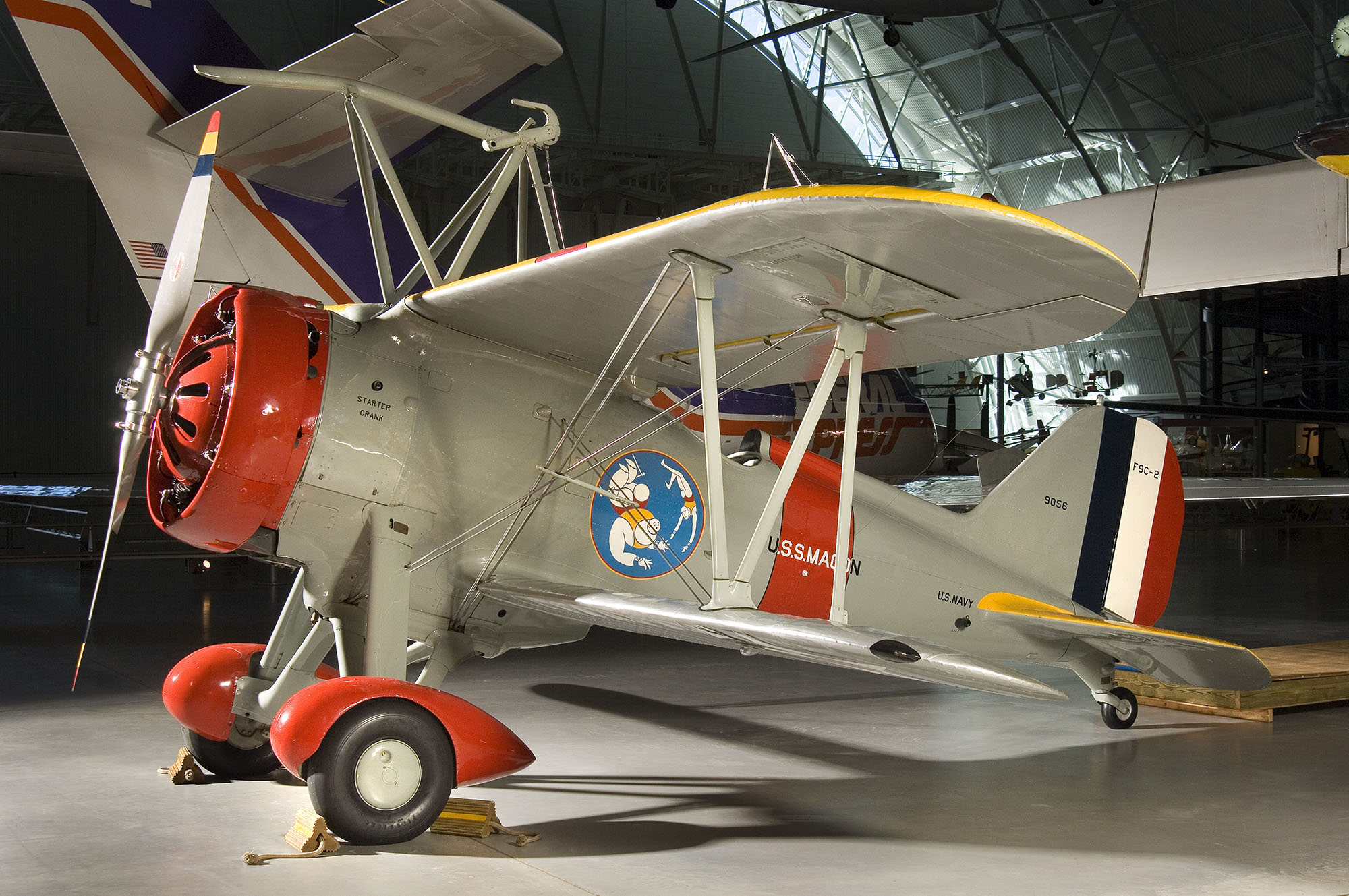
The Sparrowhawk’s aircraft carrier was an airship. A hook above the cockpit let the pilot catch a hanging trapeze beneath USS Akron or USS Macon, then be lifted into an airborne hangar. The small airplane extended the airship’s scouting reach over the ocean. This surviving Sparrowhawk makes the idea real: in the 1930s, U.S. Navy pilots routinely practiced returning to a carrier that was itself flying.
In depth
A scout for the scout
A large airship could remain aloft for long periods and carry observers far over the sea. Small airplanes extended the area it could search. A Sparrowhawk could leave its carrier, investigate a distant direction, and return without requiring the airship to travel the entire route itself.
The Navy operated Sparrowhawks from Akron and Macon between 1932 and 1935. The arrangement treated the airship as a mobile base, complete with a hangar. It was an ambitious attempt to combine the endurance of lighter-than-air flight with the speed and flexibility of an airplane.
Landing without a runway
The hook above the pilot’s head engaged a retractable trapeze. Once attached, the aircraft could be drawn upward into the airship. Launch reversed the sequence: lower the airplane, release it, and fly clear.
The mechanism was straightforward to describe and demanding to use. The pilot had to control relative position between two moving aircraft, rather than merely aim toward a fixed patch of ground. The essential reference was the carrier and its trapeze. That makes the Sparrowhawk a striking early example of the precision required whenever one vehicle docks with another in motion.
Weather ended the experiment
Akron was lost in a storm in 1933, and Macon crashed off California in 1935. Their losses ended the Sparrowhawk’s operational role. The airplane’s success at hooking onto a trapeze could not overcome the vulnerability of the larger system on which it depended.
This survivor served aboard Macon. Its insignia depicts two acrobats, a larger figure representing the airship and a smaller one the airplane. The visual joke captures the seriousness of the operation better than a formal diagram: both partners had to be in the right place, with complete trust in the connection between them.