Air Force Museum
Brig. Gen. William 'Billy' Mitchell
Billy Mitchell commanded American air forces in France and became the most forceful interwar advocate for military aviation. He argued that aircraft could strike ships, cities, and enemy forces independently and that air power required stronger organization and funding.
In depth
Evidence, advocacy, and institutional conflict
Bombing demonstrations against captured warships gave his campaign public visibility, although their conditions and conclusions were disputed. Mitchell's public criticism of military leadership led to a 1925 court-martial.
History & service
William "Billy" Mitchell became an untiring advocate for air power between the two world wars. His name remains synonymous with military aviation during the 1920s.
The son of a wealthy United States senator from Wisconsin, Mitchell was born in Nice, France, on Dec. 29, 1879, while his parents were on vacation. He grew up in Milwaukee and attended Racine College and Columbian University (now The George Washington University in Washington, D.C.). Before graduation, however, he enlisted in the 1st Wisconsin Infantry in 1899 as a private to fight in the Spanish American War.
Because of his father's status, Mitchell quickly received a comission, but the war ended before he could get into the fight. Nevertheless, he stayed in the U.S. Army Signal Corps and served in Cuba and the Philippines during the Philippine Insurrection. Sent to Alaska in 1901, Mitchell distinguished himself by successfully laying a telegraph line through some of the most remote parts of that territory.
While stationed in Alaska, Mitchell studied Otto Lilienthal's glider experiments, and he wrote an article in 1906 predicting that wars would soon be fought in the air and under the sea.
After attending the Army Staff College, Mitchell became the only Signal Corps officer on the Army General Staff in 1913. Since Army aviation was assigned to the Signal Corps, Mitchell became familiar with the early military aviators. Made the deputy commander of the aviation section in 1916, he took private flying lessons at the age of 38.
With the growing possibility of war, Mitchell went to France to study the production of military aircraft, and he arrived just after the United States declared war on Germany in April 1917. Mitchell met with many Allied air commanders, but Sir Hugh Trenchard, the Royal Air Force commander who advocated using independent air power as an offensive weapon, had the greatest impact.
Promoted to brigadier general and put in command of all American aerial combat units in France, Mitchell put Trenchard's ideas into practice during the battle of St. Mihiel in September 1918. Commanding 1,481 American and Allied airplanes, Mitchell won complete aerial superiority and devastated German ground forces.
For his wartime efforts, Mitchell received the Distinguished Service Cross, the Distinguished Service Medal and several foreign decorations, but his brash methods and unwillingness to work within the chain of command had alienated his superiors.
After the Armistice, Mitchell returned to the United States expecting to command the Army Air Service, but instead, he became the deputy chief under Maj. Gen. Charles Menoher. Nevertheless, Mitchell steadfastly advocated the creation of an independent air force, and he promoted the small Army Air Service with border patrols, forest fire patrols, aerial mapping missions and any other activity that demonstrated the value of aviation.
Details that tell the story
Served as a senior American air commander in World War I · Advocated an independent and stronger air arm · Promoted bombing demonstrations against ships · Court-martialed in 1925 after public accusations against military leadership
A new invention becomes a public world
Before airplanes became routine transport, public demonstrations helped establish what they could do. Exhibition flights, races, and crossings placed fragile machines before crowds, officials, and potential customers. The audience saw courage and spectacle. Behind the spectacle were less visible questions about reliable engines, controllable wings, suitable landing grounds, and how to recover when the weather changed.
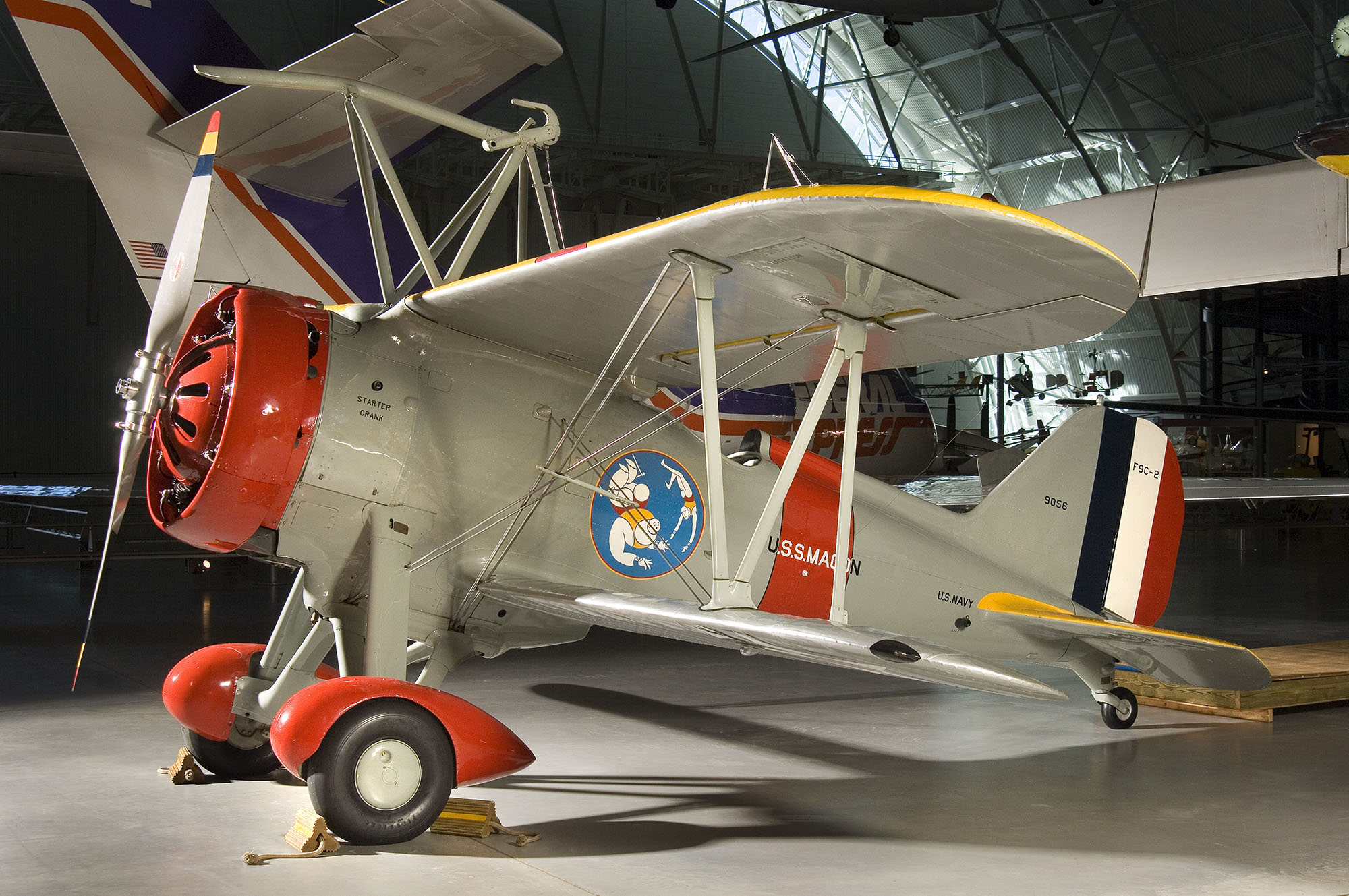
Different configurations competed at the same time. Some designers placed the propeller behind the pilot; others put it at the front. Biplanes used bracing to make light structures sufficiently rigid. Monoplanes reduced some of that external framework but posed their own structural and handling problems. Balloons and dirigibles remained part of the same aviation world, offering capabilities that early airplanes could not simply replace.
The famous firsts matter, but so does the period immediately after them. Flight schools, licensed manufacture, military trials, mechanics, and spare parts carried an invention outward. An aircraft could influence aviation through the pilots trained on it or the designs adapted from it, even after its own performance became outdated. The machines in Washington and Dayton preserve different points along that process. Their differences show how quickly an experimental achievement became an international industry, and how many people had to turn a remarkable flight into a repeatable service.