Air Force Museum
Boeing P-12E
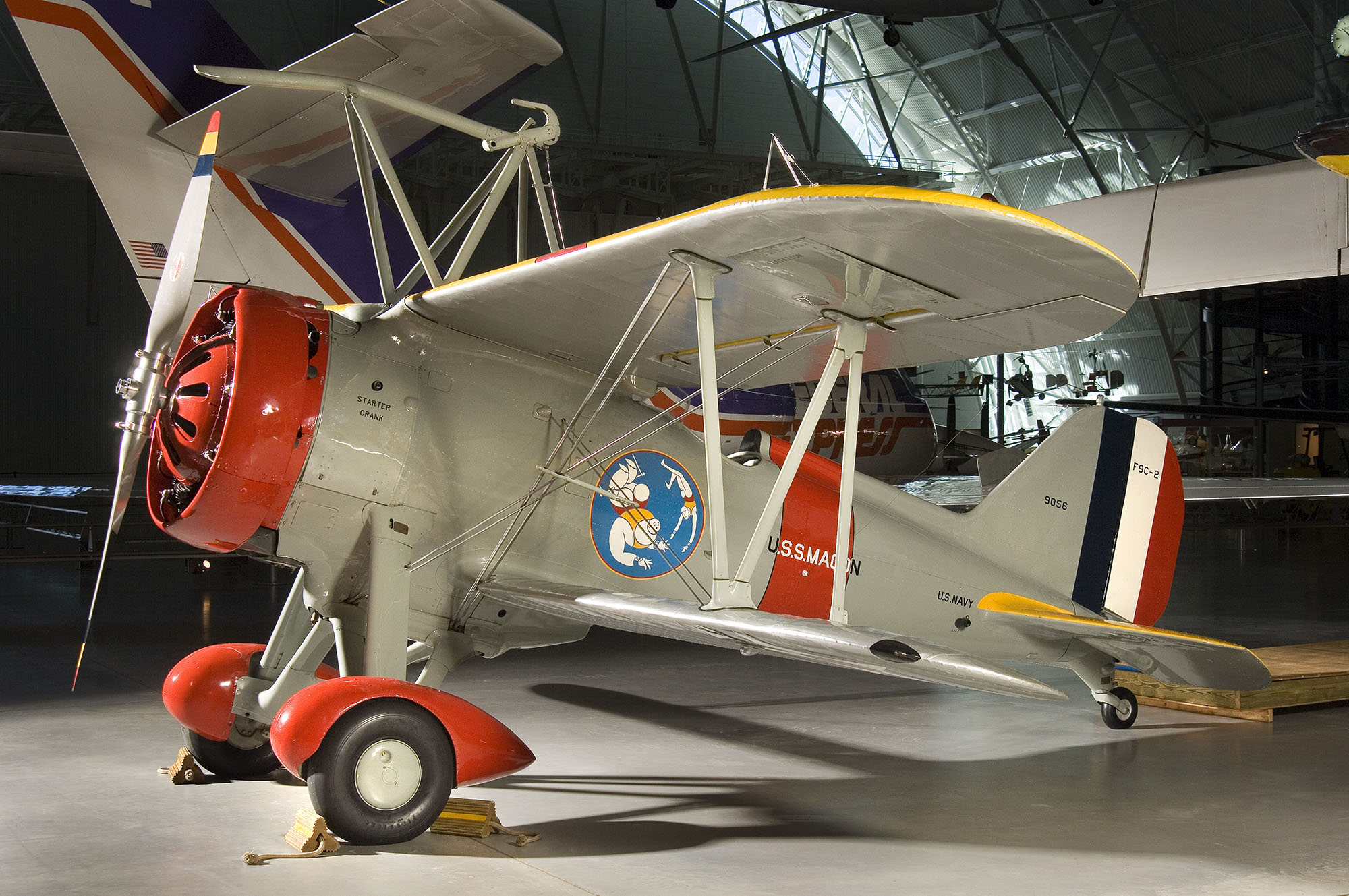
The P-12E represents a highly developed biplane fighter at the moment when all-metal monoplanes were beginning to transform military aviation. The P-12E and P-26A show that technological transitions are not instant replacements. Training, maintenance, production capacity, doctrine, and risk all shape adoption.
In depth
History & service
The P-12 was the US Army’s last biplane fighter. Developed by the Boeing Airplane Company in the late 1920s, the P-12 served the United States’ Army Air Corps, Navy, and Marine Corps as a highly maneuverable pursuit plane and trainer in the 1930s. The P-12 evolved through five models (B through F) with the E and F models having an all-metal fuselage. Boeing built 366 P-12s, roughly a third of which were P-12Es. All variants of the aircraft retained wooden wings.
Founded by pioneering Black pilot and flying enthusiast Cornelius Coffey, the Coffey School of Aeronautics trained aspiring Black aviators who were otherwise denied the opportunity to fly due to their race. The school supported the US Government’s wartime Civilian Pilot Training Program’s goal of increasing military readiness and contributed to Chicago’s prominence in Black aviation history.
Details that tell the story
Biplane fighter of the early 1930s · P-12E introduced a metal fuselage to the series · Fixed landing gear and open cockpit reflected the period · Rapid monoplane development soon made the type obsolete
The aircraft in figures
Armament: Two .30-cal. or one .30-cal. and one .50-cal. machine guns; 244 lbs. of bombs carried externally · Engine: Pratt & Whitney R-1340-17 of 500 hp · Maximum speed: 189 mph · Range: 570 miles
A new invention becomes a public world
Before airplanes became routine transport, public demonstrations helped establish what they could do. Exhibition flights, races, and crossings placed fragile machines before crowds, officials, and potential customers. The audience saw courage and spectacle. Behind the spectacle were less visible questions about reliable engines, controllable wings, suitable landing grounds, and how to recover when the weather changed.
Different configurations competed at the same time. Some designers placed the propeller behind the pilot; others put it at the front. Biplanes used bracing to make light structures sufficiently rigid. Monoplanes reduced some of that external framework but posed their own structural and handling problems. Balloons and dirigibles remained part of the same aviation world, offering capabilities that early airplanes could not simply replace.
The famous firsts matter, but so does the period immediately after them. Flight schools, licensed manufacture, military trials, mechanics, and spare parts carried an invention outward. An aircraft could influence aviation through the pilots trained on it or the designs adapted from it, even after its own performance became outdated. The machines in Washington and Dayton preserve different points along that process. Their differences show how quickly an experimental achievement became an international industry, and how many people had to turn a remarkable flight into a repeatable service.