Air Force Museum
About the Caproni Airplane
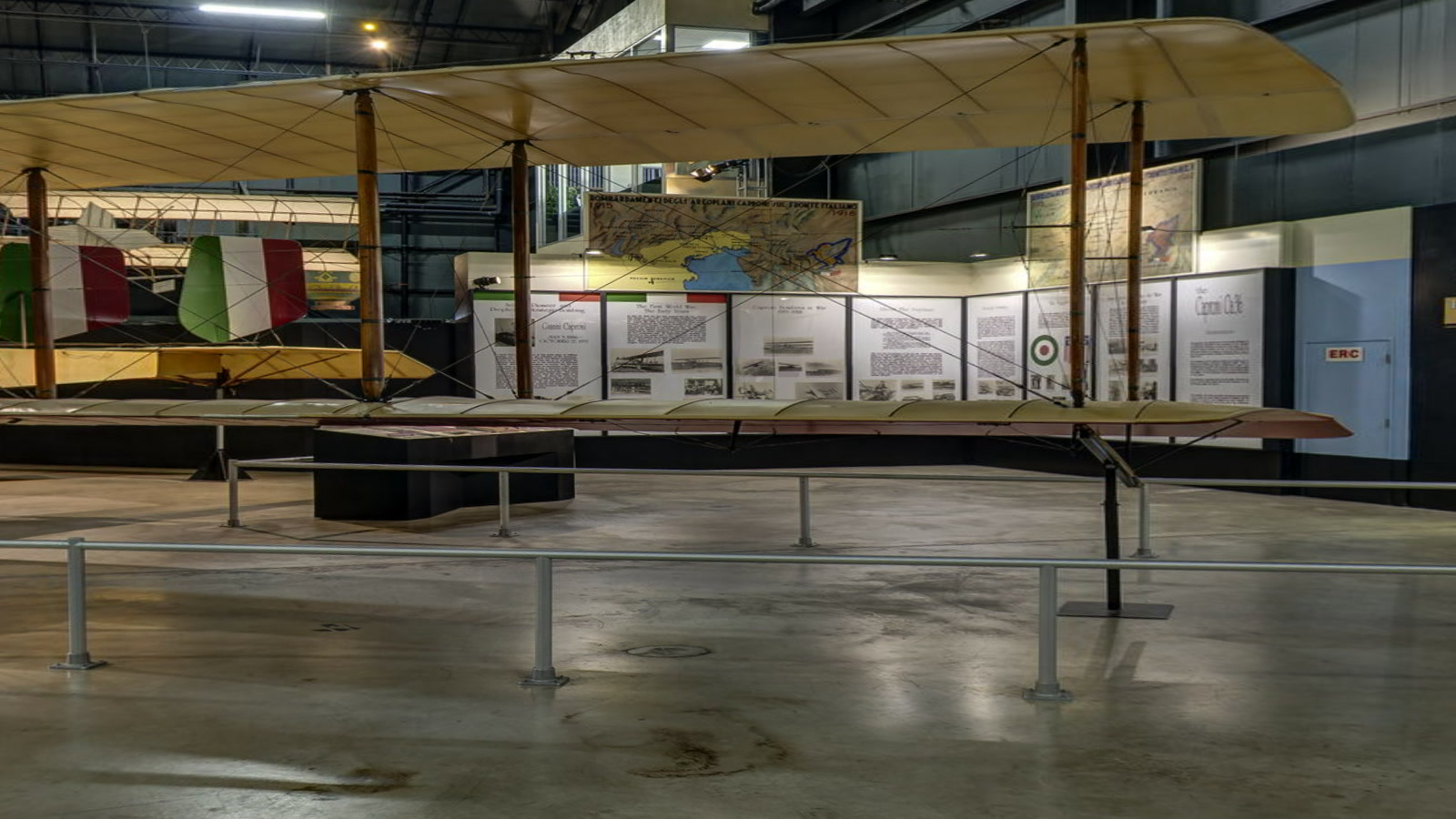
The Caproni placed a tractor engine at the front of each tail boom and a pusher engine behind the central nacelle. That arrangement distributed power without requiring one enormous engine and left the central structure available for crew and payload.
In depth
Designing a multi-engine bomber
The layout also multiplied maintenance and coordination demands. Three engines meant more controls, fuel lines, cooling, vibration, and failure possibilities. Twin booms and extensive bracing carried loads through a structure whose strength depended on careful rigging.
History & service
If it is not desired to make great speed, it is well to stop one engine (preferably the rear one) and proceed on two engines. Thus there will be a slight decrease in speed, but a large saving in fuel.
In this latter case, the speed of the machine as read on the relative speed indicator should be that of the climbing speed.
The stopping of a lateral engine, or the difference in traction due to poor working of an engine, can be corrected by the vertical rudder alone."
1917 saw the introduction of the Ca. 33, which was essentially a Ca. 32 re-engined with 150-hp Isotta Fraschini engines -- they improved both climb and airspeed. Moreover, the I-F engines were generally more reliable than the 100-hp FIAT engines they replaced. It was the Ca. 33 and its subtype, the Ca. 36, which provided the backbone of the Italian bombing efforts for the remainder of the war.
Other more powerful Caproni-designed bombers were produced during the 1917-1918 period, including a massive triplane, and a 600-hp enlargement of the Ca. 33, but none of these really exceeded the combination of load, range and reliability that were characteristic of the earlier aircraft.
Details that tell the story
Two tractor engines and one pusher engine · Central crew nacelle · Twin tail booms · Extensive wire bracing carried structural loads
A new invention becomes a public world
Before airplanes became routine transport, public demonstrations helped establish what they could do. Exhibition flights, races, and crossings placed fragile machines before crowds, officials, and potential customers. The audience saw courage and spectacle. Behind the spectacle were less visible questions about reliable engines, controllable wings, suitable landing grounds, and how to recover when the weather changed.
Different configurations competed at the same time. Some designers placed the propeller behind the pilot; others put it at the front. Biplanes used bracing to make light structures sufficiently rigid. Monoplanes reduced some of that external framework but posed their own structural and handling problems. Balloons and dirigibles remained part of the same aviation world, offering capabilities that early airplanes could not simply replace.
The famous firsts matter, but so does the period immediately after them. Flight schools, licensed manufacture, military trials, mechanics, and spare parts carried an invention outward. An aircraft could influence aviation through the pilots trained on it or the designs adapted from it, even after its own performance became outdated. The machines in Washington and Dayton preserve different points along that process. Their differences show how quickly an experimental achievement became an international industry, and how many people had to turn a remarkable flight into a repeatable service.