Air Force Museum
De Havilland DH-4
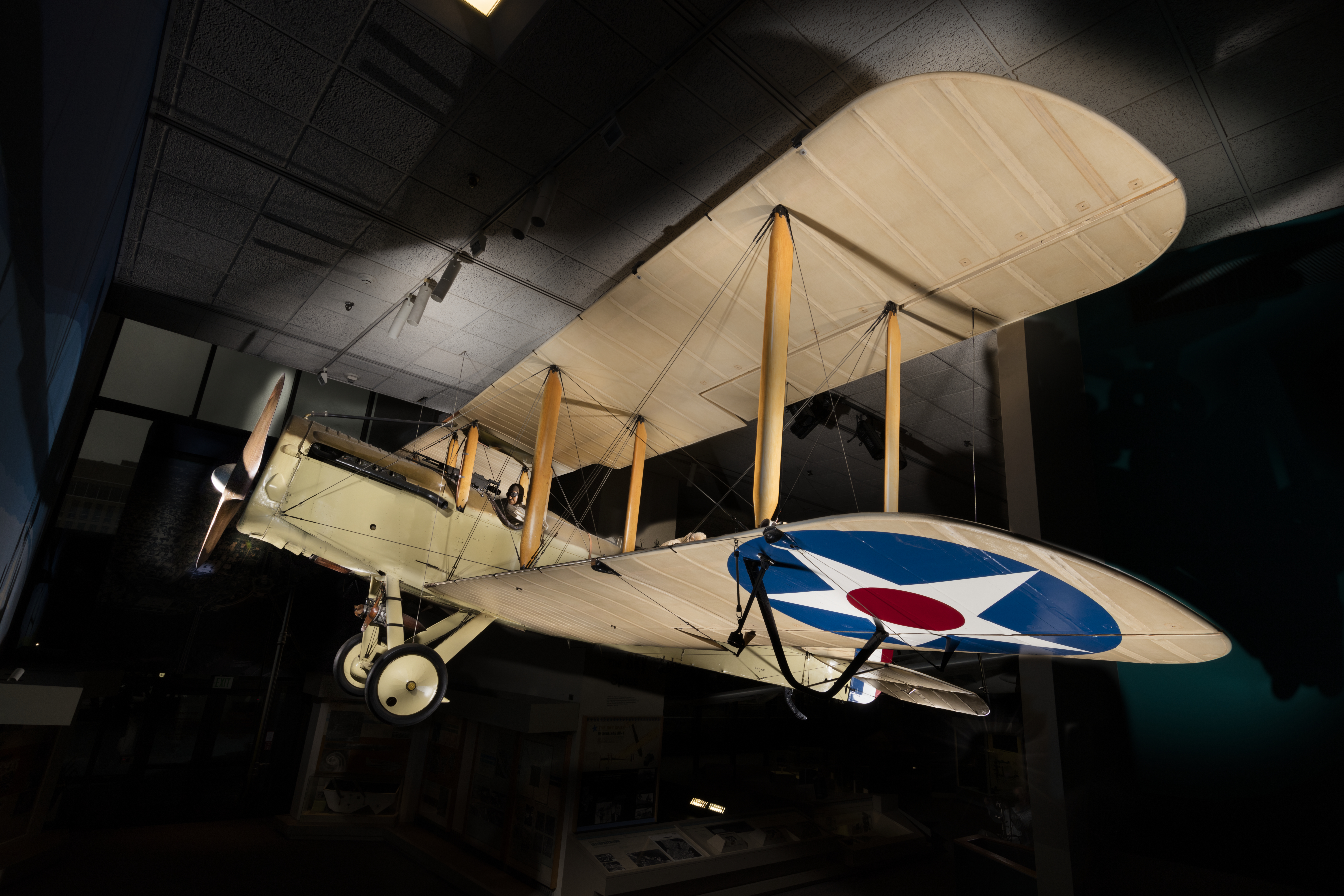
The British-designed DH-4 was the only American-built aircraft type to see combat with the U.S. Army Air Service during World War I. American production paired the design with the Liberty engine and sent it to France for observation and bombing.
In depth
One airframe, many missions
After the war, limited budgets kept modified DH-4s in service for reconnaissance, mapping, border patrol, air mail support, experiments, and record flights. That long career shows how maintenance and adaptation can extend a machine far beyond the conflict for which it was built.
History & service
The DH-4 was an ever-present element of the U.S. Army Air Service during and after World War I. When the United States entered WWI in April 1917, the Aviation Section of the Signal Corps only had 132 aircraft, all obsolete. Modeled from a combat-tested British De Havilland design, the DH-4 was the only U.S. built aircraft to see combat during World War I. With inadequate funding to buy new aircraft, the newly created U.S.
Army Air Service continued to use the DH-4 in a number of roles during the lean years following the war. By the time it was finally retired from service in 1932, the DH-4 had been developed into over 60 variants.
During World War I, the Air Service used the DH-4 primarily for daytime bombing, observation and artillery spotting. The first American-built DH-4 arrived in France in May 1918, and the 135th Aero Squadron flew the first DH-4 combat mission in early August. By war's end, 1,213 DH-4s had been delivered to France.
Unfortunately, the early DH-4s had drawbacks, including the fuel system. The pressurized gas tank had a tendency to explode and a rubber fuel line under the exhaust manifold caused some fires. These problems led to the title of "The Flaming Coffin," even though only eight of the 33 DH-4s lost in combat by the U.S burned as they fell. In addition, the location of the gas tank between the pilot and observer limited communication and could crush the pilot in an accident.
Perhaps the most notable mission flown in the DH-4 was the brave attempt by 1st Lt. Harold Goettler and 2nd Lt. Erwin Bleckley of the 50th Aero Squadron to find and assist the famed "Lost Battalion" on Oct. 6, 1918. During a resupply mission to this surrounded unit, their DH-4 was shot down. Both men posthumously received the Medal of Honor.
Of the three U.S. companies that built the DH-4 during World War I, the largest producer was the Dayton-Wright Company of Dayton, Ohio. The Air Service ordered over 12,000 DH-4s, but a number of problems kept initial production figures low and construction quality poor.
The many changes involved in converting the design to American production standards, along with the use of the American Liberty 12-cylinder engine rather than the Rolls Royce engine of the British model, contributed to early production delays.
As the months of 1918 passed, however, quantity and quality improved considerably. By the end of the war, Dayton-Wright delivered 3,106 DH-4s, while the Fisher Body Division of General Motors built 1,600 and the Standard Aircraft Corporation added another 140, bringing the total to 4,846. The remaining 7,500 DH-4s still on order were cancelled.
With few funds to buy new aircraft in the years following WWI, the Air Service used the DH-4 in a variety of roles, such as transport, air ambulance, photographic plane, trainer, target tug, forest fire patroller, and even as an air racer. In addition, the U.S. Post Office operated the DH-4 as a mail carrier.
Details that tell the story
British design produced in the United States · Only American-built aircraft type to see U.S. combat service in World War I · Powered in U.S. service by the Liberty engine · Remained in military use until 1932
The aircraft in figures
Crew: Two (pilot and observer/gunner) · Armament: Two .30-cal. Marlin machine guns in the nose and two .30-cal. Lewis machine guns in the rear; 322 lbs. of bombs · Engine: 400-hp Liberty 12 · Maximum speed: 128 mph · Range: 400 miles · Ceiling: 19,600 ft. · Weight: 3,557 lbs. loaded
A new invention becomes a public world
Before airplanes became routine transport, public demonstrations helped establish what they could do. Exhibition flights, races, and crossings placed fragile machines before crowds, officials, and potential customers. The audience saw courage and spectacle. Behind the spectacle were less visible questions about reliable engines, controllable wings, suitable landing grounds, and how to recover when the weather changed.
Different configurations competed at the same time. Some designers placed the propeller behind the pilot; others put it at the front. Biplanes used bracing to make light structures sufficiently rigid. Monoplanes reduced some of that external framework but posed their own structural and handling problems. Balloons and dirigibles remained part of the same aviation world, offering capabilities that early airplanes could not simply replace.
The famous firsts matter, but so does the period immediately after them. Flight schools, licensed manufacture, military trials, mechanics, and spare parts carried an invention outward. An aircraft could influence aviation through the pilots trained on it or the designs adapted from it, even after its own performance became outdated. The machines in Washington and Dayton preserve different points along that process. Their differences show how quickly an experimental achievement became an international industry, and how many people had to turn a remarkable flight into a repeatable service.