Air Force Museum
Gnome N-9
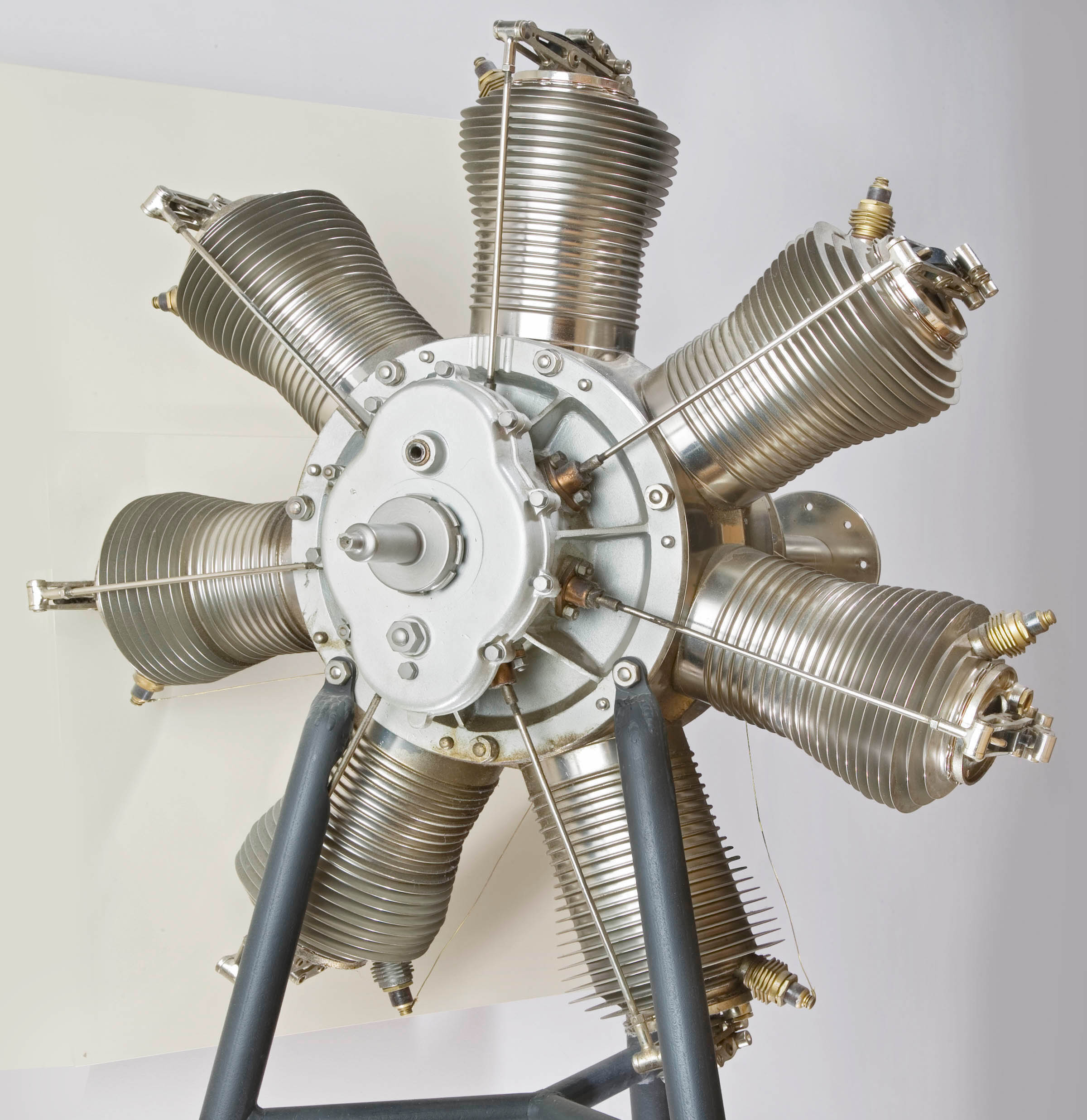
In a Gnome rotary engine, the crankshaft remains fixed while the cylinders and propeller rotate together around it. The spinning cylinders receive cooling air, and the design delivered useful power at a low weight when early aircraft could carry very little.
In depth
A lightweight solution with unusual tradeoffs
Rotary engines also consumed oil, complicated throttle control, and created strong gyroscopic forces that affected turning. Their success shows how an engineering solution can dominate for a time because it matches the immediate problem—even if later engines replace it.
History & service
The French Gnome engine was one of the most important designs in early aviation, and a main source of aircraft power for the Allies in World War I. First appearing 1909, this engine type was developed into several models and used throughout the war. The 9-cylinder model on display at the museum is typical of the Gnome design.
The Gnome was a rotary type, meaning the engine and propeller were bolted together, and both rotated around a fixed shaft. Air passing over the hot cylinders cooled the spinning engine. Gnome Monosoupape (single valve) engines like the one on display had one valve per cylinder acting as both air inlet and exhaust. Fuel was mixed with air not in a carburetor, but in the hollow central shaft, where the fuel-air mixture entered each cylinder at its base.
Gnome engines were reliable and powerful for their weight, but had certain drawbacks. First, the gyroscopic effect of the heavy, spinning engine made quick left turns easy, but hard right turns were difficult. Second, the motor used a large amount of fuel and lubricating castor oil, and some of the unburned oil was thrown from the spinning engine, making life unpleasant for pilot a few feet behind it.
A cowling around the engine directed most of this under the aircraft, but thick, greasy fumes and oil inevitably coated the pilot. Castor oil was used because it burns cleanly, but pilots joked about its well-known laxative effect.
Gnome engines were built with great craftsmanship, and all their parts were finely machined to very close tolerances. The cutaway 165-hp Gnome N-9 on display shows how the design worked. The engine had no throttle so pilots used a "blip switch" on the control stick to adjust power when landing -- turning the engine on and off to maintain the right speed -- though some adjustment was possible by restricting air and fuel flow.
Clerget and Bentley rotaries featured a selector switch for using 9, 7, 5 or 3 cylinders to adjust power.
Gnomes powered many aircraft, including Nieuports, Moranes and Sopwiths. Rotary engines, however, fell out of favor after the war. More fuel-efficient in-line and non-rotating radial engines did not have the rotaries' gyroscopic problem, they produced less drag, and their fixed cylinders could be made larger and more powerful than rotating ones. Faster, heavier aircraft with greater range had advanced beyond the rotary's capabilities.
Details that tell the story
Nine-cylinder rotary engine · Engine and propeller rotate around a fixed shaft · Airflow cools the exposed cylinders · Rotary mass affected aircraft handling
A new invention becomes a public world
Before airplanes became routine transport, public demonstrations helped establish what they could do. Exhibition flights, races, and crossings placed fragile machines before crowds, officials, and potential customers. The audience saw courage and spectacle. Behind the spectacle were less visible questions about reliable engines, controllable wings, suitable landing grounds, and how to recover when the weather changed.
Different configurations competed at the same time. Some designers placed the propeller behind the pilot; others put it at the front. Biplanes used bracing to make light structures sufficiently rigid. Monoplanes reduced some of that external framework but posed their own structural and handling problems. Balloons and dirigibles remained part of the same aviation world, offering capabilities that early airplanes could not simply replace.
The famous firsts matter, but so does the period immediately after them. Flight schools, licensed manufacture, military trials, mechanics, and spare parts carried an invention outward. An aircraft could influence aviation through the pilots trained on it or the designs adapted from it, even after its own performance became outdated. The machines in Washington and Dayton preserve different points along that process. Their differences show how quickly an experimental achievement became an international industry, and how many people had to turn a remarkable flight into a repeatable service.