Udvar-Hazy
Sikorsky JRS-1
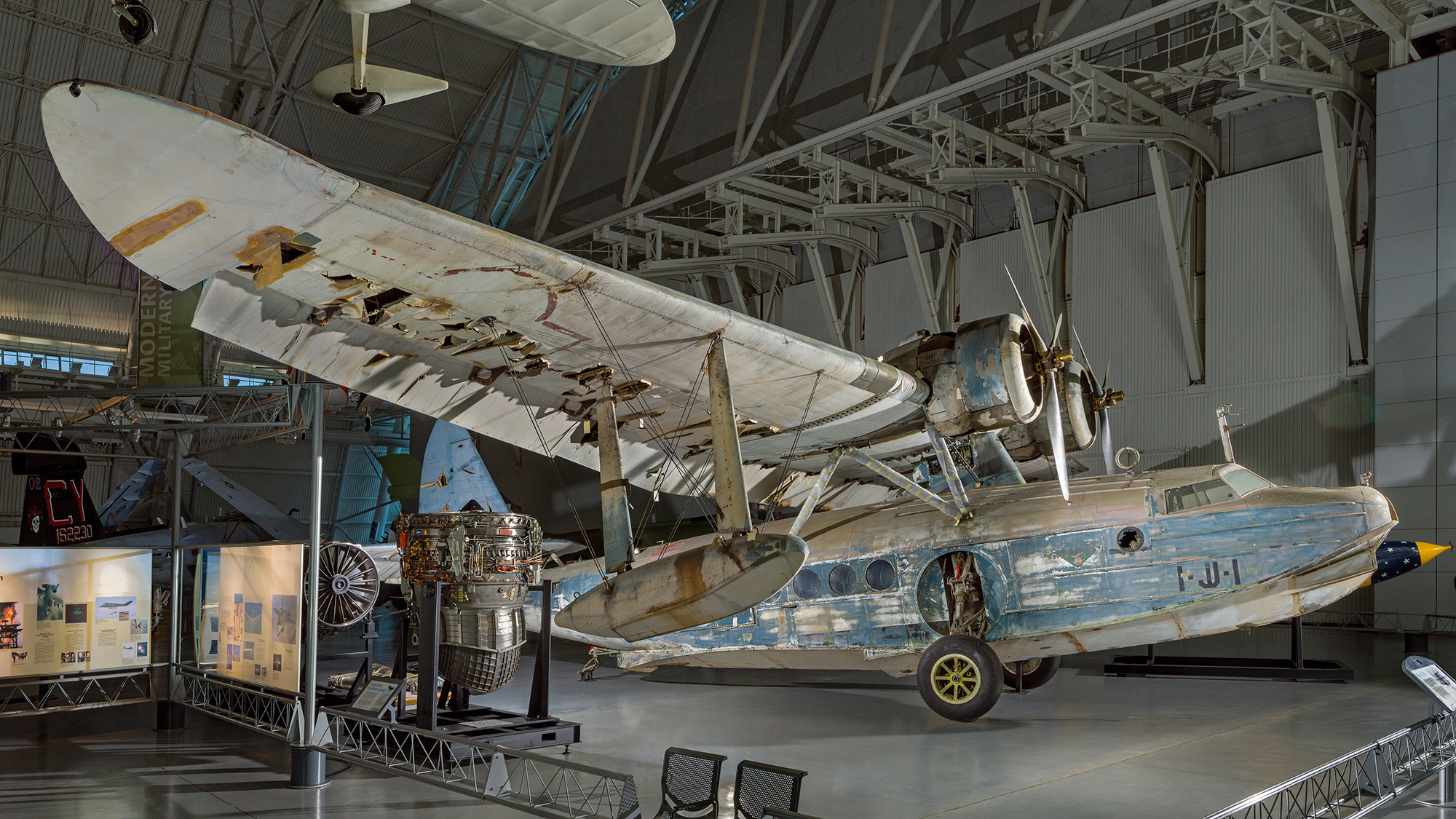
This JRS-1 was at Pearl Harbor when the Japanese attacked on December 7, 1941. After surviving the attack, aircraft of its unit were sent out to search for the enemy fleet, despite being utility amphibians rather than combat aircraft. Its weathered surfaces preserve traces of earlier paint and a long life afterward. The JRS-1 carries an unusually direct connection to one of the defining days in American history.
In depth
A civilian idea in naval service
The JRS-1 was the Navy version of Sikorsky’s S-43, known as the Baby Clipper. Its amphibious configuration allowed it to operate from water or a runway, making it useful for transport and utility work in places where access mattered more than combat performance.
That ordinary usefulness placed it in Hawaii before the United States entered World War II. The museum aircraft was one of the JRS-1s assigned to the naval base when the attack began. It is the museum’s only aircraft that was present at Pearl Harbor on that day.
Searching after the attack
The Navy dispatched surviving utility amphibians to search for the Japanese force. These were not aircraft designed to fight enemy carrier aviation. Their crews faced the possibility of encountering a far more capable opponent while trying to obtain information urgently needed by their command.
The museum’s account of Lieutenant Junior Grade Wes Ruth describes one such search with only Springfield rifles available as armament. Ruth received recognition for undertaking the mission despite the danger. That account concerns the unit’s response and should not be treated as proof that every surviving airframe flew the same sortie.
Paint as a witness
Before the attack, the aircraft wore a colorful scheme including silver, black, green, and red. Crews applied blue paint afterward. Weathering and years of outdoor storage later exposed traces of earlier finishes.
Those surfaces can look less impressive than a freshly restored aircraft, yet they contain historical information. Conservators must decide how to preserve that evidence while stabilizing the object. A new-looking finish would not automatically tell a more truthful story.
Service without a fighter’s glamour
The JRS-1 invites attention to crews who used the machines available to them in an emergency. Its significance is not a record speed or a formidable weapon load. It is a surviving connection to duty performed under conditions for which a utility airplane had never been intended. In the panorama, its hull and wing-mounted engines still reveal the practical transport beneath the extraordinary history.