Udvar-Hazy
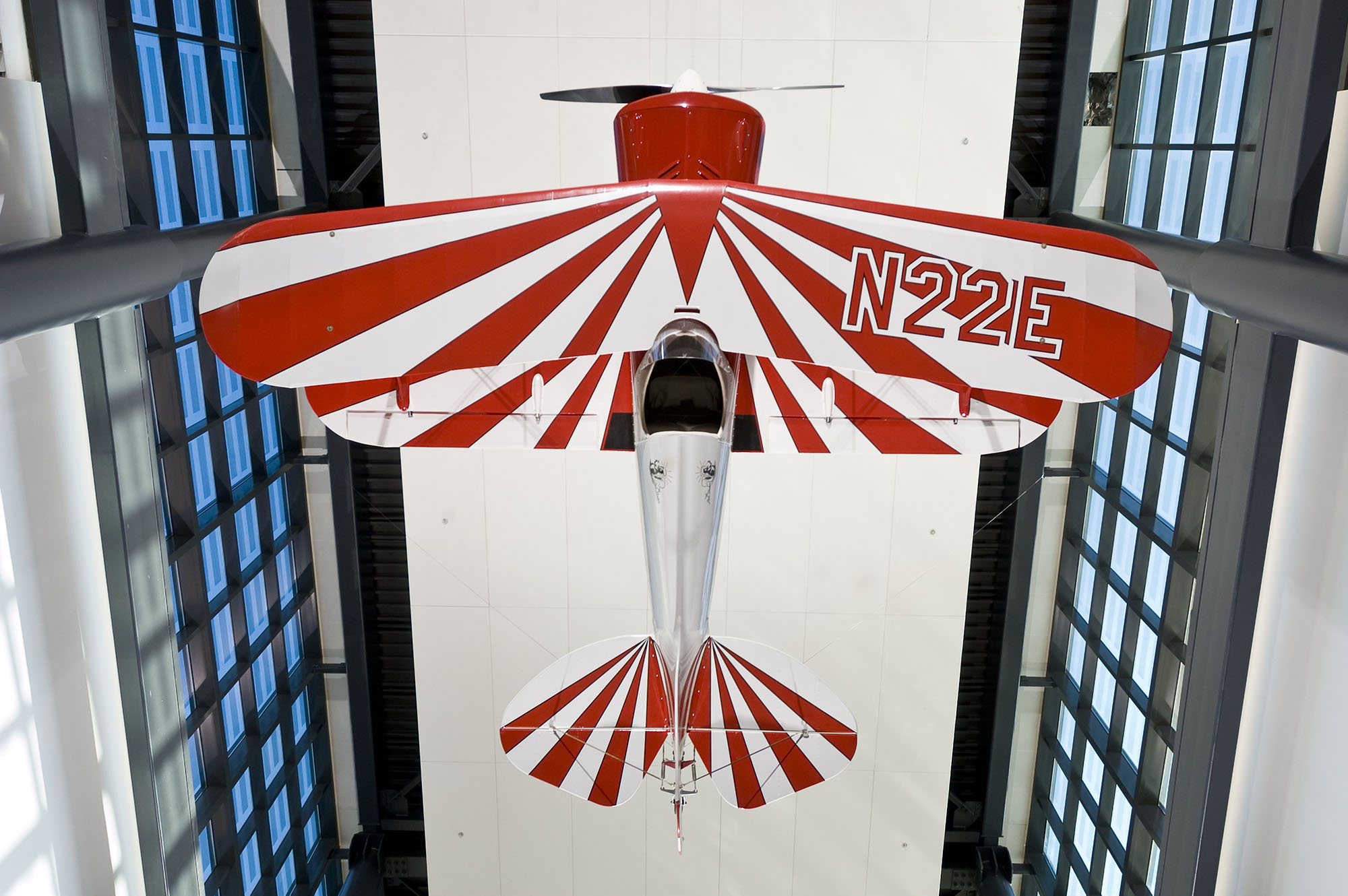
Pitts Special S-1C Little Stinker
Betty Skelton and Little Stinker helped make aerobatic flying unforgettable. She bought this tiny Pitts in 1948 and won major championships in it in 1949 and 1950. Its short wings and light structure made it exceptionally agile, but the performance depended on her precision and confidence. Suspended here, the aircraft invites a closer look at a partnership that helped establish both a remarkable pilot and one of aviation’s most influential aerobatic designs.
In depth
The airplane that put the Pitts in the spotlight
Little Stinker was the second Pitts Special built and is the oldest surviving example. Curtis Pitts’s design concentrated an aerobatic airplane into a very small package. Short wings, light weight, and responsive controls offered the agility that competition pilots sought.
Betty Skelton bought the aircraft in 1948. Her victories in the 1949 and 1950 International Feminine Aerobatic Championships brought attention to both her skill and the design. At a time when women faced substantial barriers in aviation, her public performances made exceptional ability difficult to overlook.
A memorable airplane needs a memorable pilot
Skelton understood the public side of aviation as well as the technical one. A recognizable name, a distinctive small aircraft, and a confident performance could make a lasting impression on people watching from the ground.
Among her best-known feats was an inverted ribbon cut, in which the airplane flew upside down and severed a ribbon held above the ground. The museum identifies her as the first woman to perform the maneuver. Her performance made a compact homegrown design famous far beyond the circle of pilots who already knew its potential.
Small dimensions, large demands
An airplane’s resistance to changes in rotation depends partly on how its mass is distributed. A compact aircraft can respond quickly, making the Pitts well suited to sharp, accurate maneuvers. That responsiveness also puts responsibility on the pilot to make deliberate inputs and maintain awareness of speed, attitude, and load.
Look closely at the relationship between the cockpit, engine, and short wings. There is little aircraft beyond what the task requires. The design’s efficiency is not primarily about carrying passengers or crossing oceans; it is about giving one pilot precise control over a demanding sequence of movements.
A second reunion and a lasting influence
Skelton sold Little Stinker in 1951. She and her husband later reacquired it and donated it to the Smithsonian. A volunteer team restored the aircraft between 1996 and 2001, adding another chapter of skilled work to its history.
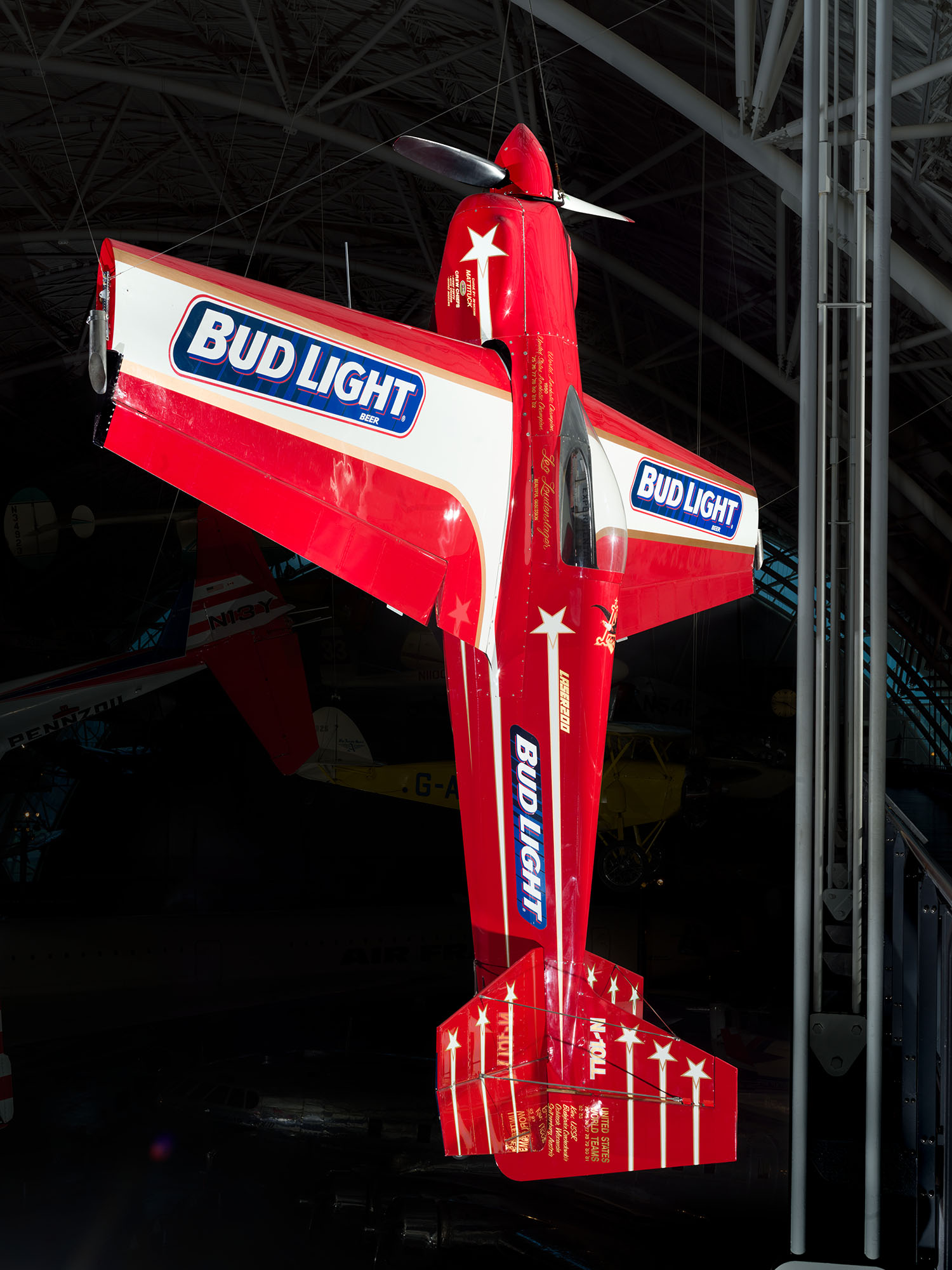
Later Pitts models became important in competition and advanced aerobatic training. Little Stinker lets a visitor stand near the beginning of that lineage. Compare it with the Laser 200 to see how different generations pursued the same ambition: translate a pilot’s intention into exact motion through the sky. Skelton’s story gives that ambition a human face.