Air Force Museum
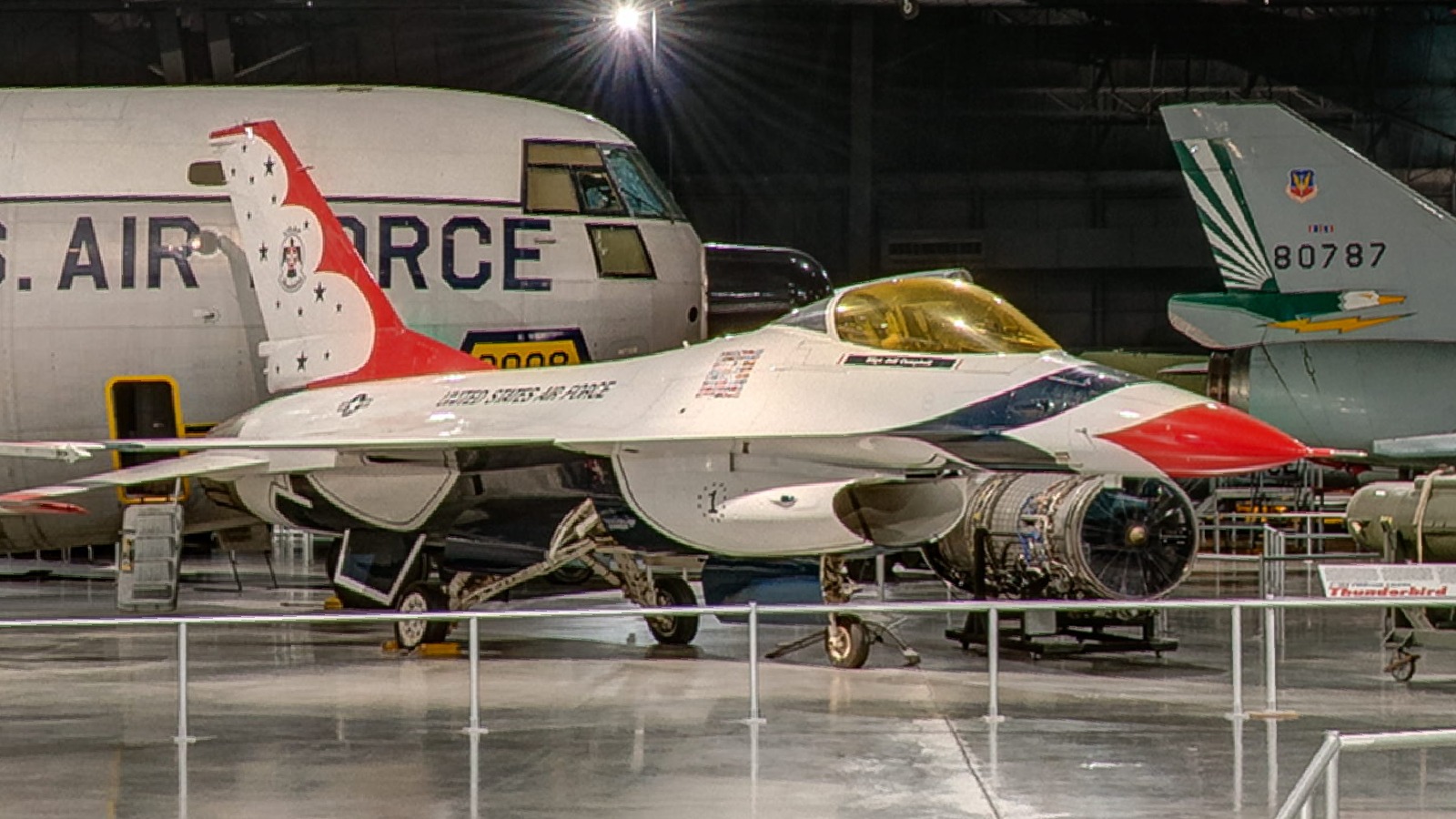
F-16A Fighting Falcon
The F-16A paired a lightweight airframe with fly-by-wire controls, excellent visibility, and strong acceleration. Initially conceived as an agile day fighter, it grew into a multirole aircraft used by the United States and many allied air forces. Its longevity reflects both adaptable design and continuous improvements to sensors and weapons.
In depth
History & service
The F-16 on display (S/N 81-0663) was one of the first F-16s to be received by the Thunderbirds in 1982 when they transitioned from T-38s to F-16s. The Thunderbirds continued to fly this aircraft until 1992 when they converted to F-16Cs. It was then modified to operational condition and assigned to the Air Education and Training Command to train pilots at Luke Air Force Base, Ariz. In 1996 the Thunderbirds repainted it in Thunderbird colors at Nellis Air Force Base, Nev.
The F-16 evolved from a 1972 USAF Lightweight Fighter prototype program which sought a small, lightweight, low cost, air superiority day fighter designed for high performance and ease of maintenance. It achieved combat-ready status in October 1980. Many foreign nations, including Belgium, Denmark, Turkey, Egypt and Israel, have purchased the F-16.
Details that tell the story
Single-engine multirole fighter · Uses fly-by-wire flight controls · Adopted by numerous allied nations
The aircraft in figures
Armament: One 20mm M-61A1 cannon and various combinations of air-to-air and air-to-ground missiles and bombs · Engine: One Pratt & Whitney F100-PW-200 of 23,830 lbs. thrust with afterburner · Crew: One · Maximum speed: 1,345 mph · Cruising speed: 577 mph · Range: 1,407 miles · Ceiling: 55,000 ft. · Span: 32 ft. 10 in. · Length: 49 ft. 6 in. · Height: 16 ft. 5 in.
Readiness became a permanent condition
During the Cold War, aviation was organized around the possibility of a conflict that governments hoped to prevent. Bombers, missiles, interceptors, reconnaissance aircraft, warning networks, and tankers became parts of interdependent systems. Their value was judged not only by what they could do in flight, but by how reliably they could be maintained, alerted, launched, supported, and controlled.
This emphasis produced striking aircraft and difficult tradeoffs. Long range demanded fuel and support. High speed increased heat and mechanical stress. Sophisticated electronics offered new capabilities but created new maintenance requirements. A reconnaissance aircraft needed an effective camera and a workable route as well as altitude or speed. An interceptor depended on warning and guidance before its pilot could make an engagement.
The human experience included long periods of training and routine punctuated by crises. Crews and ground personnel practiced procedures whose purpose was to remain credible without being used in war. At the same time, military aviation carried out reconnaissance, transport, rescue, humanitarian missions, and conventional operations around the world. Linking these aircraft with civil airliners, research machines, and spacecraft reveals a history of shared technologies and different purposes. The machines embody technical accomplishment, but also the enormous resources and sustained human effort required to keep a global force ready.