Air Force Museum
Humanitarian Efforts in Bosnia-Herzegovina
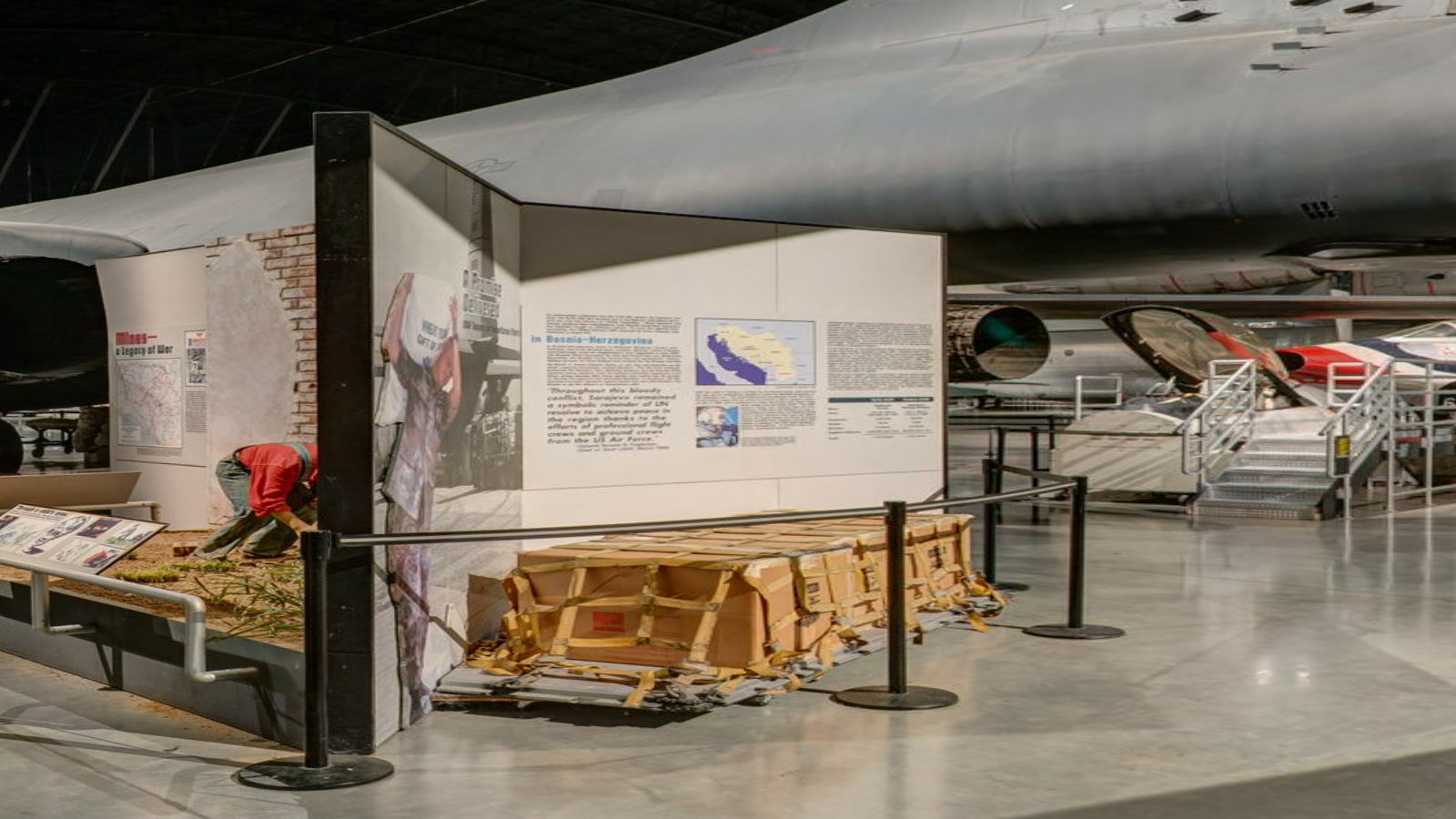
Air power in Bosnia-Herzegovina was used not only for enforcement and combat but also to sustain civilians isolated by war. Airlift, airdrop, reconnaissance, and coalition coordination moved relief supplies despite weather, terrain, and hostile fire. The effort illustrates how military transportation can support humanitarian aims while remaining embedded in a political conflict.
In depth
History & service
As communism collapsed and the Cold War ended, the Germans tore down the Berlin Wall and reunited, but in the Balkans, nationalism led to civil war and the horrors of "ethnic cleansing." When Slovenia and Croatia declared their independence from Serbian-dominated Yugoslavia, the Serbians fought to maintain control. To keep the fighting from spreading, the United Nations imposed an arms embargo and mediated a cease-fire.
In Bosnia-Herzegovina -- home to Bosniacs (Muslims), Croats and Serbians -- the issue became more complex. Bosniac voters in Bosnia overwhelmingly voted for independence from Yugoslavia in early 1992. The Bosnian Serbs boycotted the vote and formed their own government. Meanwhile, the Bosnian Croats formed their own government. Vicious fighting between the three factions soon erupted into the Bosnian Civil War.
On March 3, armed citizens -- Serbs on one side and Bosniacs on the other -- erected barricades around Sarajevo. The UN arms embargo prevented the Bosniacs from obtaining weapons, but the Bosnian Serbs received heavy weapons from the Serbian-controlled Yugoslavian army. Better armed, Bosnian Serb forces quickly took control over 60 percent of Bosnia-Herzegovina and encircled Sarajevo.
In response, the UN imposed economic sanctions against Serbia and sent peacekeepers into Bosnia to aid the delivery of humanitarian relief.
With the roads to Sarajevo controlled by the Bosnian Serbs, airlift became the only way for humanitarian supplies to reach the 380,000 inhabitants of the besieged city. The multinational UN humanitarian airlift, Operation Provide Promise began with the arrival of a French C-130 at Sarajevo airport on July 2, 1992, and it continued for three-and-a-half more years -- three times longer than the Berlin Airlift. The USAF played a major role, starting when the first American C-130 flew into Sarajevo on July 3.
Augmented by Active Duty, Air National Guard and Air Force Reserve units from the United States Air Forces in Europe provided food, medicine and other relief supplies to Sarajevo and other areas throughout Bosnia-Herzegovina. In remote areas, the airlifters airdropped supplies.
Continued Serbian resistance to humanitarian efforts forced the UN to establish "no-fly" zones over Bosnia and to launch air strikes. Adding to the pressure on the Bosnian Serbs, the United States mediated an agreement between the Bosniacs, the Bosnian Croats and the Government of Croatia to form a federation of Bosniacs and Croats. This agreement ended the fighting between those factions.
Nevertheless, the Bosnian Serbs remained belligerent and fired on aircraft flying humanitarian Operation Provide Promise flights. One Italian transport was shot down, and the crew was killed. When it became too dangerous to land at Sarajevo Airport, the airlifters airdropped supplies.
At the insistence of the United States, NATO undertook an intensive, month-long bombing campaign in August 1995. Combined with an all-out peace effort by the United States, these airstrikes produced the desired effect. A cease-fire went into effect in October, and peace talks began at Wright-Patterson Air Force Base, Ohio, on Nov. 1, 1995. These negotiations produced the framework for peace known as the Dayton Peace Accords. Operation Provide Promise continued until Jan. 9, 1996.
Details that tell the story
Operations involved NATO and United Nations missions · Airlift and airdrop delivered relief supplies · Mountainous terrain and combat conditions complicated access
Readiness became a permanent condition
During the Cold War, aviation was organized around the possibility of a conflict that governments hoped to prevent. Bombers, missiles, interceptors, reconnaissance aircraft, warning networks, and tankers became parts of interdependent systems. Their value was judged not only by what they could do in flight, but by how reliably they could be maintained, alerted, launched, supported, and controlled.
This emphasis produced striking aircraft and difficult tradeoffs. Long range demanded fuel and support. High speed increased heat and mechanical stress. Sophisticated electronics offered new capabilities but created new maintenance requirements. A reconnaissance aircraft needed an effective camera and a workable route as well as altitude or speed. An interceptor depended on warning and guidance before its pilot could make an engagement.
The human experience included long periods of training and routine punctuated by crises. Crews and ground personnel practiced procedures whose purpose was to remain credible without being used in war. At the same time, military aviation carried out reconnaissance, transport, rescue, humanitarian missions, and conventional operations around the world. Linking these aircraft with civil airliners, research machines, and spacecraft reveals a history of shared technologies and different purposes. The machines embody technical accomplishment, but also the enormous resources and sustained human effort required to keep a global force ready.