Air Force Museum
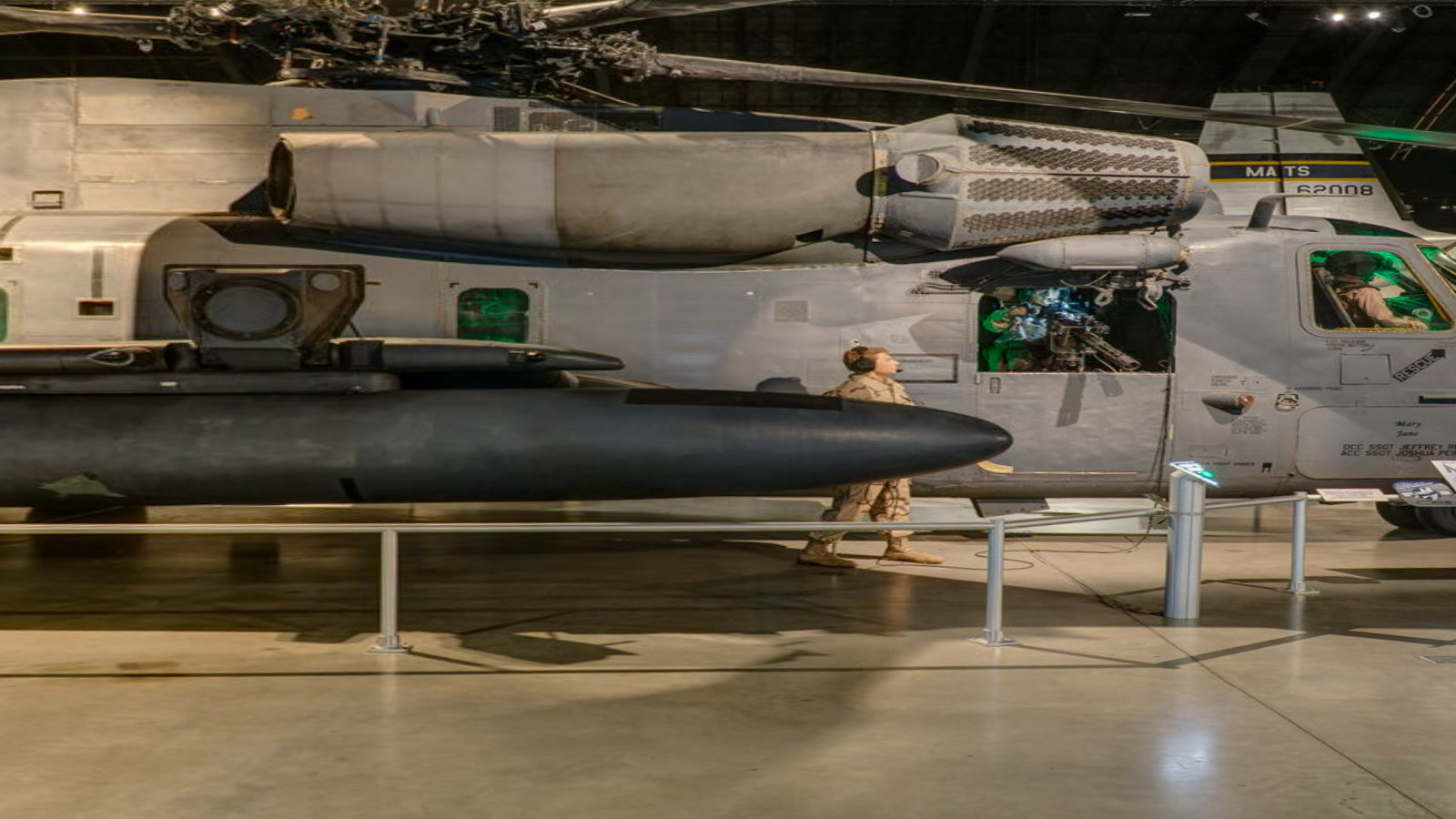
MH-53M Pave Low IV
The MH-53M carried special-operations teams deep into hostile territory at night and in poor weather. Terrain-following radar, infrared sensors, precision navigation, and defensive systems helped the large helicopter fly low when visibility was limited. Pave Lows supported combat rescue and special operations from Southeast Asia through the early twenty-first century.
In depth
History & service
U.S. Air Force special operations forces used the Sikorsky MH-53M to covertly enter enemy territory. Capable of operating at day or night or in bad weather, these helicopters conducted long-range, low-level missions to insert, extract, and resupply special operations forces.
The MH-53 helicopters were originally HH-53 "Super Jolly Green Giants" used by the U.S. Air Force in the Southeast Asia War. Over the years, however, they received many upgrades and improvements. After the 1960s, they were completely re-skinned and had their engines and rotors replaced. Along with these improvements came a new designation, MH-53 ("M" for Multi-mission and "H" for helicopter).
The most significant enhancement to the Super Jollies was the Pave Low program, which modified them for operating at night or during bad weather. Equipped with forward-looking infrared (FLIR) sensors, inertial global positioning systems (GPS), Doppler radar navigation systems, and terrain-following and terrain-avoidance radar, the MH-53 could fly clandestine, low-level missions in any weather, day or night.
The MH-53M Pave Low IV has a system that greatly increased the aircraft's capabilities. This system gave the aircrew instant access to the total battlefield situation on a color, digital map screen that was compatible with night vision goggles. Using feeds from satellite links, the system displayed nearly real-time information about potential hazards along the flight route such as power lines or enemy electronic threats.
The aircraft on display was assigned to the 20th Expeditionary Special Operations Squadron and its last flight was a combat mission in Iraq on March 28, 2008. During its 38-year career, this helicopter participated in many important missions. It carried the "command element" on the mission known as Operation Kingpin, to rescue American prisoners of war thought to be held at the Son Tay prison near Hanoi, North Vietnam. It is the last among the five HH-53s that participated in that raid.
After Vietnam, it also flew in many more combat engagements including Operations Desert Storm and Iraqi Freedom before it was retired.
In 2008 the Air Force Special Operations Command (AFSOC) retired the MH-53 from active service.
Details that tell the story
Long-range special-operations helicopter · Equipped for low-level night and adverse-weather flight · Retired from Air Force service in 2008
The aircraft in figures
Crew: Six -- two pilots (officers), two flight engineers and two aerial gunners (enlisted) · Armament: Combination of three 7.62mm mini-guns or three .50-cal machine guns · Engines: Two General Electric T64-GE-100 engines with 4,330 shaft hp per engine · Rotary diameter: 72 ft. · Length: 88 ft. · Height: 25 ft. · Speed: 165 mph (at sea level) · Ceiling: 16,000 ft. · Range: 690 miles
Readiness became a permanent condition
During the Cold War, aviation was organized around the possibility of a conflict that governments hoped to prevent. Bombers, missiles, interceptors, reconnaissance aircraft, warning networks, and tankers became parts of interdependent systems. Their value was judged not only by what they could do in flight, but by how reliably they could be maintained, alerted, launched, supported, and controlled.
This emphasis produced striking aircraft and difficult tradeoffs. Long range demanded fuel and support. High speed increased heat and mechanical stress. Sophisticated electronics offered new capabilities but created new maintenance requirements. A reconnaissance aircraft needed an effective camera and a workable route as well as altitude or speed. An interceptor depended on warning and guidance before its pilot could make an engagement.
The human experience included long periods of training and routine punctuated by crises. Crews and ground personnel practiced procedures whose purpose was to remain credible without being used in war. At the same time, military aviation carried out reconnaissance, transport, rescue, humanitarian missions, and conventional operations around the world. Linking these aircraft with civil airliners, research machines, and spacecraft reveals a history of shared technologies and different purposes. The machines embody technical accomplishment, but also the enormous resources and sustained human effort required to keep a global force ready.