Air Force Museum
B-58A Hustler
The B-58 was the Air Force’s first operational supersonic bomber and a dramatic expression of speed as a means of survival. A delta wing, four afterburning engines, and a compact crew compartment carried nuclear weapons in an external pod. The type set numerous records, but cost, complexity, changing defenses, and a shift toward low-altitude penetration limited its service to 1960–1970.
In depth
History & service
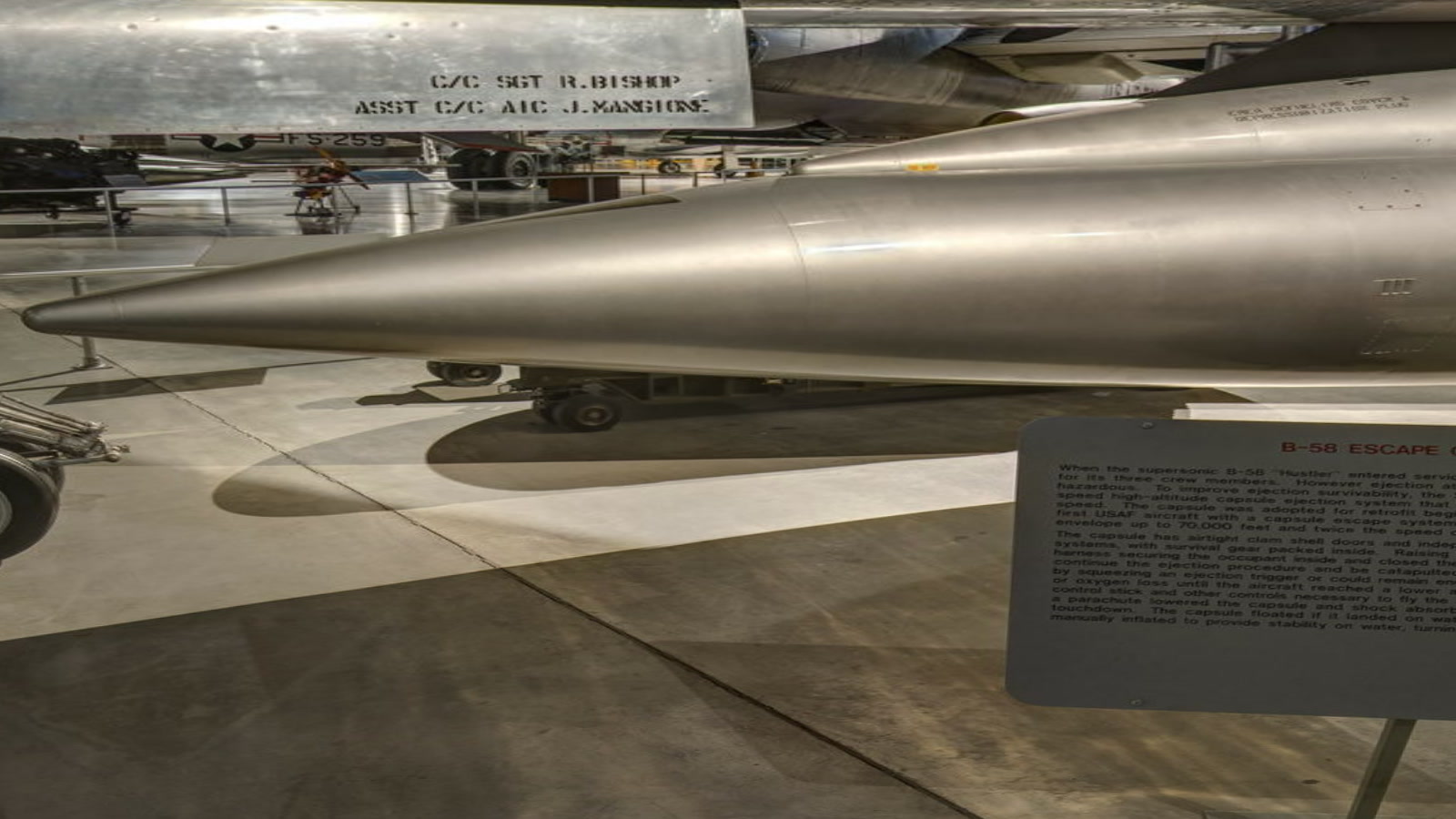
The U.S. Air Force's first operational supersonic bomber, the B-58 made its initial flight on Nov. 11, 1956. In addition to the Hustler's delta wing shape, distinctive features included a sophisticated inertial guidance navigation and bombing system, a slender "wasp-waist" fuselage and an extensive use of heat-resistant honeycomb sandwich skin panels in the wings and fuselage. Since the thin fuselage prevented the carrying of bombs internally, a droppable, two-component pod beneath the fuselage contained a nuclear weapon -- along with extra fuel, reconnaissance equipment or other specialized gear. The B-58 crew consisted of a pilot, navigator/bombardier and defense systems operator.
Convair built 116 B-58s: 30 test and pre-production aircraft and 86 for operational service. Hustlers flew in the Strategic Air Command between 1960 and 1970. Setting 19 world speed and altitude records, B-58s also won five different aviation trophies.
The B-58A on display set three speed records while flying from Los Angeles to New York and back on March 5, 1962. For this effort, the crew received the Bendix and Mackay Trophies for 1962. It was flown to the museum in December 1969.
Details that tell the story
First operational U.S. supersonic bomber · Served with Strategic Air Command · Set 19 world speed and altitude records
Readiness became a permanent condition
During the Cold War, aviation was organized around the possibility of a conflict that governments hoped to prevent. Bombers, missiles, interceptors, reconnaissance aircraft, warning networks, and tankers became parts of interdependent systems. Their value was judged not only by what they could do in flight, but by how reliably they could be maintained, alerted, launched, supported, and controlled.
This emphasis produced striking aircraft and difficult tradeoffs. Long range demanded fuel and support. High speed increased heat and mechanical stress. Sophisticated electronics offered new capabilities but created new maintenance requirements. A reconnaissance aircraft needed an effective camera and a workable route as well as altitude or speed. An interceptor depended on warning and guidance before its pilot could make an engagement.
The human experience included long periods of training and routine punctuated by crises. Crews and ground personnel practiced procedures whose purpose was to remain credible without being used in war. At the same time, military aviation carried out reconnaissance, transport, rescue, humanitarian missions, and conventional operations around the world. Linking these aircraft with civil airliners, research machines, and spacecraft reveals a history of shared technologies and different purposes. The machines embody technical accomplishment, but also the enormous resources and sustained human effort required to keep a global force ready.