Air Force Museum
Radioplane OQ-19D
The OQ-19D was a reusable target drone that made air-defense and gunnery training more realistic. Remote-controlled targets allowed crews to practice tracking and engagement without risking a pilot. Its presence points to an often-overlooked side of readiness: testing weapons and training operators against moving airborne targets.
In depth
History & service
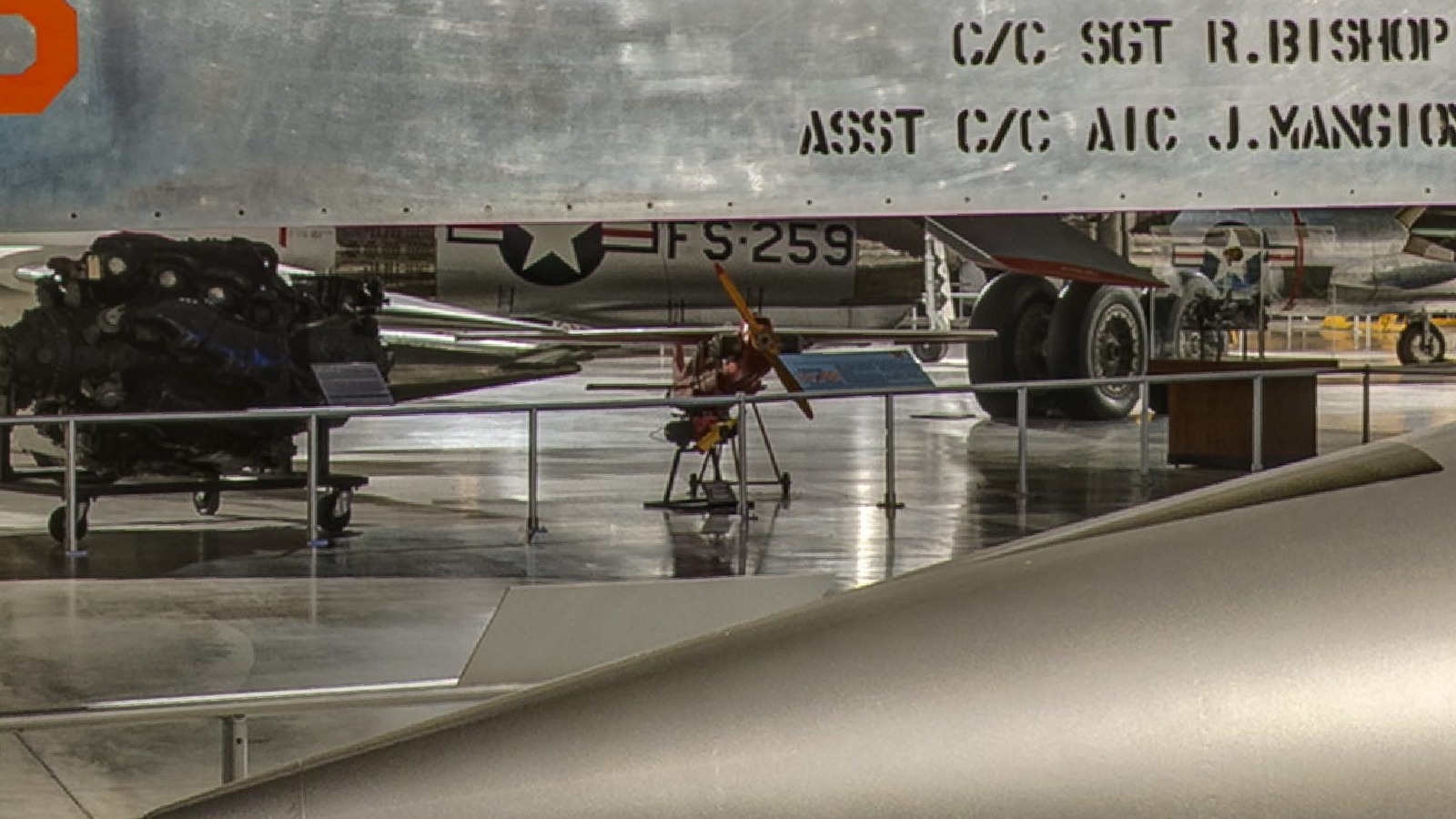
In response to the U.S. Army Air Forces' requirement for fast aerial targets with which to train anti-aircraft gunners, Radioplane (a division of Northrop Aircraft Co.) developed a 200 mph class airplane in 1945. Evolved from earlier designs, such as the OQ-2A, the OQ-19 was first flight tested in 1946. It was capable of catapult launches, rotary launches from a circular runway, and air launches from a B-26C. When hit or out of fuel, the target was recovered under a 32-foot diameter parachute.
Four men were needed to launch this target, whether by catapult or by the rotary method. A fifth man flew the target from the ground or from another aircraft. At a range of 200 yards, the OQ-19 appeared to gunners like a single-engine fighter at 500 yards. Over 10,000 OQ-19s were built for the USAF between 1955-1958. Of the four models, the OQ-19D was the largest and fastest.
Details that tell the story
Uncrewed target aircraft · Used for gunnery and missile training · Recovered and reused after many missions
The aircraft in figures
Engine: 72 hp McCulloch O-100-1 · Maximum speed: 228 mph · Endurance: 90 min. at sea level · Ceiling: 25,000 ft. · Span: 11 ft. 5 in. · Length: 12 ft. 3 in. · Height: 2 ft. 7 in. · Weight: 319 lbs. maximum
Finding the way, then trusting it
The view from the cockpit can be wonderfully clear, or it can disappear into cloud, darkness, smoke, or unfamiliar terrain. Aviation navigation developed to bridge those conditions. Maps and visual landmarks worked alongside compasses, clocks, radio signals, instruments, and increasingly sophisticated calculations. Each new method changed what routes and weather conditions could be attempted, but it also required training and a clear understanding of its limitations.
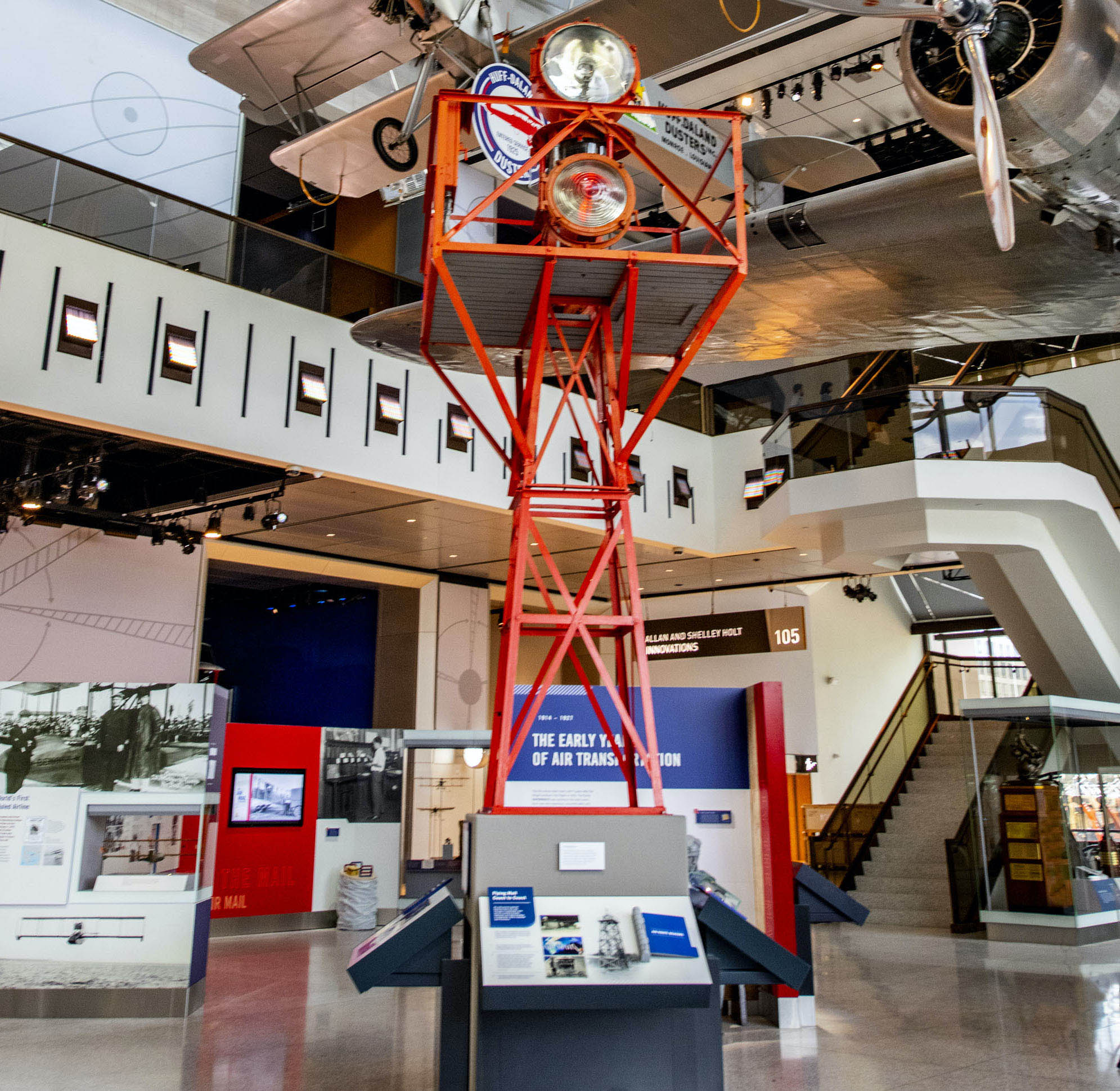
The challenge was larger than keeping one airplane on course. Busy air routes needed shared procedures, reliable communications, and ways to separate aircraft that could not see one another. A beacon on the ground, a radio in the cockpit, and an instrument trainer belonged to the same expanding system. The result was an ability to operate more regularly instead of waiting for ideal visibility.
Navigation also connects aircraft with spacecraft. Both depend on measurements, reference frames, timing, and the interpretation of signals. Their environments differ greatly, yet both require people to decide whether the instruments are describing reality correctly. Comparing a route beacon with a satellite or a cockpit instrument makes that continuity visible. The extraordinary flight is often supported by something deceptively modest: an accurate clock, a dependable signal, or a practiced procedure followed at the right moment.