Air Force Museum
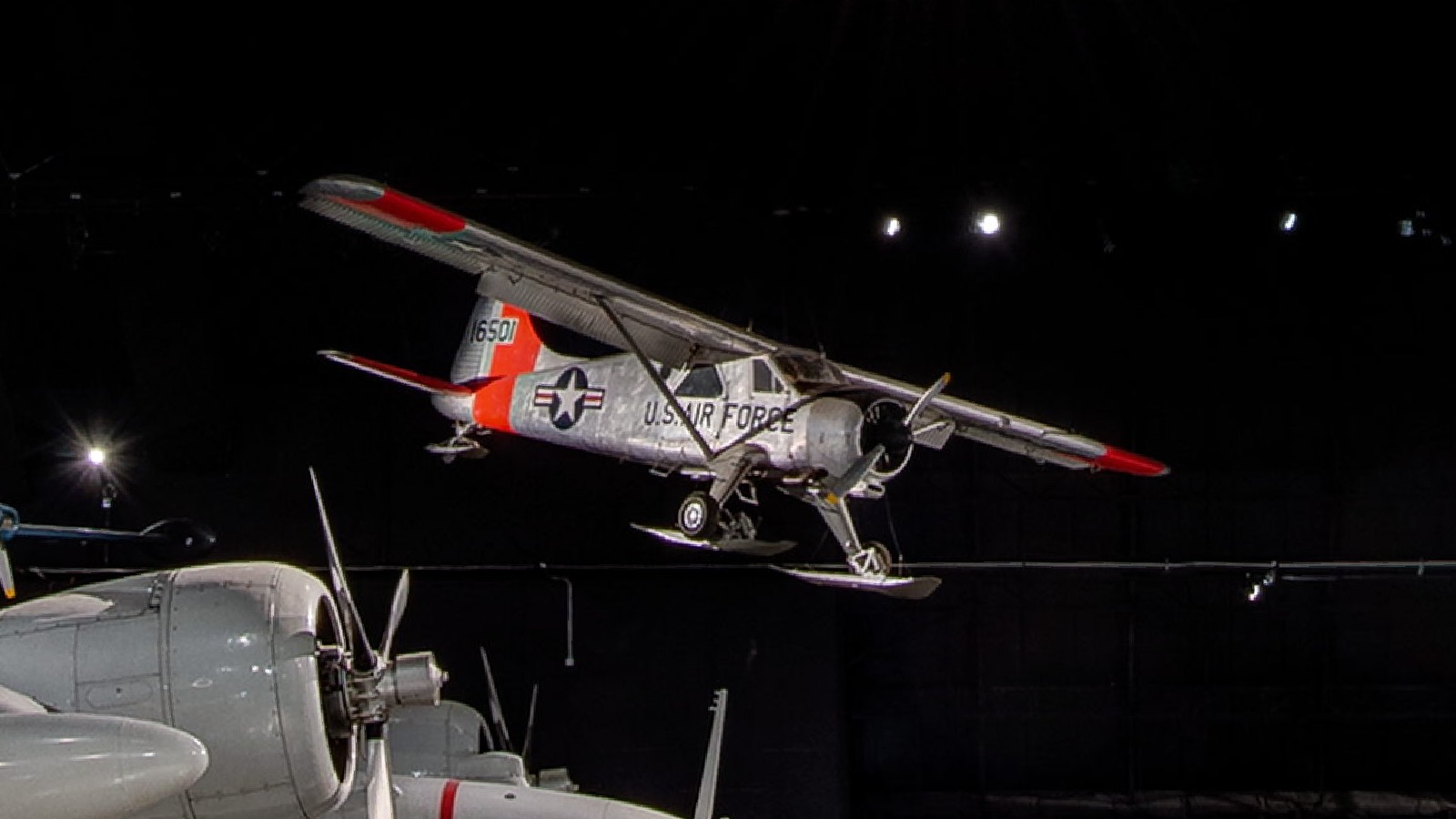
U-6A Beaver
The U-6A Beaver carried people and supplies into short, rough landing areas beyond the reach of larger transports. Its sturdy landing gear, high wing, and excellent low-speed performance made it useful from the Arctic to Southeast Asia. The aircraft illustrates the unglamorous but essential connective work that kept dispersed forces supplied.
In depth
History & service
From 1952-1960, De Havilland Aircraft of Canada manufactured the U-6A (designated L-20 until 1962), delivering nearly 1,000 to the United States' armed services. Although flown mostly by the U.S. Army, the U.S. Air Force employed more than 200 U-6As, primarily for aeromedical evacuation. However, the USAF also used the U-6A aircraft for courier service, passenger transport, light cargo, reconnaissance, rescue and aerial photography missions.
The U-6A saw USAF service in both the Korean and Southeast Asia Wars.
Details that tell the story
Military version of the de Havilland Canada Beaver · Designed for short and unimproved fields · Used for liaison, utility, and light transport missions
The aircraft in figures
Armament: None (provisions for two racks under each wing capable of carrying one 250-lb. bomb or chemical tank on each rack) · Engine: One Pratt & Whitney R-985 of 450 hp · Maximum speed: 163 mph · Range: 455 miles · Span: 48 ft. · Length: 30 ft. 4 in. · Height: 10 ft. 5 in. · Weight: 5,100 lbs. loaded · Serial number: 51-16501
Readiness became a permanent condition
During the Cold War, aviation was organized around the possibility of a conflict that governments hoped to prevent. Bombers, missiles, interceptors, reconnaissance aircraft, warning networks, and tankers became parts of interdependent systems. Their value was judged not only by what they could do in flight, but by how reliably they could be maintained, alerted, launched, supported, and controlled.
This emphasis produced striking aircraft and difficult tradeoffs. Long range demanded fuel and support. High speed increased heat and mechanical stress. Sophisticated electronics offered new capabilities but created new maintenance requirements. A reconnaissance aircraft needed an effective camera and a workable route as well as altitude or speed. An interceptor depended on warning and guidance before its pilot could make an engagement.
The human experience included long periods of training and routine punctuated by crises. Crews and ground personnel practiced procedures whose purpose was to remain credible without being used in war. At the same time, military aviation carried out reconnaissance, transport, rescue, humanitarian missions, and conventional operations around the world. Linking these aircraft with civil airliners, research machines, and spacecraft reveals a history of shared technologies and different purposes. The machines embody technical accomplishment, but also the enormous resources and sustained human effort required to keep a global force ready.