Air Force Museum
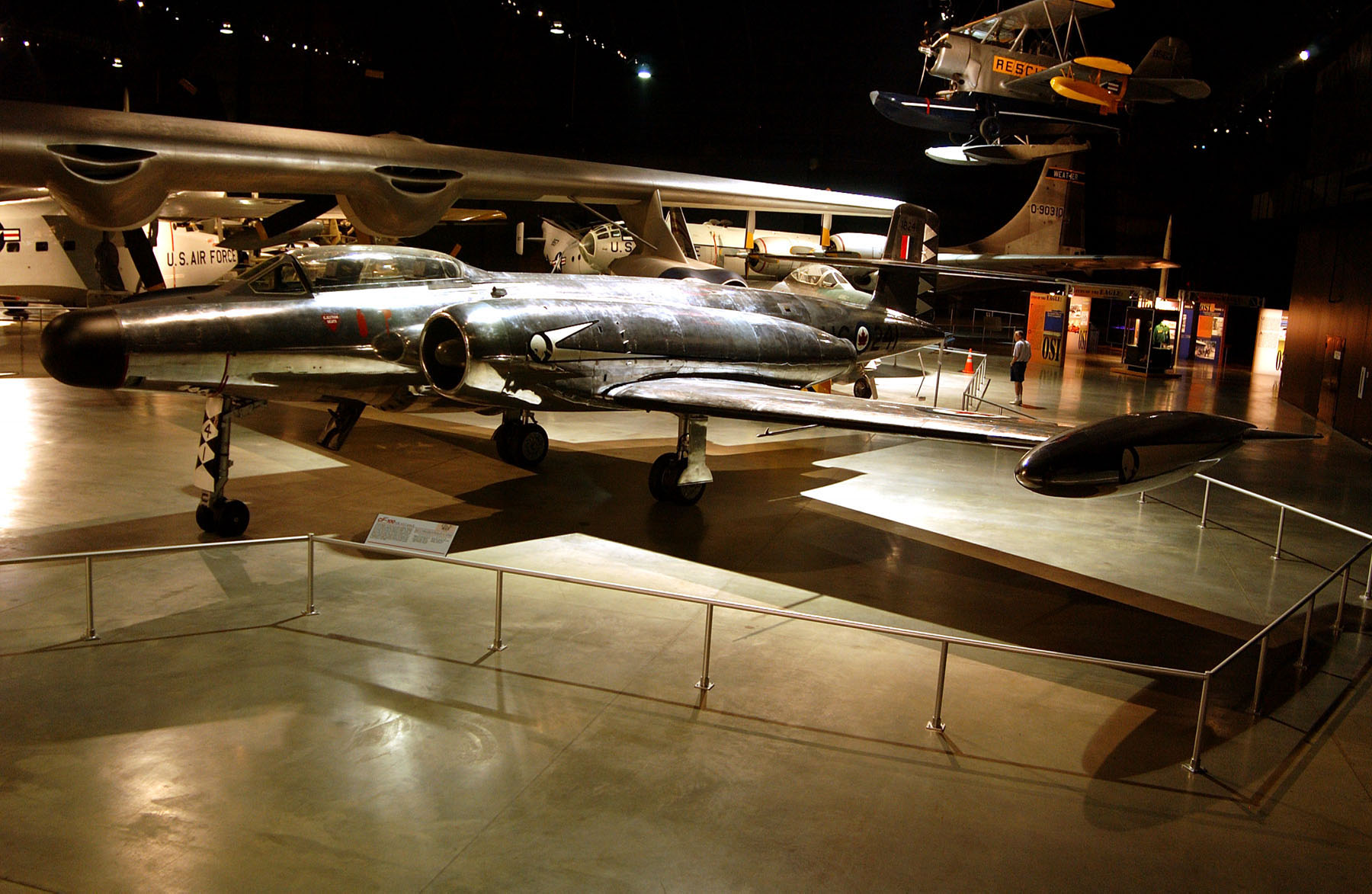
CF-100 Mk.4A Canuck
Canada’s CF-100 Canuck was a durable all-weather interceptor and a tangible product of continental defense cooperation. Its radar, two-person crew, and long endurance suited patrols over the vast northern approaches to North America. Canadian and American warning networks increasingly operated as one system, culminating in the North American Air Defense Command.
In depth
History & service
The all-weather CF-100 was the only Canadian-designed and Canadian-built fighter to go into large-scale production. Powered by two Canadian-designed Orenda jet engines, the CF-100 entered service with the 445 Squadron in 1953. In 1957 the two-seat CF-100 became an integral part of the newly formed U.S.-Canadian North American Air Defense (NORAD) system.
Side-by-side with USAF units, nine Royal Canadian Air Force (RCAF) CF-100 squadrons helped protect the continent from potential Soviet bomber attack across the North Pole. Although RCAF fighter squadrons phased out the CF-100 in 1961-1962, it continued to serve as an electronic warfare aircraft well into the 1970s.
Details that tell the story
Designed and built in Canada · Two-seat, radar-equipped interceptor · Connected to the joint defense of North American airspace
The aircraft in figures
Armament: Eight .50-cal machine guns and 58 2.75-inch rockets · Engine: Two 6,355-lb. thrust Orenda 9 jet engines · Maximum speed: 640 mph · Range: 2,000 miles · Ceiling: 45,000 ft.
Readiness became a permanent condition
During the Cold War, aviation was organized around the possibility of a conflict that governments hoped to prevent. Bombers, missiles, interceptors, reconnaissance aircraft, warning networks, and tankers became parts of interdependent systems. Their value was judged not only by what they could do in flight, but by how reliably they could be maintained, alerted, launched, supported, and controlled.
This emphasis produced striking aircraft and difficult tradeoffs. Long range demanded fuel and support. High speed increased heat and mechanical stress. Sophisticated electronics offered new capabilities but created new maintenance requirements. A reconnaissance aircraft needed an effective camera and a workable route as well as altitude or speed. An interceptor depended on warning and guidance before its pilot could make an engagement.
The human experience included long periods of training and routine punctuated by crises. Crews and ground personnel practiced procedures whose purpose was to remain credible without being used in war. At the same time, military aviation carried out reconnaissance, transport, rescue, humanitarian missions, and conventional operations around the world. Linking these aircraft with civil airliners, research machines, and spacecraft reveals a history of shared technologies and different purposes. The machines embody technical accomplishment, but also the enormous resources and sustained human effort required to keep a global force ready.