Air Force Museum
F-94C Starfire
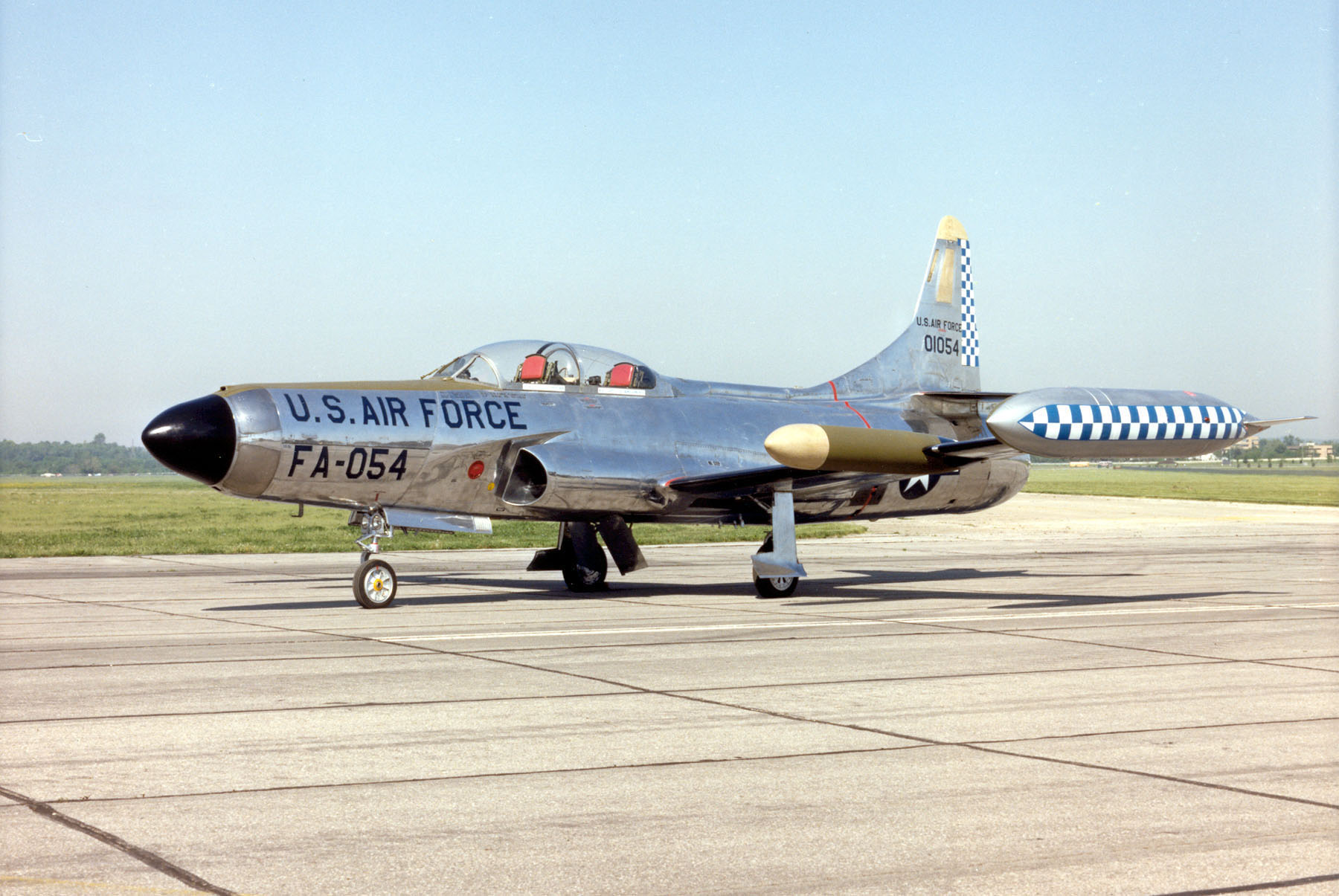
The F-94C was an all-weather interceptor built to defend North American cities and bases against Soviet bombers. Radar guided a two-person crew to targets at night or in poor weather. Instead of guns, the C model carried folding-fin rockets behind doors in the nose and, on some aircraft, in wing pods—a specialized solution to the problem of stopping formations of nuclear-armed bombers.
In depth
History & service
The F-94 series all-weather interceptors were developed from the Lockheed P-80 Shooting Star. The prototype F-94 first flew on July 1, 1949. The Starfire was subsequently produced in the A, B and C series. The F-94C (originally designated the F-97A) was a fundamental redesign of the F-94B and made its first flight on Jan. 18, 1950.
Improvements in the F-94C included a higher thrust engine, single point refueling, a redesigned wing, a sweptback horizontal stabilizer, upgraded fire-control and navigation systems, and later, mid-wing rocket pods. Twenty-four rockets were carried in the nose in a ring around the radome, shielded by retractable doors, with an additional 24 in the wing pods, if installed. The F-94C carried no guns. Starfires were employed in the air defense of the continental United States in the 1950s.
In the F-94A form, they served as the first all-jet, all-weather interceptor for the Air Defense Command. The last F-94Cs were withdrawn from USAF service in 1959.
The aircraft on display (S/N 50-980) has been painted to represent an F-94C assigned to the 60th Fighter Interceptor Squadron at Otis Air Force Base, Mass. during the late 1950s.
Details that tell the story
All-weather radar interceptor · Rocket armament replaced conventional guns · Served in continental air defense during the 1950s
The aircraft in figures
Armament: 24 2.75-in. Folding Fin Air Rockets (FFARs) in nose and 24 FFARs in two wing pods · Engine: Pratt & Whitney J48-P-5 or -5A of 8,750 lbs. thrust with afterburner · Maximum speed: 640 mph · Cruising speed: 476 mph · Range: 1,275 miles · Ceiling: 51,800 ft. · Span: 37 ft. 4 in. · Length: 44 ft. 6 in. · Height: 14 ft. 11 in. · Weight: 24,000 lbs. loaded
Readiness became a permanent condition
During the Cold War, aviation was organized around the possibility of a conflict that governments hoped to prevent. Bombers, missiles, interceptors, reconnaissance aircraft, warning networks, and tankers became parts of interdependent systems. Their value was judged not only by what they could do in flight, but by how reliably they could be maintained, alerted, launched, supported, and controlled.
This emphasis produced striking aircraft and difficult tradeoffs. Long range demanded fuel and support. High speed increased heat and mechanical stress. Sophisticated electronics offered new capabilities but created new maintenance requirements. A reconnaissance aircraft needed an effective camera and a workable route as well as altitude or speed. An interceptor depended on warning and guidance before its pilot could make an engagement.
The human experience included long periods of training and routine punctuated by crises. Crews and ground personnel practiced procedures whose purpose was to remain credible without being used in war. At the same time, military aviation carried out reconnaissance, transport, rescue, humanitarian missions, and conventional operations around the world. Linking these aircraft with civil airliners, research machines, and spacecraft reveals a history of shared technologies and different purposes. The machines embody technical accomplishment, but also the enormous resources and sustained human effort required to keep a global force ready.