Air Force Museum
B-36J Peacemaker
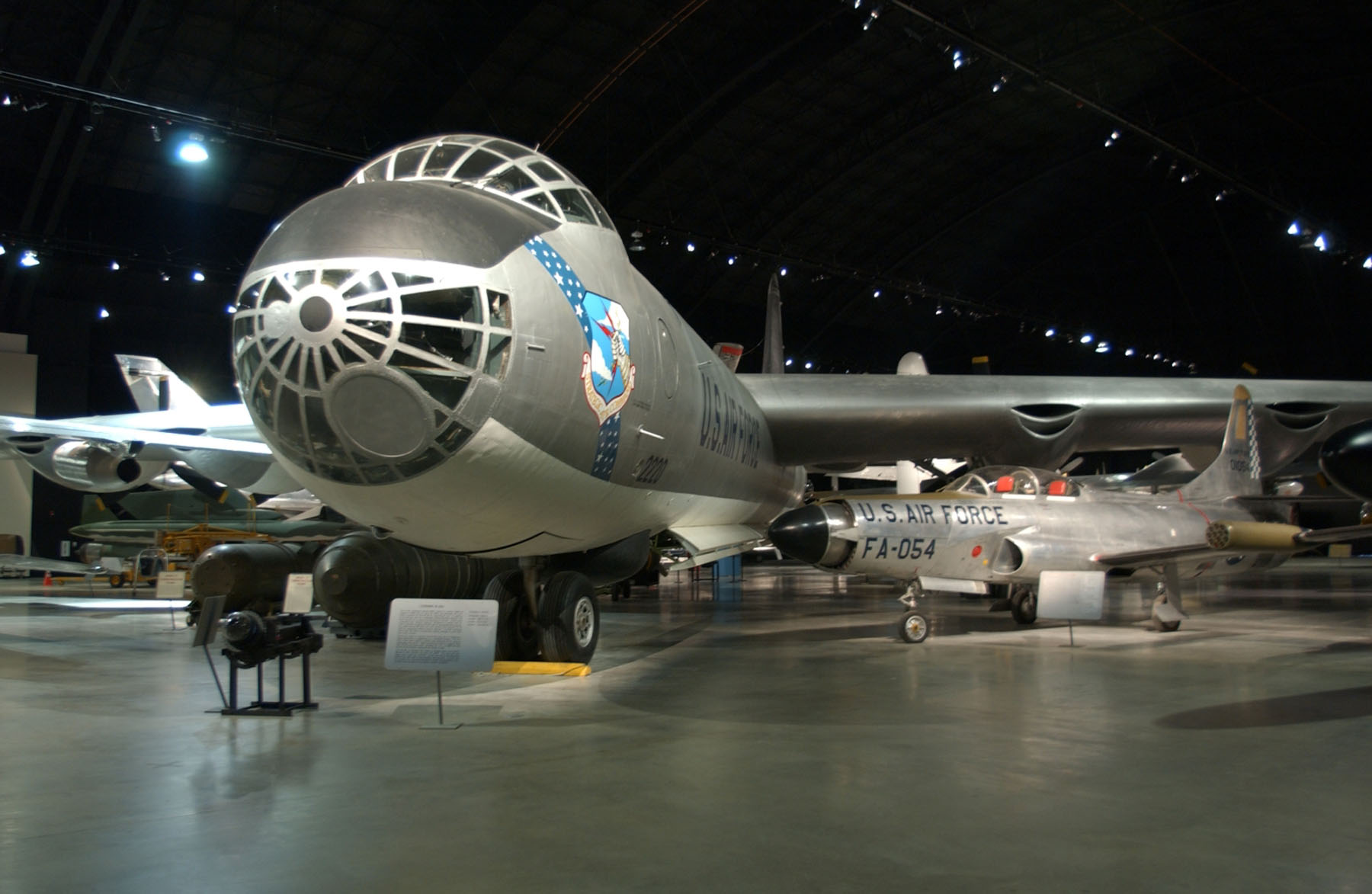
The immense B-36 gave Strategic Air Command true intercontinental striking range before aerial refueling and overseas basing were fully mature. Six piston engines and four jet engines carried a bomber built to reach distant targets while carrying very heavy conventional or nuclear loads. It never fired a shot in combat, yet its constant readiness made it a highly visible instrument of deterrence until the all-jet B-52 replaced it.
In depth
History & service
Responding to the U.S. Army Air Forces' requirement for a strategic bomber with intercontinental range, Consolidated Vultee (later Convair) designed the B-36 during World War II. The airplane made its maiden flight in August 1946, and in June 1948 the Strategic Air Command received its first operational B-36. Some B-36s served as photographic reconnaissance aircraft, and others were adapted to launch and retrieve specially modified RF-84F/K reconnaissance planes.
Powered by six Pratt & Whitney R-4360 engines, the B-36J cruised at 230 mph, but for additional bursts of speed its four General Electric J47s increased the maximum speed to 435 mph. It carried 86,000 pounds of nuclear or conventional bombs. When production ended in August 1954, more than 380 B-36s had been built for the U.S. Air Force. In 1958-1959, the USAF replaced the B-36 with the all-jet B-52. Although never used in combat, the B-36 was a major deterrent to enemy aggression. Making the last B-36 flight ever, the aircraft on display flew to the museum from Davis-Monthan Air Force Base, Ariz., on April 30, 1959.
Details that tell the story
First operational B-36s entered Strategic Air Command in 1948 · Six piston engines were supplemented by four turbojets · The museum aircraft made the final B-36 flight in 1959
Readiness became a permanent condition
During the Cold War, aviation was organized around the possibility of a conflict that governments hoped to prevent. Bombers, missiles, interceptors, reconnaissance aircraft, warning networks, and tankers became parts of interdependent systems. Their value was judged not only by what they could do in flight, but by how reliably they could be maintained, alerted, launched, supported, and controlled.
This emphasis produced striking aircraft and difficult tradeoffs. Long range demanded fuel and support. High speed increased heat and mechanical stress. Sophisticated electronics offered new capabilities but created new maintenance requirements. A reconnaissance aircraft needed an effective camera and a workable route as well as altitude or speed. An interceptor depended on warning and guidance before its pilot could make an engagement.
The human experience included long periods of training and routine punctuated by crises. Crews and ground personnel practiced procedures whose purpose was to remain credible without being used in war. At the same time, military aviation carried out reconnaissance, transport, rescue, humanitarian missions, and conventional operations around the world. Linking these aircraft with civil airliners, research machines, and spacecraft reveals a history of shared technologies and different purposes. The machines embody technical accomplishment, but also the enormous resources and sustained human effort required to keep a global force ready.